
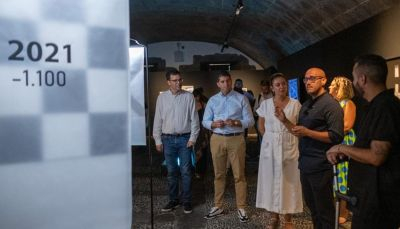
The Tourist Centers have raised the curtain this Thursday on the 11th Lanzarote Art Biennial with the presentation of the exhibitions 'Hidden Assets', 'Archaeological Museum of the Revolt' and 'Monument to Darkness'.
The president of the Cabildo of Lanzarote, María Dolores Corujo, the CEO of the Tourist Centers, Benjamín Perdomo, and the artistic director of the Biennial, Adonay Bermúdez, were responsible for presenting the most outstanding aspects of some exhibitions "that are a magnificent prologue to six months of intense cultural activity."
María Dolores Corujo highlighted the "strong social content of a Biennial that has the will to transcend beyond the borders of this island." The president, who thanked the work carried out by the artistic director, Adonay Bermúdez, to shape a program that "aims to stir consciences and invite reflection and action with the aim of transforming our reality to successfully face a new, fairer and more sustainable way of life.
"A Biennial that proposes us to advance in an intercultural society, which is nothing more than delving into democracy fueled by the universal values of freedom, equality, justice and solidarity," added the president.
For his part, Benjamín Perdomo thanked the collaboration provided by artists, museums and entities to make this edition of the Biennial a reality. "It is the Biennial of change, of the change of discourses, of stories, of ways of doing things and of proposals, and of the vertigo linked to this change that aims to contribute to fostering critical thinking in citizens," he said.
Adonay Bermúdez, finally, conveyed his gratitude to the people who have intervened to make a Biennial a reality "aligned with the defense of social rights and the fight in favor of the most disadvantaged; a Biennial," he pointed out, "that proposes a renewal of thinking about the world we inhabit."
The exhibitions
The Cabildo explains that 'Hidden Assets' is a collective exhibition in which "the main conflicts of the current process of neoliberal globalization, the borders and walled states, the decline of democracy, migratory pressure, feminicides or necropolitics" are unraveled. The works not only try to reveal the structures of power but also "the potential of art to stage the gains generated by the critical and symbolic analysis of these structures."
Curated by Carlos Delgado Mayordomo and Adonay Bermúdez, this exhibition features the participation of Santiago Sierra, Tracey Emin, Teresa Correa, Rigoberto Camacho, Isidro López, Lotty Rosenfeld, Enrique Jezik, Julieta Hanono, Teresa Margollesy Mounir Fatmi.
On the other hand, with 'Archaeological Museum of the Revolt', Avelino Sala ironically plays with the classic format of archive display case to show a series of stones collected in different demonstrations around the world as a museographic record. It is a work that presents a global chronicle of resistances and that goes beyond the particularities of each of the protest actions to talk about the need to take measures in the face of the clear failure of the stories built to date. Sala's stones serve to put a point of irony in his particular way of approaching the symbolism of the stone as an archaeological object.
Both 'Hidden Assets' and 'Archaeological Museum of the Revolt' can be visited at the MIAC – Castillo de San José until November 7.
On the other hand, this Saturday, September 3, 'Monument to Darkness' will be inaugurated, an exhibition by Eugenio Merino and Miguel G. Morales that can be visited in the Ermita de Tías until October 15.
This exhibition starts from the disappearance of hundreds of people during the Civil War and the Franco regime in the Canary Islands, focused especially on the figure of the Tenerife poet Domingo López Torres. The artists turn the work into an underwater memorial to all the disappeared, activating a new meaning of the sea as a mass grave. In short, a counter-monument that questions the Francoist monuments.
Through collaboration with Historical Memory researchers, Eugenio Merino and Miguel G. Morales set the point where the murder was committed and throw a bronze commemorative plaque with the text Monument to Darkness and the geolocation 28°28'11"N 16°13'32"W.
The Biennial until March 2023
The 11th edition of the Lanzarote Art Biennial presents a marked social character and is based on three lines of work such as "historical memory, migratory flows and borders, and feminism and women". Three discourses represented by national and also international artists of great relevance from Mexico, Colombia, Ecuador, Venezuela, Cuba, Chile, Argentina, USA, Morocco, Romania, United Kingdom and Iran.
With the artistic direction of Adonay Bermúdez, the Lanzarote Art Biennial will have a program structured in four collective exhibitions, three individual exhibitions, five projections, three cycles of conferences, a round table, a performance and an action in neighborhoods of the island.
Next October will be the conferences of Emilio Silva, president of the Association for the Recovery of Historical Memory, and the political scientist Sami Naïr.
In November, the Mexican artists Tania Candiani and Ximena Labra, the Cuban Carlos Martiel and the Venezuelan Marco Montiel-Soto will be present with their exhibition projects.
In the month of March there will be exhibitions by the artist Patty Chang, Jenny Jaramillo, Mónica Mayer, Marina Vargas and Teresa Correa.
To this will be added various activities such as conferences, talks and colloquiums, among others.


