
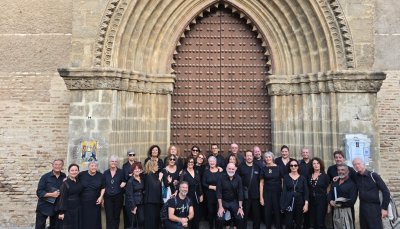
As is now tradition among the members of the San Ginés de Arrecife Polyphonic Choir, each year they embark on a cultural trip through different provinces and cities of the Iberian Peninsula. It is not just about sightseeing, but about sharing their art, their passion, and the effort of many hours of rehearsal at their headquarters, offering concerts in temples with a marked heritage and spiritual value.
This weekend, the choir traveled to the historic city of Seville, where they were warmly received by the members of the Canarian Center in Seville, who carefully coordinated their first performance in the Church of San Marcos. This temple, representative of the 14th-century Gothic-Mudéjar style, still retains much of its original structure, despite the multiple vicissitudes suffered over time.
In this building of singular architectural beauty, the San Ginés Polyphonic Choir offered a Sacred Concert, with works of spiritual reflection, among which the Ave María by Tomás Luis de Victoria, the Ave Verum Corpus by W. A. Mozart, and Oh Lacerated Face by J. S. Bach stood out, among others. The audience, visibly moved, rewarded the quality and interpretive sensitivity of the ensemble with lengthy applause.
As a spontaneous finale, and already outside the temple, the choir members gifted the audience two emblematic pieces from the Canarian repertoire: Sombras del Nublo, by Néstor Álamo, and the Himno de Canarias (Arrorró, Cantos Canarios), by T. Power, which resonated in the portico of San Marco as a tribute to their roots and a thank you to Seville's hospitality.
The second day of this cultural journey took place in the majestic Cathedral of Santa María de Sevilla, one of the jewels of European Gothic architecture. At 1:00 p.m., in an environment of incomparable solemnity, the choir performed its second Sacred Concert, with an exquisite selection of works such as the Alleluja by Henry Purcell, Sanctus and Agnus Dei from the Messe Bréve by Léo Delibes, and Quédate, Buen Jesús by L. Iruarrizaga, among other pieces that demonstrated the group's versatility and technical rigor.
The San Ginés Polyphonic Choir, founded in 1973 by Braulio de León Navarro, has been a cultural reference point in Lanzarote for more than five decades, taking its repertoire throughout the islands, the peninsula, and even abroad. Among its most outstanding distinctions are the Pancho Lasso Medal awarded by the Cabildo of Lanzarote, and the Gold Medal of Arrecife, granted on the occasion of its 50th Anniversary.
On this occasion, under the direction of Elías Roldán, the choir not only exceeded expectations but also moved and left a deep impression on the Seville audience. The director himself expressed his gratitude for the warm reception received and congratulated the choir members for their dedication, commitment, and the musical excellence demonstrated in each of the concerts offered, reaffirming once again the prestige of Lanzarote's culture.


