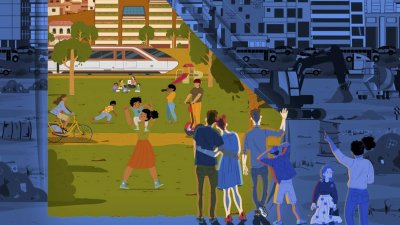
The César Manrique Foundation (FCM) and the Canary Islands International Environmental Film Festival (FICMEC) are organizing a new edition in Lanzarote, this year under the slogan Adapting to Climate Change. The event will consist of three days of audiovisual screenings —Tuesday, October 14, Wednesday, October 15, and Thursday, October 16— and, as usual, all will be linked to ecology and nature. The screenings are free and will take place in the José Saramago Hall, located in La Plazuela, Arrecife.
As in previous editions, the screening sessions will be organized into morning and afternoon sessions. The former will be exclusively reserved for the school community of the centers agreed through the FCM's Pedagogical Department (with the screening of the short film With Grace), while the afternoon sessions will be open to the general public.
On the afternoon of Tuesday, October 14, at 7:00 p.m., the fiction feature film titled Hanami will be screened, directed by Denise Fernandes. It tells the story of Nana, who lives on a remote volcanic island from which all its inhabitants want to leave. In fact, shortly after her birth, her mother Nia, who suffers from a mysterious illness, leaves. When Nana has a high fever, she is made to go to the foot of a volcano to receive treatment. There she encounters a world suspended between dreams and reality. Years later, when Nana is a teenager, Nia returns.
On Wednesday, October 15, a selection of three short films will be shown starting at 5:00 p.m.: Lanawaru (when a member of a community disappears, a boy confronts a distant memory and seeks comfort in indigenous traditions, healing rituals, and his grandfather's advice); Audio y el caimán (Audio Caña enjoys telling fantastic stories to his loved ones, but no one believes him when he claims that a huge alligator lives in his pond. With the help of his granddaughter, he will try to prove its existence to his friends and family); and Zona wao (for more than 50 years, oil companies have been extracting oil from the Amazon, threatening the area with the greatest biodiversity on the planet and the lives of indigenous communities with the complicity of the Ecuadorian government. These are the so-called "sacrifice zones").
That same afternoon, at 7:00 p.m., the screening of Flow will begin, an animated feature film directed by Latvian filmmaker and animator Gints Zilbalodis. It tells of a world full of vestiges of human presence that seems to be coming to an end. Cat is a solitary animal, but when his home is destroyed by a huge flood, he takes refuge on a boat crewed by various species and will have to collaborate with them despite their differences.
FICMEC is directed by the documentary filmmaker and filmmaker from Tenerife, David Baute, whose film Black Butterflies received the Goya award for best animated film in 2025. It is a drama inspired by real women, which proposes a journey from Africa, the Caribbean, and Asia towards an uncertain future for humanity. Climate change impacts the lives of Tanit, Valeria, and Shaila, three women from very different parts of the planet but with something in common: all three lose everything due to the effect of global warming and are forced to migrate.
The Canary Islands International Environmental Film Festival is presented as a space for reflection on the acceleration of events and processes related to the deterioration of Nature. This premise is presented through audiovisual language and is done from a place like the Canary Islands, a fragile territory, with valuable landscapes and natural resources that are threatened by being subjected to intense tourist pressure, which makes it a favorable space when reflecting on open and profound conflicts.
FICMEC takes up the baton of the Canary Islands Ecological and Nature Film Festival, which was held from the early eighties in Puerto de la Cruz (Tenerife) and was a pioneer in Spain with regard to its theme: the first film contest in the country focused on environmental issues. Now, from a contemporary, more complex and problematic perspective, FICMEC consolidates this reflective field in the face of what has become one of the great themes that disturb and challenge our time. Since 2014, the FCM and FICMEC have jointly developed this activity in Lanzarote, which addresses aspects related to the work and activist discourse of César Manrique and the Institution itself.


Add La Voz de Lanzarote as a preferred Google source.
Stay informed with the latest current news.