
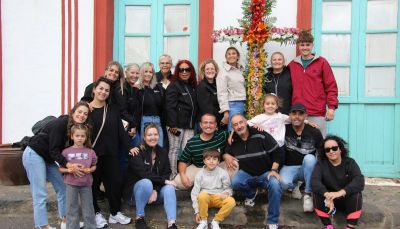
May 3 is considered a very important date in the festive calendar of many towns in the Canary archipelago for the celebration of the festival of the Holy Cross. One of the main activities that takes place is the decoration of crosses, that is, the decoration of them with flowers.
With the celebration of the Day of the Cross, this Friday we remember the importance that this symbol has had in Lanzarote and in the different forms and meanings with which it is presented in various spaces of the island territory. As a foundational Christian symbol par excellence, the cross is an element that appears in the islands after the Conquest, and that is part of our most deeply rooted cultural heritage. Thus, a calm and peaceful look through our towns and fields will reveal countless crosses that stand, almost always solitary, as silent testimonies of a past that today seems distant to us.
In Lanzarote, where the tradition is most rooted is in La Villa de Teguise, where cultural groups are in charge of decorating each of the wooden crosses that are distributed in different streets and buildings in the historic center of the Villa. They represent each of the stations of the Via Crucis, the way of the cross or the Passion of Christ, from when he was sentenced to death to his crucifixion and burial.
Among the cultural groups are the Esperanza Spínola Theater, Red Cross, Calicanto, A.F. Guanapay, A.F.O.L, Coral Villa de Teguise, CEIP Dr. Alfonso Spínola and Instituto de Teguise. Another of the crosses well known on the island is the 'Cruz del Siglo', according to the manuscripts of the time on December 31, 1899, in which a committee of faithful led by the parish priest Manuel Miranda Naranjo installed a Cross on the Islote del Francés in the capital of Lanzarote and where you could read 'Remembrance of the tribute to Jesus Christ Redeemer of the world, year 1900'.
The reason for this event was a papal order from Leo XIII, who encouraged the faithful to place a large cross to welcome the new century, celebrating a pilgrimage for it. Currently, it is very common to find crosses on top of the mountains and according to historians some would have been placed as symbols of protection.


