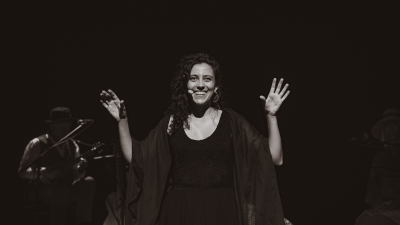
The word "storyteller" can limit us to thinking of an activity exclusively for children or something very simple that anyone can do. The reality, however, is different, and behind this cultural activity aimed at adults and children, oral storytellers like Isabel Cabrera from Lanzarote are hidden. Graduated in Early Childhood Education, Journalism and with a master's degree in children's books and literature and different courses, her training does not remain stagnant.
Cabrera's passion for theater and the performing arts in general comes from when she has use of reason. "I've been a theater person since I was a girl," she says. In her childhood, at school she did all the plays that came up and, in addition, in her adolescence she spent her afternoons at the TEA.
When she was at university, one of the subjects she was studying was Theater, whose professor was Ernesto Rodríguez Abad, oral storyteller and the director of the Los Silos International Storytelling Festival, the most important storytelling event we have in the archipelago. "When I finished his subject he asked me if I wanted to be part of his professional company, I said yes and that's where I started with my 18 years just turned to tell my first stories and do my first professional scenes in schools, institutes and libraries," says Cabrera.
"Theater and oral narration are like two daughters that accompany me: one doesn't stop moving: she jumps, does acrobatics, dances. She is restless and insatiable and the other... is calm, curious, loves reading, enjoys the small things and loves time alone," she metaphorizes.
The day-to-day work to be a narrator
Narrating a story or a tale may seem simple, but to transmit emotions, mood changes or emphasize what is said, the work is not concentrated in a few months of preparation, but you have to shape the learning and, above all, gain experience over the years.
"The Dramatic Art career trains you to be an actor or actress, that is, a performer of performing arts, but there is no official public school of oral narration in Spain," she declares. This leads people who want to dedicate themselves to it to train in some courses or workshops that are held on time.
"With this I want to say that to be a narrator it is not necessary to have studied dramatic art because, although it is a performing art, it is not theater: it is oral narration and, unfortunately, it is not in the university curriculum. But you have to train," advises the actress.
To be part of this guild it is not only worth having that "gift" and this is something that Isabel Cabrera is clear about. "With my years of experience I have realized that having talent can provide you with 1% of success, the other 99% is in the work of ants and in constant training, without ceasing, without stopping, without declining," she comments.
And Cabrera continues to train after two degrees, a master's degree and many courses. "I have just spent the month of July in an intensive course of the Zar company of the Grotowski theater in Poland and I combine it with my work as an autonomous artist and, in addition, now I also combine it with the studies of Dramatic Art, musical itinerary, and all this will help me for both trades," she declares.
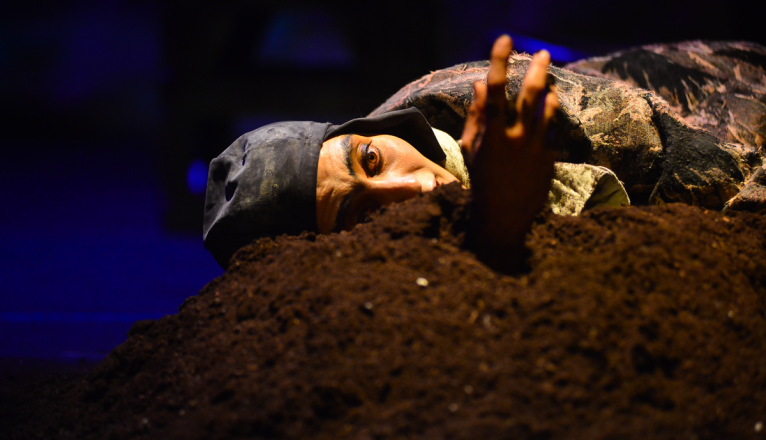
A profession sometimes unknown
In her beginnings, the narrator tells how ten years ago being a storyteller meant that many people said comments from ignorance. "They asked me if it was only for children, if I dressed up or if I characterized myself. I was amazed because to be an oral narrator you only need a mind with more or less repertoire of stories, well-hydrated vocal cords, voice and, in the case of having a large capacity, a cranial microphone so as not to strain yourself," she recalls.
"I think that the regular audience of stories already knows how to distinguish what baby stories are, sessions where they can take their children from 0 to 3 years of age, which are different from family storytelling sessions (from 3, 4 years old) and where the children do not go in front and the parents behind, but families sit together to listen to stories, and the same with adult sessions, which are becoming more and more full," explains the narrator.
"I think that, in general, people are understanding the concept of the profession, but it is still very important to clarify and disseminate what it is and how it is and dignify it by explaining what are the suitable and unsuitable places for oral narration or what our needs are," she comments.
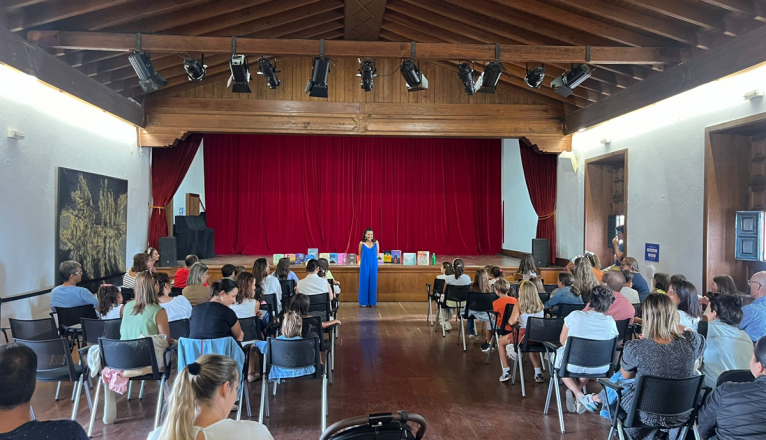
The loss of the power of the word
Today we live surrounded by new technologies that trap us and separate us from listening and hearing. "The word has lost weight by itself if it is not supported by a visual stimulus and that is the enormous problem of our century," says Cabrera.
"That is why the profession of oral narration and the performing arts in general have become, from my point of view, a first necessity service for society, an S.O.S to recover what the screen has snatched from us, reconnect with the power of the word, with the present word," she declares.
The artist invites people to enjoy theater and narration more and leave the screens aside more. "We must, as an imperative, relearn to listen, to look, and listening to stories, seeing a play or attending a concert are wonderful therapies to feel again from the place that corresponds to us," she says.
Such is the power of words that the narrator has lived very exciting anecdotes in the time she has been in this profession. "Some years ago, on the night of stories in La Laguna, I told the fable of the conceited little mouse by the Venezuelan poet Aquiles Nazoa. When I got off the stage, a lady approached me very excited with tears in her eyes and told me that she was Venezuelan and that her mother told her that poem every night when she was a child in her country and that through my narration it had taken her directly to the memories of her childhood," she recalls.



Add La Voz de Lanzarote as a preferred Google source.
Stay informed with the latest current news.