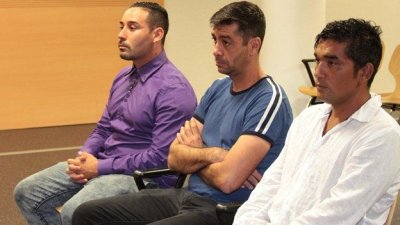
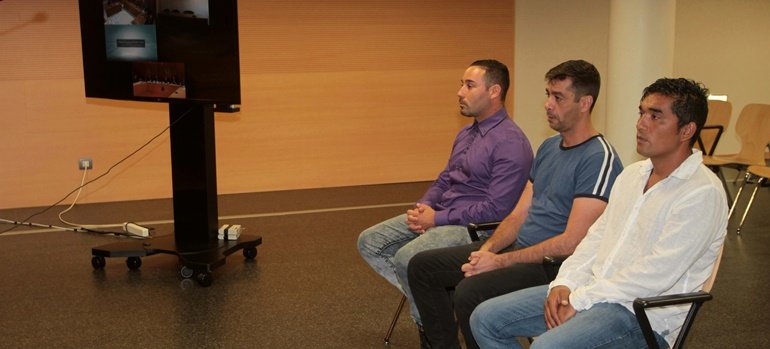
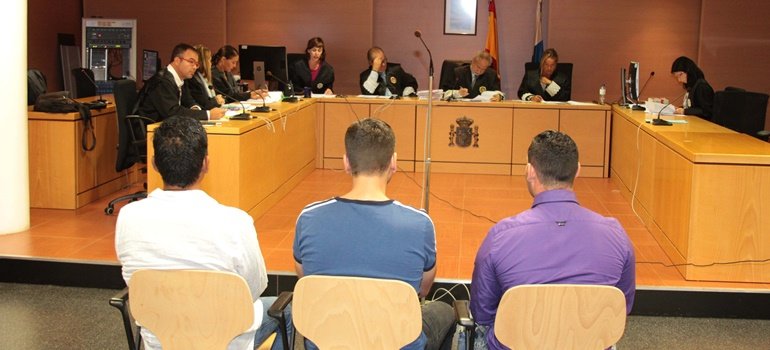
The four defendants accused of selling drugs at the Swing Disco-Pub in Playa Blanca, for whom the Prosecutor's Office is requesting seven and a half years in prison, have denied the facts during the trial that the Sixth Section of the Provincial Court held this Tuesday in Arrecife, although three of them have acknowledged that they were consumers. "I was a consumer at that time but I did not tolerate the sale or consumption in the premises. That's why we had security," one of the owners said, a fact that his partner also assured, who stated that "if someone consumed, they were kicked out."
In this way, both Jaime B.G. and Manuel M.L. have said "to know nothing" about the 67.7 grams of cocaine that the Civil Guard found in a search in the disc-jockey's booth in the early morning of December 22, 2013. The only thing that the second one has responded to, who has declared through video conference, is for the 0.20 grams of cocaine that the Benemérita found in his pocket, alleging that it was for "own consumption". In fact, although he has assured that he "did not allow the consumption or sale of drugs" in the disco, he has acknowledged that he and his partner did consume in the office of the same and that is why the Benemérita found a tray and a blade there.
The DJ claims that the cap with drugs belonged to the public relations, who denies it
As for Juan Elías V.A., who had only worked as a DJ in the disco "in the month of August" and that night of December 22 to "replace" the resident DJ "because he was sick", he is the only one who has said that he is not and has never been a drug user and has also denied that the cocaine found by the Civil Guard in the booth was his. The drug was found inside a cap "in two bags" and "in single doses" as has been stated in the trial, a cap that, according to Juan Elías V.A. "belonged to Mariano David", public relations of the premises, who has denied it.
According to Juan Alías V.A., Mariano David A. accessed the DJ booth that night to leave the cap. "He was crouched for five minutes. I was surprised but I didn't pay attention," the disc-jockey has declared. "Fifteen minutes later he told me that he was leaving it because he didn't trust a waiter, because he was a thief," added Juan Elías V.A., who has insisted that "Mariano David A. was the only one who entered the booth" that night and that he did not know that there was cocaine inside the cap until he was arrested and transferred to the Civil Guard barracks in Yaiza. Juan Elías also pointed out that in the booth there were several garments of clients, men's and women's jackets and bags, although he has specified that in this case it was he who kept them.
Asked about why his DNA was on the cap, Juan Elías V.A. has pointed out that "he touched it" when the Civil Guard asked him for it and has pointed out that he had also sweated "quite a bit" because "there was no ventilation" in the premises and the DJ booth is "closed".
For his part, Mariano David A. has not only denied that the cap was his, but also that he entered the DJ booth. "I left him a jacket and that's it," the public relations of the disco has assured. "I don't have confidence and that's why I didn't enter the booth," he added.
"I suppose he accuses me because I am South American, foreign and the weakest"
Mariano David A. has pointed out that, in addition, "he knew nothing" of what happened "until the next day", since he was not in the disco when it was searched by the Civil Guard since he had "finished" his work shift, but was arrested a day later as a result of the statement before the Benemérita of the disc-jockey, who assured that the cap was his. "I suppose he accuses me because I am South American, foreign and the weakest. Blaming me was the easiest thing because they would take away my papers, I would be left without a job and it would destroy me," the public relations of the disco has pointed out, who has also said that that night he had "a small discussion" with the DJ about the music.
However, Mariano David A. has acknowledged that, before the Civil Guard, he declared that "drugs were sold and tolerated in the premises", although he has said that he said it "due to police pressure" and based "only on rumors", "on what third parties said". "I have never seen the owners sell or consume," the public relations of the disco has assured. His lawyer has also recalled that, although Mariano David A. was also seized 9.54 grams of cocaine in a Civil Guard control 21 days before and not the same day as mistakenly stated in the Prosecutor's Office's indictment, the case "was dismissed" when it was "proven" that the drug "was for own consumption".
The owners of the disco have also come out in his defense. "I never saw Mariano do anything strange," Jaime B.G. has declared, who nevertheless has said that he did know "that he was a consumer". "He was not a seller and he has not consumed with me," Manuel M.L. has said for his part, who has pointed out that if he previously declared to the trial that when they asked him about drugs he referred people to Mariano "it is because he knows everyone, not because he sells".
Reports of complaints for drug sales
Several Civil Guard agents who participated in the search of the premises have also testified in the trial, which, according to one of them, was carried out after "a previous study" and having "clear indications" that drugs were sold there. In fact, this agent has assured that there were "reports of complaints for sale" in that premises, as well as against the owners for "having workers without being registered with Social Security".
The Civil Guard agent has also stated that the office where the owners have acknowledged that they consumed "was not closed to the public, but was part of the room". Questioned about whether the seized effects could have been contaminated in their transfer to the Court, the agent has assured that "precautions were taken" so that it would not be so.


Add La Voz de Lanzarote as a preferred Google source.
Stay informed with the latest current news.