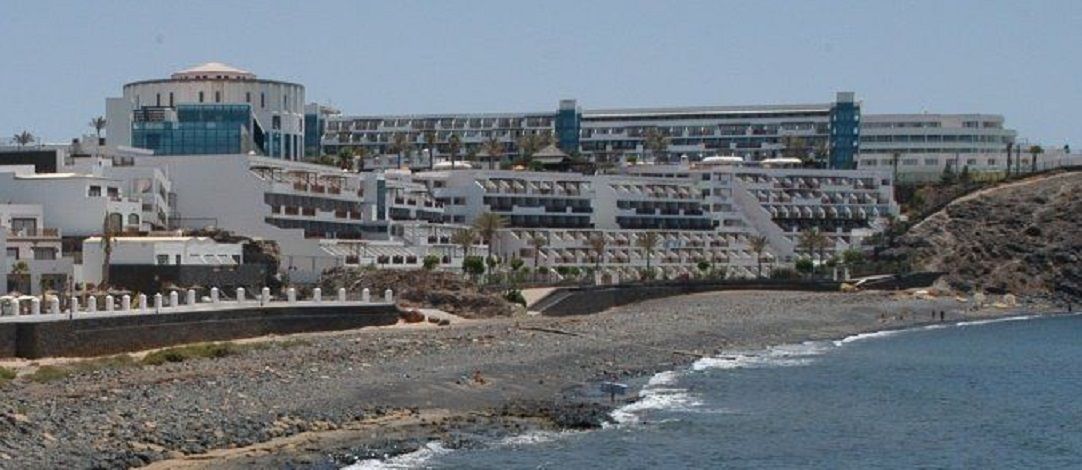
The Contentious-Administrative Chamber of the Supreme Court has rejected the appeal for cassation filed by Papagayo Arena SL against the judgment of the Second Section of the Contentious-Administrative Chamber of the Superior Court of Justice of the Canary Islands issued in February 2021, which annulled the agreement reached by the Yaiza City Council and the company for the legalization of the Papagayo hotel.
The license was annulled as a result of the procedures filed by the Cabildo of Lanzarote and the César Manrique Foundation in defense of legality, as it contravened both the Island Plan and the municipal regulations themselves. As a result of the annulment of that first license, the hotel developer presented a legalization project that was rejected in 2016 by the Local Government Board of the Yaiza City Council, through an agreement that recognized the impossibility of legalizing the Papagayo hotel.
The agreement of the Governing Board warned that what was built did not adapt to the determinations established in the General Plan of Urban Planning of the Municipality of Yaiza, Supplementary Plan, and required the property to submit “a project in which all the technical measures to be executed are contemplated in a detailed and detailed manner, including partial demolition (if necessary) in order to adjust the building to the Municipal Planning within a period of one month from the notification of the resolution.”
Against that resolution of the Yaiza City Council, the company filed a contentious-administrative appeal that was not transferred to either the Cabildo of Lanzarote or the César Manrique Foundation, "intentionally removing them from a procedure that was aimed at the execution of the judgment in favor of the theses held by both institutions", says the Island Corporation, which has now made public this ruling, which annuls the agreement reached within that parallel procedure.
"Surprising mediation"
"Surprisingly, within the framework of said contentious-administrative proceeding, an intrajudicial mediation procedure took place in which the Yaiza City Council and the promoting company reached an agreement to legalize what was built and consider the judgment executed, without the participation or control of those who had denounced before the courts the demonstrated illegality of the license granted to the hotel. As a result of such surprising mediation, was the order of November 6, 2019, issued by the Court of Contentious-Administrative No. 1 of Las Palmas de Gran Canaria, which considered the judgment of nullity of the license executed and de facto legalized the Papagayo hotel", they point out from the Island Corporation.
After becoming aware of this circumstance, both the Cabildo and the César Manrique Foundation filed the appropriate contentious-administrative procedure, now resolved in favor of both institutions, in which they argued that the actions of the Yaiza City Council and the hotel developer deprived both the Cabildo and the Foundation of their right to effective judicial protection, also violating the right to the execution of judicial resolutions. Likewise, the legal services of the Cabildo maintained that the agreement approved by the order did not comply with the legal system due to fraud of law and dealt with matters not subject to transaction, infringing the law that regulates the contentious-administrative jurisdiction.
As a result of the action carried out by the legal services of the complaining entities, the TSJC already annulled the order, rendering the intrajudicial mediation agreement without effect "processed behind the backs of those who had denounced the irregular concession to the Papagayo hotel."
Against this ruling, the owner of the hotel facility filed an appeal for cassation before the Supreme Court, which is the one that has now been rejected, not even admitting it for processing, for which the ruling of the TSJC that annulled the intrajudicial mediation becomes final.
“I can only express my satisfaction for this ruling that fortunately makes legality and common sense prevail”, declared the president of the Cabildo, María Dolores Corujo. “The annulled agreement was a real nonsense because it was done by those who have broken the law -city council and businessman- hiding it from the Cabildo to try to legalize the very serious illegality that was committed with the construction of the hotel invading a pedestrian street planned in the planning to divide the hotel plot and prevent the closure of the beach by a 'mole' of concrete like the one that has been made”, she recalls.
Sentence without executing
Finally, the president has also recalled the recent resolution issued by the Contentious Administrative Court Number 5 of Las Palmas, on January 21, 2022, in which it is declared that the Yaiza City Council has not executed the judgment that annulled the license either "that is at the origin of the serious illegality committed with the construction of this hotel", by which the Yaiza City Council authorized the “grouping” of two plots that were separated by a 5-meter wide pedestrian road, concluding that “the material urban infractions prevent the legalization of the building, so in compliance with the judgment that is executed, it must be ordered, based on the declaration of radical nullity of the acts, the restoration of the urban and territorial legality infringed, carrying out the necessary actions for it.”
The president of the Cabildo considers "inconceivable that the Yaiza City Council has systematically pronounced itself in favor of those who fail to comply not only with the regulations of an insular nature, but also with the municipal planning itself" and has recalled that it was "the Local Government Board itself that determined the impossibility of legalizing what was built."
“The legal services of the Yaiza City Council had given the green light to an agreement, fortunately annulled, that intended to legalize what the municipal government itself considered impossible to legalize”, Corujo emphasizes.



Add La Voz de Lanzarote as a preferred Google source.
Stay informed with the latest current news.