
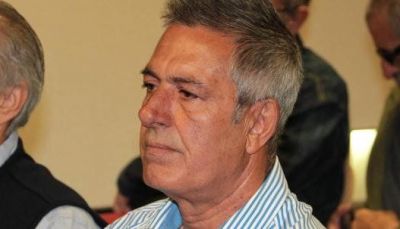
If José Francisco Reyes intends to suspend the execution of the prison sentence imposed on him in the Yate case, appealing, among other things, to the fact that he has already fulfilled "the pecuniary responsibilities", the first thing he should do is demonstrate "in a transparent and clear manner the origin" of that money, given that all his accounts and properties were seized and "he declared that he had no income" when he made that payment of 300,000 euros before the trial. This is what the private prosecution maintains, represented by the former councilor and complainant in the Yate case, Carlos Espino, who has opposed the suspension of the imprisonment of two of those convicted in the case: Reyes himself and the former municipal secretary, Vicente Bartolomé Fuentes.
"The enormous economic effort that Mr. Reyes has had to make to meet the pecuniary responsibilities is highlighted on the contrary, referring to the 300,000 euros that had to be consigned before the oral hearing. However, nothing is said or proven about how such a large amount of money could be obtained in record time, nor about the origin of such funds", warns the lawyer of the private prosecution, who responds in this way to Reyes' request that his imprisonment be suspended, despite the fact that he was sentenced to 6 years in prison.
In her writing, the lawyer refutes the arguments put forward by the former mayor's defense to take advantage of this exceptional suspension of the sentence and in particular focuses on asking where Reyes got the money to pay the fine imposed on him.
He confessed to the bribes but did not denounce the bribers
"Logic, far from helping to justify the suspension of the requested sentence, invites us to resort to fantastic literature about the price of silence", the prosecution argues, insinuating that Reyes could have obtained that money through third parties. And it is that although the former mayor confessed in this case to having received hundreds of thousands of euros in bribes in exchange for granting dozens of illegal licenses, he did not name the people who gave him that money.
The only specific bribe that Reyes acknowledged was the one received from the owners of the Marina Rubicón marina, but not with money but in the form of a gift, by letting him dock the boat El Pachi for free for years in the port. And that did not allow the businessmen to be brought to the dock, since at the time the events occurred, the Penal Code only punished the person who receives the gift, but not the one who gives it, unlike what was already happening then with the deliveries of money.
In addition, the private prosecution also questions that Reyes' defense appeals to the fact that he acknowledged the facts before the trial, since it considers that that confession, "at this moment, manifests itself as a false and empty exercise of cynicism to obtain penitentiary benefits that he does not deserve". In this regard, he reproaches the former mayor for his "demonstrated inability" to "recognize that the consequences of his crimes remain on the island territory, weigh on the economy of Lanzarote, put pressure on the resources of those of us who live on this island, alter our landscape and leave an unbearable legacy of conflict that has not yet been resolved", constituting "the first and most obvious reason why the suspension of the execution of the prison sentence imposed on him should be denied".
"An attitude that is far from true repentance"
As for Vicente Bartolomé Fuentes, who also confessed to the facts that were imputed to him and accepted a sentence of one year in prison for urban prevarication and embezzlement, the prosecution also agrees with the Public Prosecutor's Office and asks that his request to suspend the fulfillment of the sentence be rejected. "Again, the scenario is bleak: Mr. Vicente Bartolomé submits to an agreement of conformity after almost ten years of instruction, in the act of the oral hearing, showing an attitude that is far from a true repentance and is too similar to the legitimate but in extremis use of a resource that the Spanish penal system grants him to serve a minimum sentence in the face of a very probable conviction", the prosecution underlines, also questioning that alleged repentance of the former secretary.
Although in his case the Penal Code could open the door to suspending the execution of the sentence, since it does not exceed two years in prison, the private prosecution recalls the criminal record of the former secretary to ask that his request be rejected. "Mr. Vicente Bartolomé has been sentenced, for the moment, to a prison sentence and disqualification of more than thirty years in three sentences that judge facts committed in the exercise of his position as secretary-intervenor of the Yaiza City Council", he underlines, raising the same argument also used by the Prosecutor's Office to request his imprisonment.
Among those convictions that he already has behind him, there is a firm one of disqualification for urban prevarication, which was the one that removed him from his position, in addition to another for licenses granted in the Playa Blanca Partial Plan and a more recent one in the Stratvs case. In addition, he still has other pending trials, including a separate piece of the Yate case for embezzlement of public funds in the payments to the lawyer Felipe Fernández Camero from the Yaiza City Council for allegedly unprovided services.
The former secretary continues to work for a public administration
To this, the prosecution adds that "the social circumstances do not help the suspension of the sentence" of Bartolomé Fuentes either, since he is currently working as a technician in the Cabildo of Gran Canaria, despite the disqualification sentences he already has behind him. "A fact that has caused a social scandal that has been echoed by the regional and island press", underlines the writing, which recalls that one of those sentences not only disqualified him as secretary, but to exercise any "public office in the autonomous, island and local administration". The problem is that that sentence is not yet final, because it was appealed, and that has allowed Vicente Bartolomé Fuentes to return to work for a public administration, after having been removed from the Yaiza City Council by his first final conviction, which disqualified him only as secretary.
"Every day, people who have committed crimes whose effects on society are minimal compared to those related in the sentence are ordered to be imprisoned, people who have committed crimes in difficult personal, family and social circumstances, nothing compared to the economic capacity, knowledge and training enjoyed by Mr. Vicente Bartolomé", the writing adds.
In addition, he ends by recalling a phrase recently pronounced by the president of the Supreme Court, who recognized that "Justice is made for the petty thief, not for the great defrauder" and that "this is a great obstacle to the fight against corruption". "Changing this conception is in decisions such as those that must be made in this execution procedure", concludes the prosecution.
An "inheritance" that Reyes "does not want to see, recognize or admit"
Regarding the former mayor, he also recalls the criminal record that he already has behind him, which "because they are numerous and scandalous, are part of the inheritance that Mr. Reyes does not want to see, recognize or admit". In addition, he adds that the fact that he recognized the crimes that were imputed to him in the Yate case "is precisely the reason" why they do not consider "the suspension of the execution of the sentence in an exceptional way" to be "adjusted to law". The former mayor requested that benefit by taking advantage of an article of the Penal Code that, according to the Prosecutor's Office, is intended for other types of minor crimes, but not for cases of corruption as serious as those carried out by the former mayor.
"Mr. Reyes accepted to assume the consequences of these facts in the first person long before the act of the oral trial was held", underlines for its part the private prosecution, which considers that precisely for this reason he must now serve that sentence, after having reached an agreement of conformity before the trial that already served to reduce the sentence.
Regarding the "family circumstances" to which Reyes' defense referred, the writing adds that "it has been his own decisions and acts that have led to the procedural situation of his family". "We insist that it was Mr. Reyes who decided in his day to assume the protagonism of this procedure, dragging his family along, the same day that he decided to retract his confession", he points out referring to the first confession that the former mayor made during the instruction of the case, after being arrested. In that confession he did name several businessmen who would have given him bribes, but then he retracted to confess again years later, just before the trial, but this time without naming those who bribed him.


