
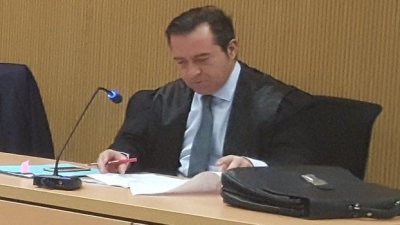
The Jiménez de Asúa Association of Jurists, which filed a complaint against the first investigating judge in the Unión case, which tried to recuse the last one and which has been condemned for acting in "bad faith" and for trying to "delay" that procedure, will not be able to enter the Montecarlo case. This has been agreed by the investigating judge of this case, Ricardo Fiestras Gil, in a ruling in which he rejects the request of this association to appear as a "pretended popular accusation" in one of the parts of this case, specifically the one that focuses on the San Bartolomé City Council.
In his ruling, dated last December, the judge points out that Jiménez de Asúa has not accredited "any legitimate interest" to exercise the popular accusation in the Montecarlo case, so he dismisses his appearance, given the risk that they are guided by "spurious, fraudulent or merely dilatory motives". In addition, he questions that he has not accredited either "the purposes of his action", nor even "the true existence of the association", by not providing a public deed of incorporation or the founding act.
The first time the name of this group of lawyers from Gran Canaria appeared was in the summer of 2015, when the investigation of the Unión case was in its final stretch and in several parts it had already finished and was pending trial. Then, he began to register writings asking to enter as a popular accusation, despite the fact that at that time he had not even officially registered as an association.
Fined for acting in "bad faith"
The investigating judge then rejected his claim, but finally managed to enter one of the pieces, as his appeal was upheld by the Provincial Court. And the first thing the association did then was to recuse Judge Silvia Muñoz. It was then that the Court imposed a fine of 1,000 euros, for having raised a recusal "lacking the slightest foundation", with a "clear and sufficiently serious bad faith" and with the sole intention "of removing the instructor to delay its processing".
As La Voz de Lanzarote has been publishing since then, at least one of the lawyers who have been part of that association, Juan David García Pazos, worked for one of the main defendants in the Unión case, Luis Lleó. Specifically, he represented him in one of the hearings of this case, in which he later intended to exercise the popular accusation. In this regard, the new ruling of the Montecarlo judge stresses that it is essential to know the "identity" of who acts on behalf of the association, "to rule out the eventual circumstance that, whoever wants to act, is already a party". That is, for example, that an accused uses this figure to try to intervene in the case as an alleged accusation.
Association linked to Lleó and a sued journalist
In the case of the Jiménez de Asúa Association of Jurists, a lawyer of Lleó has acted in its name, and this same lawyer has also represented the journalist Francisco Chavanel, in the lawsuits filed against him by Judge César Romero Pamparacuatro and prosecutor Ignacio Stampa, for violation of his right to honor, for the constant attacks on his intervention in the largest corruption case opened in Lanzarote and throughout the Canary Islands. A case that already has three convictions, two of them final.
In addition, the same lawyer was also the one who "convinced" an association from Fuerteventura to appear in the Stratvs case, which later withdrew from the procedure claiming to feel "deceived" and "used" by this lawyer. Afterwards, that same lawyer began to act on behalf of another alleged environmental association from Gran Canaria, Jacón, which since then has been unsuccessfully trying to appear in Stratvs. In addition to having shared the same lawyer, the Jiménez de Asúa and Jacón association also have in common that they are based in Gran Canaria and that they appeared almost at the same time, trying to appear in different judicial cases opened in Lanzarote.
He "took off his mask" in the preliminary hearing to the Lleó trial
To all this is added what happened last week, during the preliminary hearing of the Unión case against Luis Lleó, in which Jiménez de Asúa did end up managing to enter as a popular "accusation". During that hearing, the association "took off its mask", according to the Public Prosecutor's Office. And it is that not only did he not refute a single one of the arguments of Lleó's defense, which asks that all the evidence against him be annulled, but he even supported one of those causes of nullity invoked by the accused. In addition, he has not even filed a letter of accusation in that piece, limiting himself to "adhering" to that of the Prosecutor's Office and without contributing or adding anything.
"We understand that there is some reason in what was raised by the defense," said the lawyer who intervened on behalf of the association, José Antonio Zambrano, who was supposedly acting as an accusation. During his intervention, he himself recalled that Jiménez de Asúa filed a complaint against the first investigating judge of Unión, César Romero Pamparacuatro. And he did so after other complaints filed by Lleó against the judge, the prosecutor and the UCO were rejected. However, the association's complaint suffered the same fate and was not even admitted for processing, as the Superior Court of Justice of the Canary Islands did not appreciate any indication of a crime.
For his part, the prosecutor Javier Ródenas stressed on several occasions that it is "incompatible" for someone to exercise the popular accusation in a case after having filed a complaint against the judge who instructed it, and described as "juggling" the attempts of the lawyer of Jiménez de Asúa to justify what his role is and what they intend by being present in this case.
Tries to enter Montecarlo "without any legitimate interest"
Now, this same association has been trying for months to enter the Montecarlo case, whose investigation has also been closed for almost a year. For the moment, the judge has rejected his appearance in the San Bartolomé piece, and there is at least another pending request in one of the pieces linked to the Arrecife City Council, where the Prosecutor's Office has already opposed him being allowed to enter.
"Examined the procedural iter of the intended popular accusation so far, there is a very brief request, from which can not be inferred either the capacity to act, or any legitimate interest," says the investigating judge in the order in which he rejects his appearance in the piece of San Bartolomé, in which the auditor Carlos Sáenz, the former mayor Miguel Martín, the former councilor Javier Betancort, the treasurer Luis Manuel Rodríguez and the businessman José Vicente Montesinos are accused.
As for that "very brief request", the magistrate points out that he only dedicates "one sentence" to explain that "the purposes of the association are the defense of the public interest and legality". In this regard, the judge questions the "generic nature" of this statement and the lack of "concretion", and recalls that "the defense of the public interest and legality" is already entrusted by law to the Public Prosecutor's Office.
Thus, he recalls that the obligation to determine with what "purpose" it is intended to exercise the popular accusation "is not a subjective requirement imposed capriciously", but is intended to prevent this figure from being used for "spurious" motives. In this regard, he recalls the order by which the Popular Party was expelled as an accusation in the Gürtel case, for having been "helping" Bárcenas more than accusing. In addition, he recalls other judgments that speak of the "undoubted advantages" of the existence of the popular accusation in a case, such as "transparency, promotion of the procedure and the complement of the work of the Public Prosecutor's Office or the private accusation", but also of the "disadvantages", such as the possible "use of said appearance for purposes not exactly foreseen by the law".
In the same vein, he also quotes Judge Gómez de Liaño, who in reference to a doctoral thesis by Julio Pérez Gil warned that "if not infrequently the Public Prosecutor's Office is worthy of distrust, with greater reason it is appropriate to be wary of those who exercise popular action from the indeterminacy and subjectivity of motives and purposes".
Add La Voz de Lanzarote as a preferred Google source.
Stay informed with the latest current news.