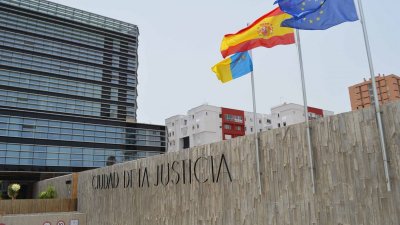
The Criminal Chamber of the Superior Court of Justice of the Canary Islands (TSJC) has agreed to investigate a possible breach of procedural good faith by a lawyer who filed an appeal in which he cited jurisprudence and official reports allegedly generated by artificial intelligence tools.
The Criminal Chamber notified in recent days the sentence that confirms the acquittal of a resident of the island of Tenerife who was tried in July of this year before the Second Section of the Provincial Court of Santa Cruz de Tenerife, accused of sexual assault.
The ruling, authored by the president of the TSJC, dismisses the appeal filed by the private prosecution against the acquittal, and notes that the lawyer for this party included in their appeal various supposedly "spurious" or "apocryphal" jurisprudence citations, in addition to a reference to a report from the General Council of the Judiciary on the credibility of child testimony, of which, similarly, the Court "has no record of its existence either".
In the opinion of the Chamber, such findings "seem to evidence conduct revealing the blatant negligence of someone who, considered an expert in procedural rules and respectful of the deontological principles of his profession, entrusted his work, without further review, to what the algorithm suggested, omitting the diligence to verify the existence of what he cited, perhaps trusting that the abundance of references would not only go unnoticed by this Court but would also lend authority to his assertions (probably of identical make to the citations)."Consequently, upon detecting these alleged irregularities, the Court orders the formation of a separate file "in order to ascertain the responsibilities that the lawyer (...) may have incurred, in accordance with the provisions of Article 247, sections 3 and 4, of Law 1/2000 on Civil Procedure, in relation to Articles 552 et seq. of the Organic Law of the Judiciary".
“Utmost creativity”
The invoked regulation refers to a possible offense for violating the rules of procedural good faith, which may result in a fine if it is determined that the professional has acted in bad faith or has shown disrespect to the Court, without prejudice, furthermore, to forwarding the facts to the respective professional association in case any disciplinary sanction may be applicable.
The Court states in its ruling that in the appeal filed by the lawyer, the citation of at least seven Supreme Court rulings was detected, "unrelated to what this Court has managed to verify in the available databases." It explains that "many others of similar nature" were found in the text, which "likewise constitute an exercise of utmost legal creativity," adding that the lawyer "unravels" them throughout his brief "with ease and boldness."
Likewise, the ruling emphasizes that the Court "also has no record of a report from the General Council of the Judiciary on the credibility of child testimony from 2019," from which a passage is also extracted in the appeal "with the precision of someone copying from an original on their desk or retrieving it from a computer file."
The Court adds that the alleged professional misconduct, "far from consisting of a mere slip or venial error, by its repetition, deserves to be purged," and therefore agrees to the formation of a separate proceeding in which, after hearing the lawyer, what is appropriate will be decided

Add La Voz de Lanzarote as a preferred Google source.
Stay informed with the latest current news.