
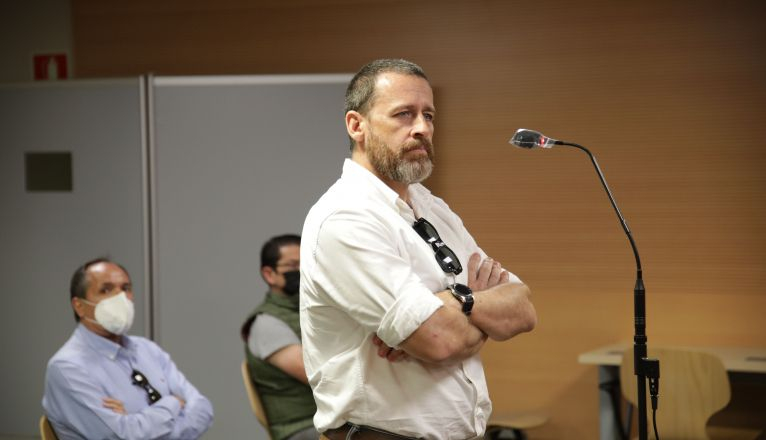
The former manager of Canal Gestión Lanzarote, Gerardo Díaz, has returned to the island to testify as a witness in the trial of the Montaña Roja desalination plant, since he played a leading role in the seizure. In fact, Díaz has acknowledged that he was present and that it was even his company that paid the locksmith who was called to forcibly enter the Club Lanzarote facilities.
Díaz has also confirmed again that the external lawyer who advised Pedro San Ginés on the seizure, Ignacio Calatayud, was working for them at the same time. "We hired him because he was the lawyer of the Consortium, as we did with other suppliers," he declared. "It was public knowledge that the lawyer of the Consortium and Inalsa was Ignacio Calatayud," he added. And the fact is that this lawyer did not really have a contract with the administration, although under San Ginés' mandate he was directly awarded both representation in lawsuits and external advisory work.
One of them was precisely to seize the Montaña Roja desalination plant, which was later handed over to Canal, for which he was working. "I don't remember how much (Ignacio Calatayud) was paid," he assured when responding to the lawyer for the prosecution. She recalled that during the investigation, Gerardo Díaz himself stated that there were no documents of the alleged work carried out by Calatayud for Canal, and that it was all "verbal" advice.
"It is very difficult to give advice only verbally. He would have to write something," Gerardo Díaz responded, however, in the trial, pointing out that perhaps he "expressed himself badly" in his first statement.
He also tried to affirm that Canal's payments to Calatayud ended before the seizure took place, because they hired another lawyer. However, after the lawyer showed him the invoices, he acknowledged that they continued several months later.
"The people of Club were not making things easy"
Gerardo Díaz also had to answer for his presence on the day of the seizure. "I was accompanying the Consortium and we saw that there were difficulties. The people of Club were not making things easy for the Consortium," he declared. "I'm not saying they had to," he added.
From that day - and until the plants were returned by court order to Club Lanzarote - Canal Gestión began charging the water to the approximately 6,000 residents of that partial plan, which the public network did not reach. "It meant more income, and it meant more expenses and more costs," he began responding to the lawyer for the prosecution.
"Did they have more losses than profits?" San Ginés' lawyer then tried to conclude, given that Gerardo Díaz had pointed out that they had to carry out works. "Right now I couldn't answer that question rigorously," the witness replied.
The lawyer for the prosecution, Nora Ferrer, also asked him about his salary while he was manager of Canal Gestión Lanzarote, between June 2013 and September 2015. "I was earning about 100,000 euros with objectives," he replied. "If Canal charged more, did you earn more?" the lawyer added. "Not everything was based on results. There were five objectives per year," he retorted.
The lawyer also asked him if he demanded that the private desalination plants that existed on the island be handed over to Canal, to which he replied no, although with nuances. "There was the intention that all the desalination plants that were in an irregular situation would pass to Canal, but it was not from one day to the next. It was in 30 years of the concession."
He also denied that he demanded that the Consortium "regularize" the situation of those private plants, before which the lawyer showed him a press clipping of an interview he gave a year before the seizure, announcing that they were going to ask precisely that.
"It was implicit in the tender specifications. That all the water be managed by Canal," the witness then defended.
He has also confirmed that before the seizure, he made a visit to the Club Lanzarote facilities together with representatives of the Consortium and the Island Water Council, who had already asked him if "they could take charge".
"It was a minor visit. Benign. The Club managers showed us that with precision," he said. Then, according to his statement, "two or three days before" the seizure they told them that this measure was going to be adopted. "They warn me to prepare troops, because it is not easy to take charge of all that."
Repeated warnings from Club about the illegality of the measure
In Tuesday's session, the locksmith paid by Canal Gestión also testified, who explained that he had to break the access padlock and change at least 20 locks, both on doors and gates of that private property.
In addition, two Club Lanzarote workers who witnessed the seizure appeared as witnesses, who confirmed that their company warned Ignacio Calatayud and the manager of the Consortium, Domingo Pérez, - who were the ones present - that "they did not have the power to do that".
They have also stressed that the seized area not only housed the desalination plant and the treatment plant, but also the offices and even a small house that was the watchman's house. "There were personal belongings and nothing could be collected from there," one of them declared.
The lawyer of Club Lanzarote, Pedro Soriano, also appeared, who stated that before the seizure they had had meetings and that "there had been talk of a file, but not of appearing there and seizing".
According to his statement, that possibility was raised in one of the previous meetings by the manager of the Council, the accused José Juan Hernández Duchemín, but Club warned him that "they had to have a court order". "That was raised from the beginning," the lawyer stressed.
Regarding the day of the seizure, he also stated that he told Ignacio Calatayud and Domingo Pérez that "they did not have the power" to forcibly enter the facilities.
In addition, when asked by the prosecution, he pointed out that they were not given a prior hearing nor were they allowed to submit allegations before executing that precautionary measure.
The next day, he explained that he went to claim a copy of the file and they told him that "they had to request authorization, because it was in the hands of Ignacio Calatayud". A few hours later they ended up giving it to him. "It was very short. The resolution and little else."
According to the lawyer for the prosecution, up to two different files later appeared.
Lawsuit against San Ginés and subsequent agreement
After the seizure, Club Lanzarote went to the courts, which annulled that precautionary measure, and also filed a lawsuit against Pedro San Ginés. However, years later it ended up withdrawing as a private prosecution, after reaching an agreement with San Ginés - still being president - by which they continue to supply water to the residents of Montaña Roja to this day.
"In 2017, is the extension that had been denied before the seizure authorized?" the lawyer for the prosecution asked.
For his part, San Ginés' lawyer asked him if they "agreed" to "regularize" the situation of the plants after the Government of the Canary Islands intervened, at the request of the Consortium, issuing an order to close the plant that was never executed. "Reaching an agreement was on the table on numerous occasions", "it had nothing to do with the Government of the Canary Islands", replied the lawyer of Club, who explained that it was the Court, in one of the lawsuits they had open, who referred them to a mediator.
In addition, he has defended that the company had the right and the "obligation" to supply water to the owners of that partial plan, because it had not yet been received by the administration. "One thing is what they say, and another thing is what it is," he said about the previous warnings.
"It is not usual" to sign resolutions without reports
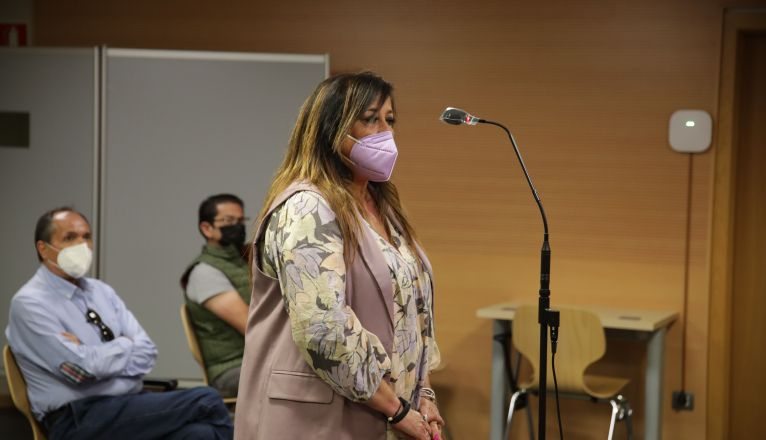
Finally, this Tuesday the former councilor Soraya Brito also testified, who when the desalination plant was seized had the powers over the sanctioning files. However, San Ginés withdrew them from her right at that moment. "I had been there very little. I barely knew the area," she declared, specifying when asked by the prosecution that after that she did continue to be in charge of the rest of the sanctioning files.
About whether she has ever issued a resolution without written reports, as was done in the case of the seizure, she replied that "it is not usual".
"Would you have signed the resolution without giving a hearing to the other party and without reports?" the lawyer for the prosecution asked her. "With the knowledge I have now, no. Then I don't know," replied the former councilor, who did not intervene in that file, because San Ginés personally assumed it.
For his part, the former president has also been asked about why he decided to withdraw the powers, and he replied that she "was totally unaware of the operation", because "she had been there for a month" when the "warnings from the Deputy of the Common" arrived.
"My decision was to face a problem that was going to generate a problem, as finally happened," San Ginés said in this regard.
Add La Voz de Lanzarote as a preferred Google source.
Stay informed with the latest current news.