
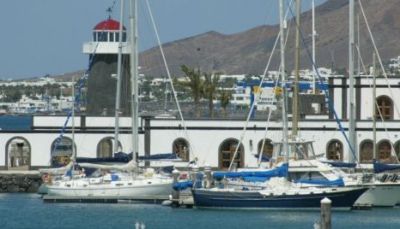
The order that orders the execution of the sentence of the Yate case also establishes that the ruling be formally notified to the Yaiza Town Hall, since it annuls dozens of licenses granted by the former mayor, José Francisco Reyes, both for hotels and for the Marina Rubicón marina. "Send an official letter to the Yaiza Town Hall for the appropriate purposes," states the resolution of the Provincial Court, dated March 22.
In the case of hotel licenses, almost all had already been annulled in the contentious-administrative channel, but the illegality of the port was proven in this criminal case, with a ruling that is now final. In addition, the sentence considers it proven that Reyes received a bribe from the owners of the port in exchange for granting that permit, as he himself ended up confessing before the trial.
The City Council, which has been immersed for years in a procedure to try to legalize the hotels authorized by Reyes in Playa Blanca, now faces another challenge, once it receives the notification from the Court. And in this case, what has been left without any type of legal coverage is a marina that was not even contemplated in the General Plan that was in force when it was built.
The new Yaiza Plan benefits the port
Just as happened with the illegal hotels, which in many cases saw the path towards legalization smoothed with the new Yaiza General Plan approved in 2014, the marina was also benefited with that document. On the one hand, the Plan recognizes the existence of Marina Rubicón and even changes the category of that land, classifying it as ordered consolidated urban.
The document indicates that it was the owners of the port themselves who presented a proposal for "ordering" that was fully assumed by the Government of the Canary Islands when preparing the Plan, thus approving what was actually already built. "Said proposal has not yet been favorably informed by Puertos Canarios, so if it does not have a favorable report from Puertos Canarios prior to the final approval of this General Plan, it will be considered as an unordered area," it was specified in the Plan.
Regarding another of the breaches of the promoters of Marina Rubicón, relating to the Coasts Law, the Yaiza General Plan also appeals to the accomplished facts to give the port a way out, stating that this law would not be "applicable" to it. The reason, according to the drafters of the Plan, is that the Berrugo coast is already "altered" by the construction of the port, so the article that imposes "limitations on private property in land adjacent to assets that retain their natural characteristics" does not apply. According to the Plan, since these natural characteristics no longer exist because they were altered by the promoters of this illegal port, the article would not be applicable.
Illegal license in six days and in exchange for bribes
As revealed by the investigation of the Yate case, Marina Rubicón began to be built without even having a license. In fact, they hadn't even requested it and the promoters only requested it when the Superior Court of Justice of the Canary Islands ordered the works to be stopped. And only six days after they requested it, José Francisco Reyes granted that illegal permit.
The then secretary of the City Council, Vicente Bartolomé Fuentes, also confessed in the Yate case that he was aware that this permit was illegal, but still issued a favorable report, so he accepted a conviction for a crime of prevarication. As for Reyes, he admitted that he received a "gift" valued at 60,000 euros from the owners of the port, Juan Francisco Rosa, Rafael Lasso and Francisco Armas, by enjoying a free mooring for five years in those facilities. And this bribe, according to the sentence, was not only due to the port license, but also to other illegal licenses granted to the same businessmen.
Two of them, that of the Princesa Yaiza hotel and that of the Son Bou hotel, were granted to Juan Francisco Rosa, in one of the cases "three days after" he requested it. The third, which allowed the construction of the Meliá Volcán Hotel, had been requested by Francisco Armas. In its ruling, as revealed by the instruction of this case, the Court points out that the Yaiza General Plan that was in force did not contemplate a marina, that the declaration of the Insular General System was not made, nor therefore was the environmental impact study processed, and that "there was no land planning instrument" that gave it "coverage", despite which that permit was granted.
As for the businessmen who gave that gift, they were at the time charged in the case, but the charges against them were finally dropped. And the Penal Code that was in force at that time did not allow the crime to be classified, as it was an improper bribery after the granting of the license, and not before. For these cases, the previous Penal Code - which is the one that had to be applied - contemplated penalties for the one who received the gift, but not for the one who gave it.


