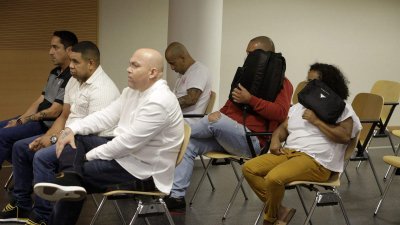
The Sixth Section of the Provincial Court of Arrecife is trying this Wednesday seven people accused of a crime against public health and belonging to a criminal group for allegedly introducing and distributing cocaine in Lanzarote from Colombia.
The defendants allegedly planned the transportation of cocaine, mostly in liquid form, from the Latin American country to the César Manrique Airport, using "human couriers".
After a manipulation process on the island, the narcotic substance was suitable for distribution in powder in small doses.
Between September 2012 and May 2013, investigations by the Organized Crime Team (ECO) and the Organized Crime and Anti-Drug Team (EDOA) of Las Palmas discovered the existence of this group of people dedicated to drug trafficking on the island.
The Public Prosecutor's Office in its indictment points to José A. Marquez as the person in charge of directing and giving orders in the process; to Luis A. Martínez as his person of "utmost confidence"; as well as the person in charge of adulterating and manipulating the cocaine Winston B. Frías; and those in charge of distributing it around the island Rafael A. Díaz, Anyi Suero and Alberto Andrés.
The Prosecutor's Office affirms that Rafael A. Díaz traveled to Madrid on one occasion to allegedly manage the acquisition of the drug and the transfer of "human couriers" directly.
Three failed cocaine shipments
The case also points to the passenger John A. Morales, who was arrested at the Lanzarote Airport, coming from a flight from Bogotá with a stopover in Madrid. The man was carrying four packages of liquid cocaine inside his suitcase, according to the Public Prosecutor's Office.
John A. Morales agreed with José A. Marquez to transfer 1,385.3 grams of cocaine, with a remuneration of 10,000 euros per kilogram.
In January 2013, the defendants Rafael A. Díaz and Anyi Suero, a sentimental couple, traveled to Madrid, following the orders of Márquez and Martínez, to supervise the transfer of another cocaine shipment.
Also by way of the "human courier" was the citizen José Matos Peñas who carried the drug, was intercepted by the authorities and convicted by the Provincial Court of Las Palmas de Gran Canaria.
On a third occasion, the trip organized by José A. Márquez and Luis A. Martínez was truncated again. This time another person who tried to introduce cocaine into Spain was intercepted at the Airport of Colombia.
As revealed by the Prosecutor's Office in its indictment, "the defendants were part of a criminal group dedicated to the illicit trafficking of drugs that, despite its stable character, distribution of specific functions and hierarchical character, did not reach the degree of complexity of a criminal organization."
During the searches of the defendants' homes, located in Madrid, the Balearic Islands and Arrecife, the authorities found cocaine, cash and electronic devices.
So far, only the first arrested passenger John A. Morales remained in pre-trial detention for two years and three months until December 2014; the alleged leader of the plot José A. Marquez was also in prison for almost two years; and the leader's right-hand man Luis A. Martínez, who was in pre-trial detention for ten months until he was released.
The Prosecutor's Office accuses the investigated for a crime against public health in the modality of substance that causes serious damage to health in a quantity of notorious importance as well as a crime of belonging to a criminal group.
Penalties requested by the Prosecutor's Office
José A. Márquez. Nine years in prison, with special disqualification for the right to passive suffrage and a fine of €261,957.652 for a crime against public health. In addition to two years in prison for a crime of belonging to a criminal group.
Luis A. Martínez. Eight years and six months in prison, with the accessory special disqualification for passive suffrage during the time of the sentence and a fine of €261,957,652. Likewise, one year and nine months in prison with disqualification for passive suffrage for belonging to a criminal group.
John A. Morales. Eight years in prison, special disqualification from passive suffrage and a fine of 88,813.132 euros. In addition to belonging to a criminal group, the Prosecutor's Office requests one year and six months in prison.
Winston B. Frías. Eight years in prison, special disqualification from passive suffrage and a fine of 261,957.652 euros. On the other hand, one year and six months in prison for belonging to a criminal group.
Rafael A. Díaz. Eight years in prison, special disqualification from passive suffrage and a fine of 261,957.652 euros. At the same time, one year and six months in prison for belonging to a criminal group.
Anyi Suero. Eight years in prison, special disqualification from passive suffrage and a fine of 261,957.652 euros. At the same time, one year and six months in prison for belonging to a criminal group.
Alberto A. Sánchez. Eight years in prison, special disqualification from passive suffrage and a fine of 261,957.652 euros. At the same time, one year and six months in prison for belonging to a criminal group.


Add La Voz de Lanzarote as a preferred Google source.
Stay informed with the latest current news.