
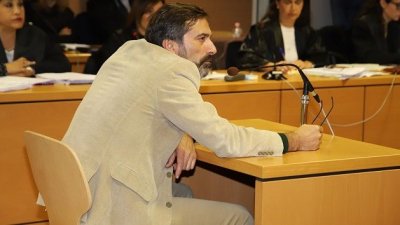
The Provincial Court of Las Palmas has ordered the opening of a new criminal case against the former president of the Cabildo, Pedro San Ginés, for an alleged crime of perjury in a judicial proceeding. The order, issued on October 13, points out that San Ginés may have “maliciously misrepresented the truth” when he testified as a witness in the case of the Tourist Centers, of which he was also a complainant.
After the definitive dismissal of that case for not finding evidence of a crime, and a few months after the death of businessman Antonio González - who spent almost a decade accused in that proceeding - his daughter decided to file a complaint against San Ginés, accusing him of crimes of slander, false accusation and perjury. Initially, the Court of Instruction Number 2 of Arrecife decided not to admit it for processing, but the First Section of the Court has upheld the plaintiff's appeal, annulling that order and ordering an investigation into one of the crimes.
“From the facts narrated in the complaint and the documentary bases provided, it cannot be ruled out, much less, that a crime of perjury may have been committed in a criminal case,” the Court concludes, after having analyzed both the statement made by San Ginés and the order of the judge who agreed to the dismissal of those proceedings a year ago, in November 2019. As a result of that analysis, the Court emphasizes that as a plaintiff and as a witness in the case, the former president of the Cabildo made accusations that were “objectively refuted in the dismissal order.”
Specifically, Pedro San Ginés stated that when the work on the Jameos del Agua kitchen was awarded to Antonio González's company, Climafrical, there was “a more economical offer” that was not taken into account. And he also questioned “the price of the goods supplied, mentioning that it seems that they have been inflated by up to 40%”. However, the Court recalls that the investigating judge concluded that, indeed, Climafrical's offer was “apparently the cheapest”, contrary to San Ginés' “supposedly false statements.”
Regarding the subsequent increase in price during the work, the investigating judge concluded that “it did not represent an increase of more than 20% of the final work” and that “this increase was justified by the peculiarities of the work and the urgency required.” In addition, he added that what was paid complied with the legal channels established in the Billing Regulations and that “a multitude of people intervened in the contracting procedure, which contributed to providing the system with regularity.”
The complaint, “framed within the scope of apparent political games”
“We are not facing an investigation process initiated by the authorities to which the witness is called to testify, providing data that may be erroneous, but rather the witness takes the initiative in attributing facts that are supposedly constitutive of a crime,” the Court highlights in reference to San Ginés' status as a plaintiff. “We are facing a person who had knowledge of the contracting process as he himself points out, who was also the CEO of the centers until May 2007 and since then a member of the Council representing his party,” he adds, referring to the fact that after his statement there may have been something more than a “mistake.”
In fact, he recalls that San Ginés himself acknowledged before the judge, when asked about it by the defense, that he “knew of a document - signed by Mr. Ortega - based on which Climafrical's offer was considered the cheapest of the three,” although he still insisted that this “did not legitimize the contracting process.”
“It is a person who had specific knowledge of the facts, and access to the documentary sources on which the entire process was based, framing the complaint within the scope of the apparent political game between formations of different signs,” the Court goes on to point out, in the same line as the plaintiff maintained.
“The whole movie put together by Mr. San Ginés had only one purpose: to justify or accentuate a political confrontation against the one who was the administrator of the Centers," the socialist Carlos Espino, Antonio González's daughter maintained in that complaint. "It is known by the entire society of Lanzarote that for Mr. San Ginés in his power struggle, anything goes, including the use of slander, false accusations or perjury, which is what he has practiced in this process," he added.
In this regard, the Court also points out that one thing is the “political debate,” where the scope of freedom of expression may be greater within the exercise of the work of opposition, and another is “going to the authorities formalizing complaints or accusations, and maintaining in these facts that could give rise to the declaration of criminal responsibility of specific people.” Especially “when they are attributed not to members of other political options in the exercise of their functions, who therefore assume a certain elasticity in the limits of criticism, but to individuals who apparently have no more intervention than to attend a public contracting procedure.”
In this case, along with Espino, several suppliers of the Centers were investigated, such as Antonio González himself, who, according to his daughter, suffered serious economic consequences due to Pedro San Ginés' “falsehoods.” “In a few months he lost all his clients” and this led to "the closure and disappearance of his company, Climafrical, liquidated through bankruptcy proceedings," it was indicated in the complaint.
Penalties of up to three years in prison
Regarding the crimes initially reported, the plaintiff herself has withdrawn the slander charge, which consists of accusing someone of a crime with knowledge of its falsehood, but without the aggravating circumstance of being within a judicial case, which is what will finally be investigated.
Regarding the crime of false accusation, the Court points out that it is “absorbed” by that of perjury. “If after the imputation of criminal acts that are false or with reckless disregard for the truth, its ratification is followed in judicial presence when declaring as a witness, we would be facing a concurrence of rules to be resolved in favor of the crime of perjury in a judicial case,” he points out.
In fact, the latter is the most punished, especially when a witness lies to harm a person investigated within a criminal case. For this case, the Penal Code contemplates penalties of between one and three years in prison, in addition to a fine of six to twelve months.
Finally, regarding one of the arguments that the Court of Instruction had used to dismiss the complaint, pointing out that Antonio González's daughter was not legitimized to exercise the private prosecution, because she is not directly harmed by the crime, the Court also questions it.
On the one hand, the Chamber points out that it can “glimpse that legitimate interest” because the reported facts have “supposed the impairment of the good name of the affected party, but also of his most direct relatives such as his children, and that they may be burdened in the consideration of others by everything that has affected their parents in life, especially insofar as it has supposed the undervaluation of the correct procedure that is presumed of any citizen.”
On the other hand, he points out that the instructor did not delve into this reason and urges him to argue whether or not that private prosecution is possible - given that technically the crime would have been committed against the administration of justice - or, in any case, if he should appear as a popular prosecution - which is the one that any citizen can exercise in defense of the common good, without being directly harmed by the facts. In any case, he emphasizes that it would be something “remediable at this time.” And in case the judge finally decides not to accept any of the forms of appearance of the plaintiff, the Court makes it clear that he will still have to initiate this investigation to clarify the reported facts.
Add La Voz de Lanzarote as a preferred Google source.
Stay informed with the latest current news.