
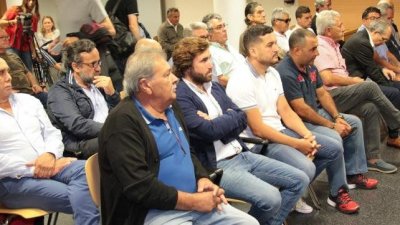
The Criminal Court Number 1 of Arrecife has sentenced 10 of the 19 people who were tried last week for participating in an illegal shearwater roast in Alegranza in February 2015. The ruling considers that Fernando González Berriel, Juan Carlos González Berriel, Andrés Curbelo González, Antonio Quintana López, Victoriano Santana Cabrera, Juan Cuevas Alonso, Jaime Isaac Rodríguez, Orlando José Rivera, Adal González and Ibrain Josué Cabrera committed a crime against the environment in its modality of protection to wildlife and imposes a fine of 8,640 euros each, as well as three years of disqualification from any activity related to hunting.
As for the rest of the defendants, they are acquitted because their participation in the events has not been proven. And although they were also on the beach when the Civil Guard officers arrived, the ruling considers that the evidence provided is not sufficient to determine that they were participating in the "feast".
Among these tests, in addition to the testimony of the agents, are the photographs they took before intervening, in which the ten convicted are seen next to the cauldron where a shearwater stew was being cooked and where they had installed a table, chairs and an awning. Therefore, the magistrate concludes that the statements made by the ten convicted in the trial "are not credible at all".
Caught "with the spoon in hand"
"They appeared distorted not only by the testimonies of the agents who testified in the plenary session, which are considered truthful and credible, but also by the photographic report in which the previous defendants appear participating in the roast in which one of the stews that was being prepared, specifically Andrés González Curbelo with a spoon in his hand, was shearwater", the ruling states, which emphasizes that González Curbelo himself acknowledged this to the agents at first, who later denied it during the trial, and it was also proven when the sample was analyzed.
Regarding "who specifically organized the feast" or who carried out "the hunting and killing of the birds", it concludes that "it is not relevant". Nor is the fact that there was more food there or that one of the defendants claimed that at that time he had a medical problem and had been recommended not to eat fats. "It does not exclude that he knew the facts, whether he ate the shearwaters or not", the ruling responds.
In this regard, it recalls that Alegranza is a protected natural area and that shearwaters are also a protected bird, which "could not be unknown by the defendants, given their roots in Lanzarote". In fact, it emphasizes that "all were born on the island and most reside there", where it is well known that hunting shearwaters is prohibited. "Especially in the case of the defendants Fernando González Berriel, Juan Carlos González Berriel, Antonio Quintana and Andrés González", the ruling adds, referring to the authorization granted to them by the Cabildo to anchor in the Veril de Alegranza.
This authorization was requested by Fernando González Berriel and allowed the anchoring of three boats between September 4 and 12, 2015, being able to only "spend the day on the beach". The ruling highlights that this authorization made express reference to the fact that it is a protected area and that "the area is one of the best places in the region for bird nesting, among which the Atlantic Cory's shearwater was mentioned, prohibiting any activity or behavior that may affect the fauna and natural resources". In fact, it was specified that they could not even "cause disturbance or disrupt the habitat" of these birds, which, however, ended up hunting and cooking in a cauldron on the beach.
"They limited themselves to denying the obvious"
Faced with the "plurality of incriminating elements" in the case against the ten convicted, the ruling emphasizes that all of them refused in the trial to respond to the Prosecutor's Office and the popular accusation, answering only their own lawyers. Thus, it points out that instead of giving a "consistent explanation", they limited themselves to "denying the obvious".
Among other things, the magistrate does not give credence to the statements of the defendants, who claimed that there were up to 50 people on the beach and that most of them escaped, thus trying to suggest that the real perpetrators of the hunting would have fled. In this regard, the ruling recalls that the agents who testified in the trial denied "that a crowd ran away at their arrival". In addition, it adds that it was a steep and difficult to access area, so "it would have been difficult for a large group to flee on foot".
Regarding the other message that all the defendants repeated in the trial, assuring that their rights were not read to them when the Civil Guard intervened, the judge also "grants credibility to the testimonies of the agents", who not only declared "in the same sense and without contradictions" that they did, but also recorded it in the report they drafted that day. "No violation of their rights occurred", the ruling concludes.
"It is the party that alleges the irregularity that must prove it"
In addition, it also rejects the challenge of evidence raised by the defenses at the end of the trial, which was described as untimely by the Prosecutor's Office and the popular accusation. Among other things, the defendants intended to have the analysis of the sample of the stew that the agents took from the beach declared null, raising at the last minute an alleged break in the chain of custody.
"The defenses merely point out the possibility of its manipulation or irregularities in the chain of custody that derive without more from the allegations that the veterinarian was not a public official, the clinic was not public, or that there were more workers there, implying that they could have committed a manipulation", the ruling points out, which after citing different jurisprudence concludes that "the general rule is that the effective manipulation must be proven and the allegation of a possibility in the abstract is not enough".
"It is the party that alleges the irregularity that must prove it", it adds, stating that in this case "no evidence is practiced from which the effective manipulation of the chain of custody results, so there is no reason or circumstance that allows to doubt that the analyzed substance was not the one occupied". Regarding the fact that the agents used a garbage bag to take away the remains of the stew, the judge responds that this was already stated in the initial report, without the defendants raising any challenge at the time, and adds that in any case that does not serve to "generate doubts about the authenticity or integrity of the source of evidence" either.
Regarding the request made by the defendants to condemn the popular accusation, exercised by the Association of Friends of the Cory's Shearwater and by Urban Transparency, to pay the costs of the trial, the ruling also rejects it, concluding that there has been neither recklessness nor bad faith in its action. In fact, the penalties imposed on the convicted are those requested by the popular accusation, which are higher than those of the Prosecutor's Office. Regarding the nine acquitted, one of them was also accused by the Prosecutor's Office and the rest only by the popular accusation, but the ruling recalls that it was the Investigating Court that agreed to open oral proceedings against the 19.


Add La Voz de Lanzarote as a preferred Google source.
Stay informed with the latest current news.