
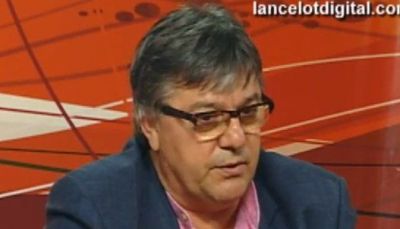
The journalist Francisco Chavanel has once again been condemned for violating the right to honor, this time for his attacks on the judge who initiated the Unión case, César Romero Pamparacuatro. In addition, together with Chavanel, Editorial Lancelot S.L, the newspaper Canarias 7, Faycán Publicidad and the production company of his radio program, El Escorpión de Jade, have been condemned for having "contributed" to the "systematic smear campaign" against the magistrate.
Through all these media, Francisco Chavanel directed attacks against Pamparacuatro and against all the judges, prosecutors and UCO agents who intervened in the largest corruption case in Lanzarote and one of the largest in the Canary Islands, trying to discredit it. And for this, according to the ruling, he not only tried to discredit the judge as a professional, but also "attacked" his "dignity as a person".
The sentence issued by the Court of First Instance and Instruction Number 3 of Puerto de la Cruz, where the magistrate currently resides, establishes compensation of 45,000 euros for the "damages" caused to Pamparacuatro, having been disseminating false information that seeks to discredit him and his work at the head of the Unión case. Of that amount, both the journalist and the media condemned along with him must respond, in different amounts.
They must publish or read the ruling with the conviction
Most of that sum, 30,000 euros, must be paid by El Escorpión de Jade S.L., producer of Chavanel's radio program El Espejo Canario. For its part, the publishing company of Canarias 7 must compensate the judge with 6,000 euros, while Lancelot must give him 5,000 euros and Faycán Publicidad 3,000. The journalist himself must respond jointly and severally for all these amounts.
In addition, Canarias 7 will have to compensate Romero Pamparacuatro with 1,000 euros more for another article signed by the journalist Carlos Inza, under the title "Pamparacuatro had the prosecutor without informing for more than two years". After analyzing the content of that "news", the sentence concludes that it is "untrue", that it "lacks any evidentiary support" and that neither the journalist nor the newspaper acted "with the minimum diligence necessary to transfer the information to public opinion", despite the fact that with this they were "jeopardizing the professional prestige of the affected person".
"With a minimum contrast through sources with knowledge of the matter, who could offer understandable explanations about the functioning of a Court, such as the press room of the Superior Court of Justice of the Canary Islands, or lawyers, or unions of justice officials, among others, would easily allow to deduce that the fact was not attributable to an intentional action of the investigating judge, as is slipped" by Inza in the article, the sentence states.
On the other hand, the Court condemns these media to publish in the heading and the ruling of this sentence or, in the case of the radio, to read its content, once it becomes final, since an appeal is still possible.
"Objectively injurious"
Although Romero Pamparacuatro filed a civil lawsuit, the sentence even points out that Chavanel's attitude "is objectively injurious", which could mean the commission of a crime, that of insults, included in the Penal Code. In this regard, the ruling states that the journalist "exceeded the limits of mere criticism" of the judge, since he went so far as to accuse him of "committing several crimes, especially serious when they take place in the exercise of the judicial function". And he did so with "firmness, reiteration and rotundity", not only through his radio program, but also with the articles he published in Canarias 7 and in lancelotdigital.
"From a global perspective of the procedure, after analyzing it with extreme caution, there is no other conclusion than to affirm that the journalist has formulated opinions without minimally contrasting the facts", the sentence concludes, which adds that this "diligence" was especially necessary, because "the defendant knew that his comments, due to the very consubstantial nature of the recipient, and due to the public interest of the matter, could cause serious professional discredit and affect the honor and credit of the plaintiff."
In addition, he insists that "due to the reiteration and extension in time of the comments, it can be affirmed that, in purely terminological terms, it was a smear campaign sustained by the defendant Chavanel Seoane, causing, unnecessarily, a deep offense to the dignity and prestige of the plaintiff, attacking his fame" and contributing to "create specific doubts about honorability".
Being a public figure does not mean being "at the mercy of invectives or outrages"
As he did in the trial for the lawsuit filed against him by prosecutor Ignacio Stampa, and in which he has also already been ordered to pay compensation of 50,000 euros, Chavanel appealed in this procedure to his right to freedom of expression and opinion. However, once again, a Court has rejected this argument, pointing out that the claim of Chavanel's defense "implies admitting - which in no way can be done - that whoever acts on the public stage is at the mercy, without limit, of any invectives or outrages that undermine their reputation or good name".
In this regard, the sentence states that although public figures "are exposed to especially intense and incisive inquisitions and criticisms and higher, in any case, than those that are usually tolerable among ordinary citizens", that does not mean that "characters and public servants" lose "their right to honor". And even less so in the case of judges, since "the possible unfounded discredit that they could suffer would eventually damage not only their personal honor, but also, inseparably, the confidence of all in justice, which is a basic condition of the Rule of Law".


