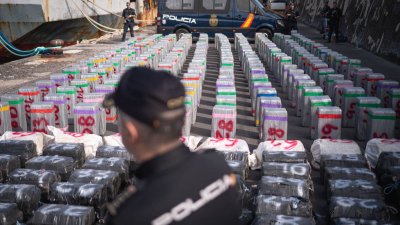
The National Court judge José Luis Calama has sent six of the thirteen crew members detained on a ship seized 535 kilometers off the Canary Islands to prison this Tuesday. The ship was carrying the largest cocaine haul ever seized at sea by European security forces: 9,994 kilos. These are **four Turkish citizens, one Hungarian, and one Serbian**, while the other **7 detainees, all of Indian origin**, have been granted provisional release with precautionary measures by the head of Central Investigating Court number 4, at the request of the Anti-Drug Prosecutor's Office. This is due to indications that they were coerced with a weapon to load the drugs onto the vessel, legal sources informed EFE. Nevertheless, and pending verification of this fact, the magistrate has imposed on them the obligation to appear every Monday at the court closest to their residence, the retention of their passports, a prohibition on leaving national territory, and the provision of a Spanish address for receiving notifications. The six who have been sent to prison are charged with offenses constituting crimes against public health, for trafficking substances or products that cause serious harm to health, of extreme gravity due to the seized quantity being notably higher than that considered of notorious importance and for the use of a vessel as a specific means of transport, and committed as part of a criminal organization. One of the detainees is also accused of illegal possession of weapons in relation to the weapon seized on the vessel, which was allegedly used to threaten the seven crew members who have been released. The ship United S, flying the flag of Cameroon, was boarded in the Atlantic by special operations agents of the Police, GEO, in an operation in which the Spanish Navy also participated and had the collaboration of the US Drug Enforcement Administration (DEA). The ship was taken to the port of Santa Cruz de Tenerife, where the head of the central narcotics brigade of the National Police, Alberto Morales, highlighted the significance of the so-called operation 'Marea Blanca'. On the one hand, due to the quantity of drugs seized, almost 10 tons, which represents **the largest cocaine seizure at sea since 1999**, when the ship Tammsaare was intercepted carrying 7,500 kilos of cocaine in its bow. On the other hand, as he explained, because the merchandise was to be distributed among various organizations that were prepared to collect it at sea, which precipitated the boarding of the vessel, which allegedly was transporting a cargo of salt from Brazil destined for a port in Turkey, from where it had departed months earlier. In fact, part of the cocaine, approximately one ton divided into 37 bales located on the starboard side, was ready for immediate unloading. The rest of the cocaine was stored in one of the two holds of the vessel, where the bales were interspersed with lines of a salt cargo. The investigation, coordinated and directed by the Special Anti-Drug Prosecutor's Office and Central Investigating Court 4, focused on an organization allegedly dedicated to the export of "huge quantities" of cocaine from South America to Europe, and has represented "a decisive blow" to international networks dedicated to the maritime trafficking of cocaine in the Atlantic, as highlighted by the National Police on Monday in a press release.


Add La Voz de Lanzarote as a preferred Google source.
Stay informed with the latest current news.