

The UNED associated center in Lanzarote celebrates its 50th anniversary. Half a century offering the people of Lanzarote opportunities to pursue university studies on the island. University entrance exams, more than 30 degrees, master's degrees, own degrees, courses for people over 55, languages and many other forms of education.
The center's secretary, Andrés Fajardo, a graduate in Philosophy, has shared documents from the time with Ekonomus and explained how the center works.
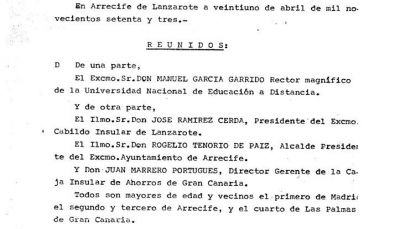
The agreement for the opening of the Lanzarote center was signed on April 21, 1973, which began as an attachment to the one in Las Palmas, the first associated center in Spain after the founding of UNED in Madrid in 1972.
Three days after the signing, 28 Philosophy students and 8 Law students began their studies. Since then, the number of available degrees has been increasing to over 30. More than 300 people from Lanzarote have completed a degree or obtained a master's degree at the center since its opening.
25% of undergraduate students choose Psychology
Currently, more than 700 people from Lanzarote are enrolled in one of the studies offered by the UNED associated center in Lanzarote. There are students from all seven municipalities. 44% are from Arrecife, while Teguise, San Bartolomé and Tías together account for a similar percentage. Yaiza, Haría and Tinajo contribute the rest of the students.
"Face-to-face tutorials are also broadcast online"
The majority of them, 458 students, are studying one of the degrees offered by the distance university. The most popular degree is Psychology, which is studied by almost 25% of the students. Next is Law, with 75 students, and Business Administration and Management, with 37 enrolled.
The fourth degree with the highest number of students is Criminology, which is currently being studied by 28 students, while Early Childhood Education occupies fifth place, with 26 students.
The most popular degrees have face-to-face classes
The most popular degrees have one face-to-face class per subject per week. “While face-to-face tutorials are given, they are also broadcast over the internet, and students can watch them from home if they want to,” explains the center's secretary, Andrés Fajardo.
In general, any first- or second-year student receives tutorials taught either by a teacher from Lanzarote, or by a teacher from the South Campus, which includes the UNED associated centers in Andalusia, the Canary Islands, Ceuta and Melilla. “Thus, a second-year Philology student from the Lanzarote center can receive classes from the La Laguna center, for example,” Fajardo points out.
In addition to degrees and master's degrees, the latter are all online, UNED Lanzarote also offers continuing education through the UNED abierta program, university extension courses and languages.
Own degrees and 16 languages
“Continuing education is the most fashionable thing nowadays, people have to continue training throughout their lives and there is a course both for teachers and open education courses for anyone who wants to specialize, they function as UNED's own degrees and can be certified,” Fajardo explains.
The university extension courses, such as the Conference on Immigration Law that was organized this week, are those offered directly by the Lanzarote center and are face-to-face. They are open to all citizens. Among them are the studies of the UNED senior program, “one of the most beloved for us, which brings together people over 55 years of age who want to learn new things, to meet and to meet more people to talk about their concerns, this year we have broken the record of registered with more than 100 students,” reveals the secretary of the center.”
"UNED senior students are collecting signatures for the building to be renovated"
UNED also offers distance courses in 16 foreign languages. Since last year, the B1, B2 and C1 levels of English have been certified by Trinity College London.
Universities, Cabildo and Government of the Canary Islands contribute the most
The UNED center in Lanzarote has funds for its operation that are around 400,000 euros per year. Most of it comes from the central headquarters of the university, which contributes 115,000 euros; followed by the contribution of the Cabildo of Lanzarote, which amounts to 100,000 euros.
The Canary Islands Government contributes another 86,000 euros and the Arrecife City Council contributes 75,000. After the capital's consistory, the largest municipal contribution comes from San Bartolomé, which contributes 5,000 euros per year. Tías and Teguise contribute 3,000 euros each. Yaiza contributes 2,400 euros, Haría with 1,500 and Tinajo with 750.

The first headquarters was an apartment in Arrecife
Another highlight of UNED in Lanzarote is its emblematic headquarters, designed by the Tenerife architect José Enrique Marrero Regalado. The building was inaugurated in 1950 as the National Tourism Inn of Lanzarote. It was also a primary school before becoming the headquarters of UNED.
In fact, the first headquarters of the center was located on the third floor of house number 10 on Ruperto González Negrín street. “It is a very cozy apartment, quite suitable for the purpose that is pursued, which is none other than the necessary coexistence of the students themselves and these with the teachers,” says the Eco de Canarias in a report from the time.
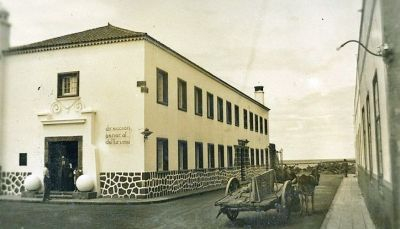
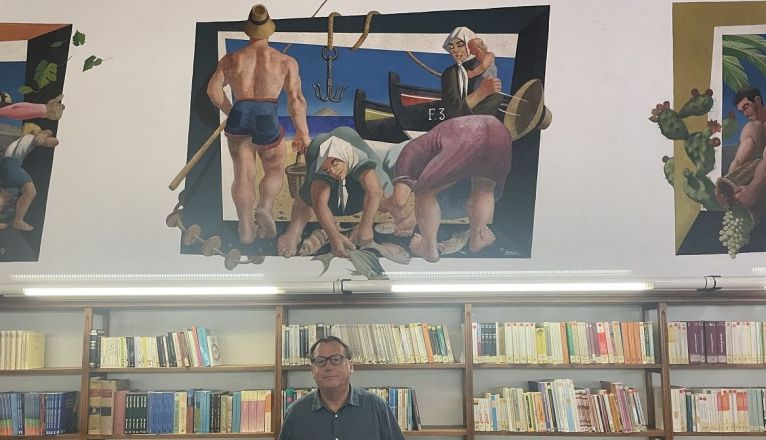
The current building, explains Fajardo, “is protected because it is within the scope of the Castle of San Gabriel” and depends on the Arrecife City Council. Inside, the building preserves some of the key murals from the first artistic phase of César Manrique, painted in 1950 for the inauguration of the inn.
The murals, which can be visited free of charge, are visited by more than 500 people a year. On the occasion of the 50th anniversary of the associated center, “we have reached an agreement with the César Manrique Foundation to place a plaque with information about the murals that will be ready in a couple of months,” says the center's secretary.
When asked if the building needs any improvement, Fajardo believes that it would at least need “a facelift”. “There is an initiative of the students of UNED senior, the elderly are the most demanding, who are collecting signatures for the building to be renovated on the outside. It is assumed that the City Council had a project for this, but I honestly don't know where that project is currently.”


