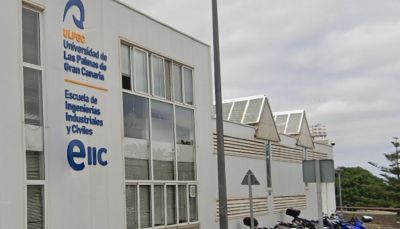
The student of the University of Las Palmas de Gran Canaria (ULPGC) Ángel Gabriel Vega Artiles, who suffers from a severe motor disability, has completed his doctorate with a thesis in which he addresses the computational study of the Nuss technique, a type of thoracic surgery.
As reported by the university institution in a statement, the student has obtained a grade of cum laude.
Vega Artiles, a graduate of the School of Industrial and Civil Engineering in 2015, said he is confident that his experience will show that suffering from a disability "is not an impediment to achieving remarkable academic goals and developing as a researcher", while thanking his mother for her "invaluable help".
Vega Artiles completed the Doctoral Program in Chemical, Mechanical and Manufacturing Engineering in collaboration with the Mechanical Engineering research group of the School of Industrial and Civil Engineering.
His thesis consisted of the computational study of the Nuss technique and the modifications to this surgical technique proposed at the Insular Hospital of Las Palmas de Gran Canaria, performed on 3D models that simulate the anatomy of the rib cage.
This technique is used in the correction of "Pectus excavatum" and "Pectus carinatum", two of the most common malformations that affect the anterior wall of the thorax.
Both malformations require surgical treatment in the most severe cases; although the technique has improved over the years, its use in adults favors the appearance of tensions in the thorax that can lead to complications that hinder or prevent the correction of these malformations.
The objective of the thesis has been the study and comparison of such modifications with the standard technique through a finite element analysis on 3D models, obtained through CT images, that simulate the anatomy of the rib cage with different levels of involvement.
"The results conclude that these proposals produce an appreciable reduction in the force necessary to correct the malformations under study and, in turn, their stiffnesses, being an applicable resource during the performance of the Nuss technique," the note concludes.
A student with a severe disability obtains a cum laude doctorate from the University of Las Palmas
The newly graduated doctor elaborated a thesis in which he addresses the computational study of the Nuss technique, a type of thoracic surgery
November 3 2022 (14:07 WET)
Updated in
November 3 2022 (14:07 WET)