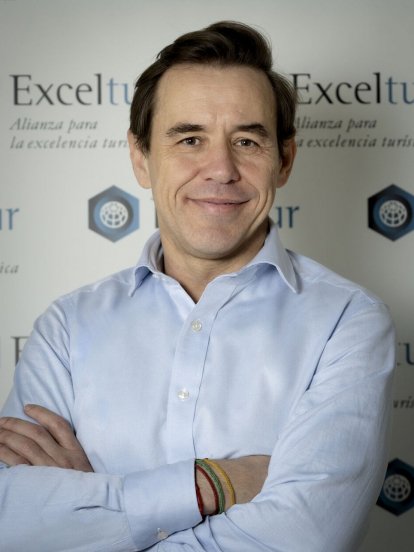
The Cabildo of Lanzarote was the first public institution to adhere to the manifesto 'Tourism that Adds Up', from the alliance of large tourism companies in Spain, Exceltur.
The businessmen's manifesto advocates for tourism in Spain to increase its social, economic and environmental returns, and for destinations to have more and more quality, innovation and sustainability.
In an interview with the radio program Buenos Días Lanzarote from Radio Lanzarote-Onda Cero, the executive vice president of Exceltur, Óscar Perelli del Amo, explains how this initiative arose and where it is headed.
“It arises from a call from society, not only in Lanzarote but also in other places in the Canary Islands and the rest of Spain, for us to work for a tourism of greater value, not only economic, but also with social and environmental value,” summarizes Perelli.
The vice president of Exceltur defines it as “a commitment to promote the things that are done well and that society perceives.”
The telephone interview takes place while Perelli is in Lloret de Mar, whose city council and business association have also adhered to the manifesto: “We want all the agents of the Spanish tourism sector, both public and private, to adhere,” he explains.
"Sensitive to the citizenry"
“We believe that in this context of tourism growth we have to be sensitive to the balance with the citizenry.” Perelló advocates for establishing how much and what type of accommodation capacity there should be in each destination so that it generates a “greater contribution to society and better employment.”
One of the objectives of the manifesto, explains Perelli, is to put on the table examples of destinations and companies that do it well so that the rest follow suit.
Asked about the tools to measure whether tourism contributes more or less to the well-being of the local population, Perelli believes that “we have to move from this mantra of sustainability” to objectives with concrete benefits: “In the Balearic Islands, a hospitality agreement has been signed with an wage growth of 18% in 3 years, when the expected inflation is around 7%.”
“We have to take care of the workers, the people who are in contact with the tourists who visit us are essential,” he summarizes.
Regarding the fact that the Cabildo of Lanzarote was the first public institution to sign the manifesto, Perelló considers that “Lanzarote is undoubtedly an example of work in favor of preserving its landscape, cultural and natural values, and it seemed to us that there could not be a better place to sign the first agreement with a public administration.”
“With its contradictions,” he clarifies, “as happens in all destinations, because it is a complex issue, there are many conflicting interests. If we want to pay workers better and invest in improving facilities, that also has to be reflected in prices,” he exemplifies.
Perelló also recognizes the challenges facing the island: “the definition of the island plan, the regeneration of spaces from the 60s as in Puerto del Carmen, working on crucial elements such as mobility to make it more suitable for the needs of its population.”
“70% of the pressure is due to more population, 30% due to more tourism”
In addition, the executive vice president of Exceltur referred to the demographic challenge, “being such a beautiful place, more and more people want to live in Lanzarote, they are no longer tourists. We must objectify the elements that strain Lanzarote.”
According to Exceltur data at the national level, in the last six years, since before the pandemic, “the increase in pressure (in tourist destinations) is due to “88% to the fact that more population wants to live there and 12% is due to more tourism. In the Canary Islands, the percentage is 70% more population, 30% more tourism.”
Asked about the sustainability of tourism, not only environmentally but also socially, the leader of Exceltur considers that “looking at the medium and long term, more among family businesses that have a commitment to the territory, is what allows you the return on your investments.”
Regarding the future of tourism in Spain, Perelli emphasizes that “the prospects are very positive, but each destination has to choose, from that growing market, which is the part that it wants to attract to its territory and work for it.”
“This has not been normal in the Spanish tourism sector as a whole, an offer was developed with better and worse hotels, one that is working on family tourism and next to one that is working on youth tourism... I think the challenge now is to have a positioning of what you really want for your territory in the medium and long term and manage it,” he advises.


Add La Voz de Lanzarote as a preferred Google source.
Stay informed with the latest current news.