
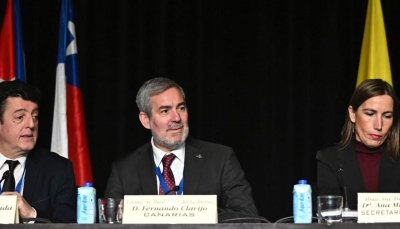
The president of the Canary Islands, Fernando Clavijo, emphasized at the opening ceremony of the Ibero-American Conference of Tourism Ministers and Entrepreneurs (CIMET), the need to move towards a tourism model that incorporates planning, governance, and territorial balance, and called to “rethink the tourism model from the real experience of territories that are already facing these challenges”.
During his speech, the president pointed out that "tourism, in the case of the Canary Islands, is not just another sector: it is a first-level public policy that directly affects the well-being of citizens, land use planning, and the future of our islands."
Fernando Clavijo explained at the event, which opens another year of FITUR's international agenda and brings together public and business leaders from the tourism sector in Spain and Ibero-America, that the Canary Islands have accepted that tourism success must be accompanied by responsible and anticipatory public decisions. "Managing tourism today involves making complex decisions, listening to citizens and anticipating challenges before they become structural problems," he stated.
In this context, the head of the Canary Islands Executive referred to the Strategic Plan Canarias Destino 2025–2027, which places **citizen well-being as the ultimate goal of tourism management**. "The ultimate purpose of tourism management is the well-being of citizens: to improve quality of life, generate decent employment, strengthen social cohesion, and consolidate a balanced relationship between residents and visitors," he indicatedThe president recalled that the Canary Islands closed 2025 with more than 18 million tourists, a figure that makes the archipelago a space where public policies are tested under real conditions. "In an island, fragmented, and limited territory, with high tourist pressure, the challenges arrive sooner and are felt more intensely. This has forced us to innovate sooner, to regulate sooner, and, on many occasions, to correct sooner," he explained.Clavijo insisted that **the Canary Islands' experience can be useful for other tourist destinations**, always from a logic of adaptation and not of exporting closed models. "We are not talking about unique recipes, but about transferable experiences that can help other territories anticipate responses in tourism planning, sustainability, or governance," he pointed outHe also highlighted the status of the Canary Islands as an **Outermost Region** of the European Union and its impact on tourism management. "Remoteness, territorial fragmentation, dependence on air transport, or climate vulnerability are part of our daily reality and force us to seek constant balance between economic competitiveness and social cohesion," he stated
Within the framework of CIMET, the president defended the role of the Canary Islands as a bridge between Spain and Ibero-America in the tourism sector. He pointed out that "the Canary Islands can contribute to strengthening Ibero-American tourism cooperation by providing experience, institutional stability, and a long-term vision based on public responsibility".
Finally, Clavijo concluded that "21st-century tourism **cannot be governed solely by the logic of growth**," and called for political leadership and social agreements to ensure its sustainability. "Tourism is not an end in itself, but an instrument at the service of human, territorial, and economic development," he concluded.This is the first time the head of the Canary Islands Executive presides over the opening of this international forum, considered one of the most relevant institutional events of FITUR's official program, which is held the day before the start of the International Tourism Fair, and which will bring together the Ministers and Vice-Ministers of Tourism from Argentina, Bolivia, Colombia, Costa Rica, Cuba, Chile, Ecuador, Honduras, Nicaragua, Paraguay, Puerto Rico, and Uruguay.CIMET constitutes the main meeting space between the ministers of Tourism of Ibero-American nations and the top representatives of the tourism sector, with the aim of promoting the internationalization of small and medium-sized tourism enterprises and strengthening public-private cooperation


