
The owners of buildings intended for tourist accommodation in the Canary Islands can now apply for aid to finance energy efficiency and circular economy projects.
The Canary Islands Ministry of Tourism has launched a call for subsidies, charged to the Recovery and Resilience Mechanism of the NextGenerationEU funds, which has a budget of 16 million euros.
Tourism informs that applications can be submitted until December 31, 2024, as long as funds are available, as applications will be processed in order of entry until the credit is exhausted.
The Minister of Tourism, Yaiza Castilla, recalled that "the decarbonization of tourism activity is a main strategic objective for the Canary Islands destination and, in addition, the only way to remain one of the most appreciated destinations in Europe".
"We are going to accompany the private sector"
Hence the recent signing of the accession agreement to the Glasgow commitment, sponsored by the United Nations (UN), by the public and private tourism entities of the archipelago and led by Tourism of the Canary Islands, and by which those who signed it commit to reduce carbon emissions from tourism by 50% by the year 2030 and eliminate them completely as soon as possible, and always before 2050.
For that journey to decarbonization, and among other measures, the head of Tourism said that as we committed, "we are going to accompany the private sector by providing them with financing through different lines of subsidies, such as these that are now being called".
The objective of the call is to grant these aids to at least 255 hotels and extra-hotel establishments (apartment, villa, emblematic house, rural house and vacation home), which must be registered in the General Tourist Registry.
The projects to be financed with these aids must guarantee a reduction in non-renewable primary energy consumption of at least 30% compared to the starting situation.
What type of reforms can obtain the subsidy?
According to the bases of the call, the renovation of buildings destined for tourist accommodation, which favor the reduction of energy consumption and carbon dioxide emissions, will be subsidized.
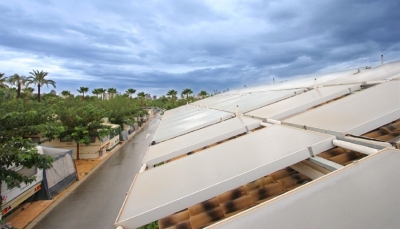
Specifically, the following actions will be subsidized: improvement of energy efficiency through conventional construction actions such as exterior carpentry, facades, solar protections... and non-conventional, or bioclimatic architecture, such as shading systems, natural ventilation, walls facing the sun...
Likewise, actions to improve energy efficiency and the use of renewable energies in thermal installations for air conditioning, refrigeration, heating, ventilation and sanitary hot water will be subsidized; and the improvement of energy efficiency of lighting installations (from more efficient lamps to remote control or automatic systems for switching on and off the lighting of buildings or installations such as awnings, blinds or curtains of the building, which allow optimal use of sunlight, among others).
Completely telematic process
The Ministry of Tourism, through its Provisional Administrative Unit (UAP) for the management of NextGeneration EU funds, has foreseen different measures to facilitate companies' access to these aids. Thus, the concession procedure has been designed with the aim of facilitating the presentation of applications and speeding up the deadlines for the concession of the subsidy, making it completely telematic.
On the other hand, a informative day in each island has been planned to disseminate the technical issues of this process and a technical office has been set up to answer queries, both in administrative matters and in telematic incidents.
Finally, Yaiza Castilla announced that these aids will soon be extended to non-accommodation tourism companies, through the corresponding call, and for which nine million euros are planned.


