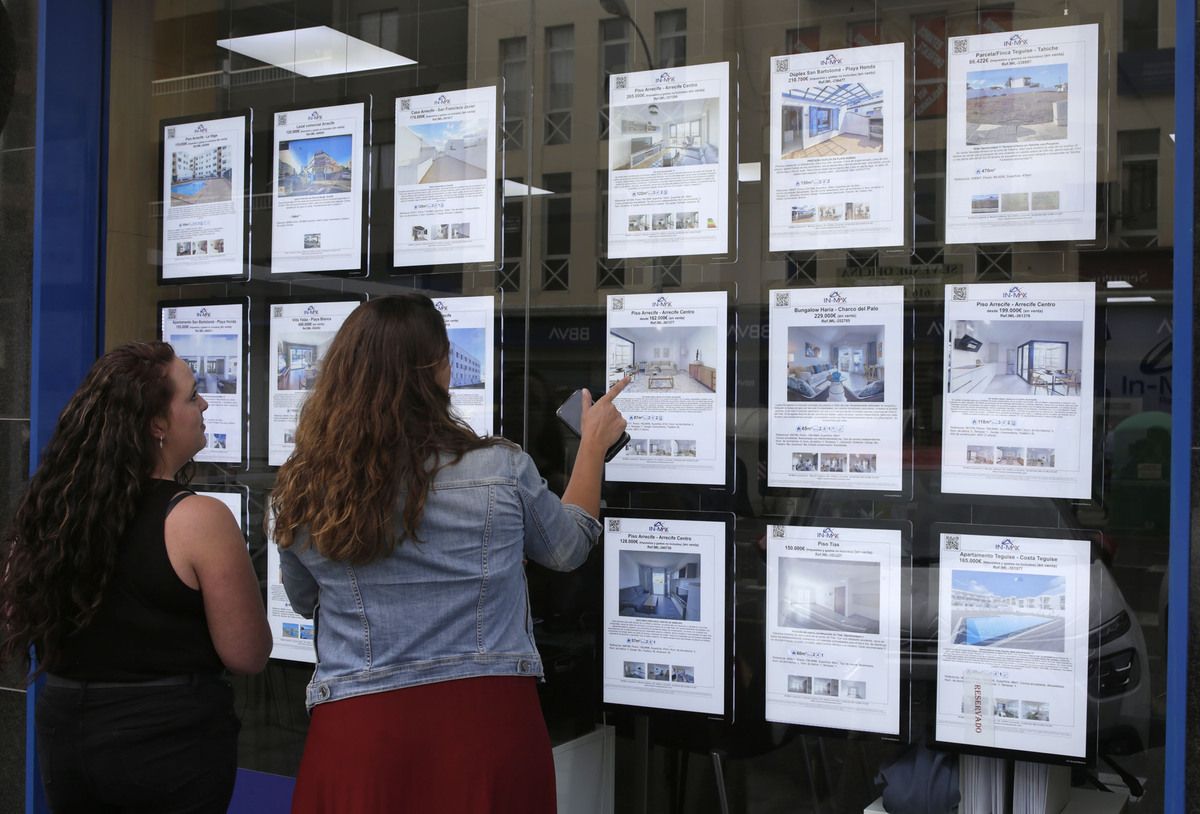
The Government of the Canary Islands will launch a surface rights tender in its consolidated urban land reserves so that, for 75 years, construction companies can "build public housing under the condition of offering affordable rents," announced the Minister of Housing, Pablo Rodríguez.
The head of Public Works, Housing and Mobility stated this Tuesday in the regional Parliament that one of the objectives of his department is to "promote public-private collaboration with this mechanism" so that, in the coming months, it can "start the construction of at least 500 homes."
The objective is to "satisfy the demand" of those aspiring to a home in the Canary Islands, which currently "amounts to 25,000 people" and this number may "increase" from the moment the offer improves, the Minister admitted in two appearances that the Socialist and Nueva Canarias-Bloque Canarista groups have raised on this matter.
Pablo Rodríguez pointed out that the "two years remaining until the end of the current Canary Islands Housing Plan" have to be "decisive and key" to increase the number of public housing and give "the response that citizens who demand a home deserve."
In addition to the aforementioned regional plan, the Canary Islands has the state plan and European funds for housing, three instruments that until now have had "absolutely insufficient" results, and therefore the Autonomous Government Council agreed this Monday to approve "a shock plan in this area," Rodríguez explained.
One of the proposals of the plan "is to increase the staff of the Canary Islands Housing Institute" (Icavi) by 72 people, a figure that is already included in its list of jobs but is vacant, despite the fact that having this staff "is absolutely necessary" to respond in this matter.
Another of the proposals is to "modify the housing allocation decree" so that this process is "more fair and social and not just an element of luck," adding Pablo Rodríguez that a "specific program for La Palma" is also contemplated in collaboration with its Cabildo and town councils, which have committed to "cede land to build 700 homes, of which there is already a drafting project for about 200."
A building program is also planned in rural areas to prevent them from becoming uninhabited, and another to encourage the rental of empty homes aimed at small landlords, who will be given guarantees that they will collect their rent and avoid problems at the end of the contract.
The Minister also pointed out that "only with the capacity of Icavi will it not be possible to meet the demand for housing even in 2030," so it is necessary "a commitment for the private sector to get involved."
Regarding empty homes, he said that his department is "analyzing why the initiative" launched to put them on the market "has failed," which may be due to the "lack of sufficient guarantees or tax incentives for it."
In this regard, the Minister commented that the fact that there is such a "significant number of empty homes also impacts the market, and not only the number of vacation homes," to emphasize that Visocan also plans to "launch a public "intergenerational" building program."
The spokesperson for Nueva Canarias-Bloque Canarista, Carmen Hernández, urged the Minister to "not waste time and take advantage of the tools he has," Icavi and Visocan, while reminding him that "he already has an "advanced" regional housing plan with a "very powerful" financial sheet, exceeding 600 million euros."
Patricia Hernández, from the Socialist group, demanded measures that "are not only for construction and bidding of projects" but to "accelerate the pace," while asking the Minister to detail "what is the course he is facing, what obstacles he encounters and how we are going to remove them."


Add La Voz de Lanzarote as a preferred Google source.
Stay informed with the latest current news.