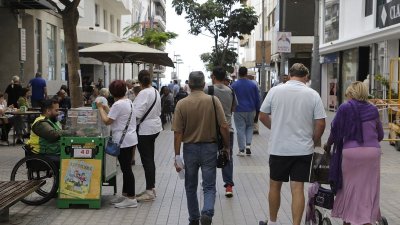
The increase in the minimum interprofessional wage (SMI) approved this week by the Council of Ministers will benefit 174,900 people in the Canary Islands, which is the second autonomous community where the most workers earn the legal minimum, one in five (21.5% of the total).
Six out of 10 workers who receive the minimum interprofessional wage (SMI) and who have therefore benefited from the 5% increase approved this Tuesday by the Government, are residents in four communities: Andalusia, Madrid, the Valencian Community and Catalonia.
According to an estimate made by the Ministry of Labor and Social Economy of the territorial distribution, in addition to sectoral, by sex and by age of the people benefited by the increase approved this week by the Council of Ministers, in Andalusia 510,500 workers receive the SMI (20.7% of the total, which amounts to 2,466,000), in Madrid 387,300 (15.7%), in the Valencian Community 306,400 (12.4%) and in Catalonia 300,100 (12.1%).
According to these figures, put in relation to the average affiliate data in January of this year published by the Ministry of Inclusion, Social Security and Migration, in Andalusia around 15.3% of its 3,333,052 workers affiliated to Social Security would receive the SMI, in the Valencian Community 14.6% of 2,099,653, in Madrid 10.6% of 3,631,270 and in Catalonia 8.1% of 3,674,896.
The rest of the workers who receive the SMI are 174,900 residents in the Canary Islands, 135,900 in Galicia, 116,700 in Castilla y León, 108,100 in Murcia, 99,100 in Castilla-La Mancha, 72,900 in Extremadura, 61,000 in the Basque Country, 52,100 in Aragon, 46,200 in Asturias, 33,900 in the Balearic Islands, 24,500 in Cantabria, 17,400 in Navarra and 14,600 in La Rioja.
The estimate made by the Ministry of Labor from the analysis of microdata from the 2022 Active Population Survey (EPA) with salaries from the main employment, reveals that, in percentage terms, the increase in the SMI will benefit 14.4% of salaried workers in Spain.
An average percentage that is widely exceeded by Extremadura (21.7%), the Canary Islands (21.5%) or Murcia (20.1%) and that is far from being reached by Navarra (6.9%), the Balearic Islands (7.5%) or Euskadi (7.6%).
By gender, two out of three workers who receive the SMI are women, around 1,594,000 (64.6% of the total), and by age group those who receive this remuneration the most are those under 25 years of age, almost three out of 10 (28.9%).
By sectors, 36.1% of agricultural workers will benefit from the increase in the SMI compared to 6.4% of employees in industry and 4.6% of those in construction.


Add La Voz de Lanzarote as a preferred Google source.
Stay informed with the latest current news.