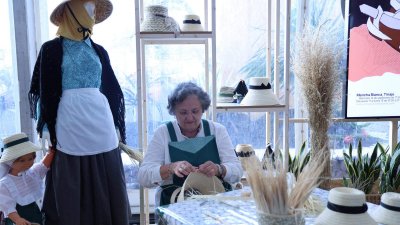
The traditional craftsmanship in Lanzarote constitutes an essential part of the cultural and historical heritage of the island, and also represents an “economic sector with potential to contribute to sustainable and differentiated development”, as stated in the Economic Activation Plan of the Chamber of Commerce of Lanzarote and La Graciosa.
On the island there are about 500 accredited artisans officially in the Island Register of Craftsmanship of the Cabildo, which gives a good idea of the roots and the vitality of this island economic sector.
However, the Chamber considers that “despite this patrimonial wealth, the Lanzarote artisan sector faces important structural challenges that put its continuity and sustainable economic development at risk”.
Generational change and raw materials
More than 60% of the accredited artisans on the island has more than 55 years, which "threatens the continuity" of many traditional trades.
According to testimonies gathered for the elaboration of the Activation Plan, the most young generations of Lanzarote residents perceive this activity as “economically unattractive and without stability in employment”.
In addition, they face a “bureaucratic complexity and administrative as self-employed, which discourages the incorporation of new artisans into the sector”.
Another relevant problem detected in the artisanal sector is the “growing difficulty in accessing raw materials traditional essential”.
The artisans have expressed concern about the progressive scarcity of certain resources such as dwarf palms, for the elaboration of traditional basketry, the clay or "snow" required for typical Lanzarote pottery, or the volcanic distilling stones.
The lack of raw materials not only increases costs, by forcing to import materials or seek less authentic substitutes, but also affects the quality and authenticity of the final product, which negatively impacts the perception that potential buyers have.
Visibility, markets and cooperation with trade
On the other hand, an additional difficulty identified by the interviewees lies in “the limited commercial visibility and in the scarce opportunities to access stable and diversified marketing channels.”
The document highlights the existing spaces such as the Artisans' Park in the Monument to the Peasant, managed in collaboration with the Juan Brito Foundation, and the municipal markets such as those of La Villa de Teguise or Haría.
But it also highlights the fact that these places to display island craftsmanship are “saturated”, which makes it difficult for new artisans to show their work.
Also noteworthy is the Insular Craft Fair, which is held annually since 1989 and which each year receives about 70,000 visitors.
However, the Economic Activation Plan considers that the aforementioned spaces "are not sufficient" on their own to guarantee the annual economic stability that many artisans of Lanzarote require.
In this context, the role that trade plays in giving visibility and an outlet to artisanal products of the island stands out, which in turn bring uniqueness and attractiveness to trade, in such a way that “both sectors strengthen each other”.
Digitalization: less than 20% have effective digital presence
The Chamber of Commerce estimates that less than 20% of accredited artisans currently have an effective digital presence, either through their own website or through the constant use of social media to disseminate their work.
The Cabildo of Lanzarote has promoted training programs specific for artisans, aimed not only at preserving and transmitting traditional techniques, but also at strengthening commercial, digital, and administrative skills.
Also, grants have been developed aimed at supporting the presence of artisans in Christmas markets and other specific events.
Incentives for young people, access to raw materials and sales channels
To guarantee the future and sustainability of Lanzarote's craftsmanship, the Chamber considers that new policies must be designed and warns that “it is necessary to decisively face the generational change through the creation of concrete, attractive, and realistic incentives.”
Likewise, they consider it fundamental “to implement measures that ensure continued and responsible access to essential indigenous raw materials” to preserve the authenticity and quality of artisanal creations.
In parallel, they propose “expand and enrich the available commercial channels” so that artisans can market their products in a stable and diversified manner, fully integrating with local commerce.
They also highlight the importance of digitalizing the sector decisively, facilitating technological tools that enhance its visibility and commercial reach both within and outside the island.



Add La Voz de Lanzarote as a preferred Google source.
Stay informed with the latest current news.