
Turismo de Canarias has turned the islands into the first Spanish tourist destination to have a certified carbon footprint measurement tool.
During the 1st Tourism Convention of the Canary Islands, held this Tuesday, the public company of the Ministry of Tourism and Employment of the Government of the Canary Islands, the initiative ‘Journey to decarbonization’ received the quality certificate from the Spanish Association for Standardization and Certification (AENOR).
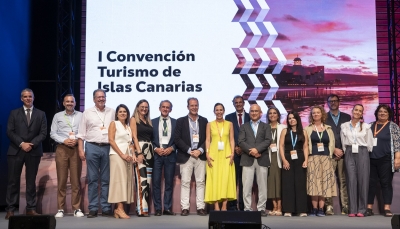
The Minister Jéssica de León was in charge of opening the convention, in which the Tourism team shared with more than a hundred agents of the sector the advances and strategies that it is implementing to achieve a more sustainable and competitive tourism.
De León explained that this convention responds to a demand from the public and private sector, who asked to “know the strategy of the Canary Islands destination, know what actions we are developing, or what are the connectivity forecasts mainly for the winter season.”
She also stressed that one of the main objectives of the event is to publicize “everything we are doing in terms of sustainability with different destinations such as El Hierro, which will be a zero-emission island by 2026.”
The Minister stressed that “the main challenge that the Canary Islands has is social”, and therefore called on the eight islands and the forty-six micro-destinations to unify the tourism strategy and place the Canarian resident at the center, with sustainability as a pillar in terms of promotion”.
Tool for companies
Precisely in terms of sustainability, there has been a great advance with the certification of the tool that Turismo de Islas Canarias offers free of charge to companies so that they can measure and reduce their carbon emissions.
The managing director of Turismo de Islas Canarias, José Juan Lorenzo, highlighted the importance of ‘Journey to Decarbonization’ having received the certification. “This implies that we are doing things correctly: by confirming that the calculation methodology, the emission factors and the tons of CO2 adapt to international standards, the rigor of the final data is strengthened and we transmit confidence and usefulness in the result to the companies that use it.”
Lorenzo announced that this quality seal will be added to the certificates that Turismo de Islas Canarias will in turn grant to the companies in the sector that measure and reduce their emissions, which will allow them to certify their commitment to sustainability to their customers.
Throughout October, November and December, five face-to-face and four online workshops will be held for companies interested in using the tool, and the II Journey to Decarbonization Meeting will be held on November 15.
For his part, Javier Lantigua, director of Aenor in the Canary Islands, Middle East & Africa, explained that the quality certificate “validates the tool that Canarian companies have at their disposal to measure and reduce their carbon footprint, giving veracity to the methodology that is used and thus demonstrating the leadership of the Canary Islands in sustainable tourism.”
Lantigua was convinced that with this step progress is being made in “the consolidation of the archipelago as a sustainable tourist destination and a world reference, which combines economic development with the protection of the environment and the improvement of the quality of life of all its inhabitants.”
Identity, digitization and data
At the beginning of the convention, José Juan Lorenzo explained the importance of the work carried out in Turismo de Islas Canarias. “All the actions we carry out pursue greater value for Canarian society and we will specify them in the revision of the Canarias Destino 2025-2027 Strategy, which will focus on three fundamental axes: citizenship, sustainability and competitiveness.”
The Marketing Director, Elena González, explained how the Islas Canarias brand has evolved. “We have incorporated elements that are relevant to the current era, values such as identity and sustainability are now placed at the center of its value proposition, but maintaining the essence of a caring brand, with an exceptional climate and with all the attributes of a destination close to the tourist all year round,” she said.
The Director of Product Promotion and Corporate Communication, Mónica Palacios, focused on how the communication strategy for 2024 is based on attracting a more responsible tourist, valuing the people who work in the sector and, above all, reaching the citizens more: “In our corporate social networks we disseminate truthful data, highlighting the industry and its professionals and even empowering them by sharing truthful and contrasted information.”
Regarding the social networks of the Canary Islands, the Director of Digital and Social Media, Sara Sánchez-Romo, recalled that around 6,000 communications are launched per year. “We work to remain in the minds of consumers and be notorious in practically all of Europe. Communication is bidirectional, it focuses on dialogue and interaction with our target audiences, hence we have a team of native ‘community managers’ who reside in the Canary Islands to maintain the necessary climate for the conversation between brand and client to take place.”
The second of the interventions, “The digital transformation process of the Canary Islands destination”, was led by Alicia García-Tuñón, Director of Technological Development and Information Technology, and Sara Sánchez-Romo, Director of Digital and Social Media.
Sánchez-Romo explained that “collaboration and shared data governance, whether between public entities or between public and private entities, has taken a key role in all the decisions that are made, radically transforming the way we had until now of understanding the digitization of the destination.”
For her part, García-Tuñón recalled that “the Digitization Plan establishes the need to build a destination platform, with an open and participatory governance model so that the Canary Islands has a more digitized and sustainable sector and, therefore, more sovereign in making its own decisions and more resilient to changes.” The platform consists of “a set of digital tools made available to the Canarian tourism sector, for free use, which will accompany it in its digitization process and in its decarbonization process,” she detailed.
Connectivity
María Guardiet, Director of Tourism Intelligence, Planning and Connectivity, spoke about the relevance of air connectivity and data analysis in the presentation ‘Connectivity and tourism intelligence’. Guardiet recalled that the islands are currently better connected than ever, with 54 airlines, 156 destinations, 443 connections and 775 routes.
“We work to maintain current connectivity and promote competition between airlines so that prices are competitive, as well as to diversify markets with new routes and attract flag airlines to attract a more premium audience,” she said.
In terms of tourism intelligence, Guardiet explained that Turismo de Islas Canarias carries out “the analysis of a large amount of data to convert it into relevant information for decision-making in the public company and to facilitate the work of those responsible for other institutions or tourism companies.”
The monitoring of the geopolitical and economic context worldwide, inbound tourism, tourist accommodation indicators, the tourist profile, the image of the Islas Canarias brand and the studies carried out ad-hoc for specific needs are the actions that are carried out.


