
The Governing Council has approved the draft law of the budgets of the Autonomous Community of the Canary Islands for 2023, which will amount to 10,180 million euros, 11.9% more than those of the current year, with social spending that will increase by 9.46%.
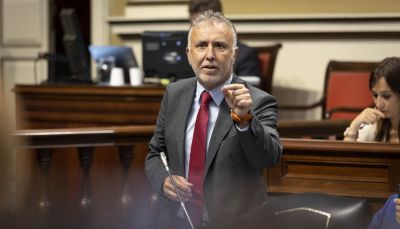
The accounts, presented by the President of the Canary Islands, Ángel Víctor Torres (PSOE), and the Vice President and Minister of Finance, Román Rodríguez (NC), take into account the fiscal adjustment, selective and temporary, which will be applied to 85% of the 954,000 taxpayers in the islands, who will benefit from an average saving of 105 euros, and which will have a cost to the regional coffers of 100 million euros.
This adjustment, which translates into an increase in current deductions and the extension of the first four regional tranches of the Personal Income Tax (tax on the income of natural persons) will have retroactive effect from January 1, 2022 and will be included in the next income tax campaign.
"These are expansive budgets" in a scenario of "uncertainties"
Chapters VI and VII of the budgets, those of real investments and capital transfers, will experience an increase of 27.1% to reach 1,746 million euros.
Román Rodríguez has indicated that these are "expansive budgets" that are inserted in a scenario of "uncertainties", although with the forecast of greater economic growth in the Canary Islands than in the rest of the country, from "prudence" and the perspective that "after 2023 comes 2024 and then 2025".
And he alluded to the "extraordinary effort" that has been made from the public sector by having increased the Government of the Canary Islands by 29.6% the budgets in the last four years, when the forecast is to close 2023 with a GDP 3.4% lower than 2019.
Regarding the fiscal adjustment, Rodríguez has stressed that it doubles the one approved by other autonomous communities, such as Madrid or Andalusia, with the difference that the Canary Islands "has not lowered or will lower taxes on the rich", which these other regions have done, he asserted.
The three fiscal measures approved in these budgets refer to an extraordinary deduction for the rise in prices, which will be 225 euros for gross salaries of up to 23,300 euros; of 175 for those of 28,700 and of 125 for those of 34,000 euros; to which will be added regional deductions in the Personal Income Tax 2022-2023 from which 35% of Canarian taxpayers will benefit.
In addition, for 95% of them, an extension of the regional tranches of the Personal Income Tax has been agreed.
This draft budget law includes an item of 160 million euros for the reconstruction of La Palma.
Canarian GDP growth of 1.3% is expected in 2023
Román Rodríguez has explained that the framework of macroeconomic forecasts on which this budget has been designed takes into account a pessimistic scenario regarding real GDP, whose growth is estimated at 1.3% for the next year, and another central one, according to which the unemployment rate will be 17.6% in October 2023 and inflation at 3.7%.
Regarding the impact of the escalation of prices on the regional administration, Rodríguez has said that the deviation of spending in this year's accounts could reach 500 million euros, an amount that the 2023 accounts "assume thanks to the increase in income, mainly state income"
The vice president stressed that in the period 2019-2022 public spending has increased by 28.4%, while tax revenues have grown by 16.4%.
During the legislature, spending per inhabitant has increased by 27.7% (from 3,692 to 4,685 euros), and investment per inhabitant by 25.8% (from 507 to 638 euros).
The budget for social policies has grown by 31.2% in the last four years, an increase that has been 63.3% in the case of investments and 90.82% in the case of support for productive sectors, which reveals, he said, "the true dimension of the commitment of the Government of the Canary Islands to the people and the economy".


