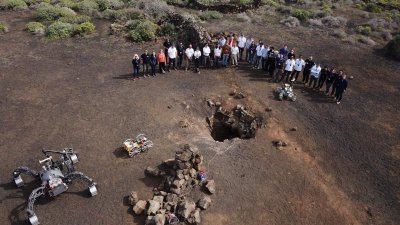
Lava tubes could be a refuge for humans at any given time, especially on space missions to other planets, but how do you ensure they are safe? A team of researchers has devised a robotic system that maps and recreates these underground volcanic networks in 3D.
The system, described this Wednesday in the journal Science Robotics, has been developed by a consortium of European researchers in which the Space Robotics Laboratory of the University of Malaga participates.
Its validation took place in a volcanic tube northeast of Lanzarote in 2023, explained in a telephone interview with EFE the researcher and professor of robotics at the University of Malaga, Carlos Pérez del Pulgar, one of the authors.
Remote places to explore
"The lava tubes of remote planets may contain valuable information about past geological events and the possible existence of life on other planets, as well as providing refuge for humans on planetary exploration missions," says Pérez del Pulgar.
Lava tubes have been identified on both the Moon and Mars, but the risky conditions there have prevented exploration missions with human astronauts.
To solve this danger for future explorations, the researchers have devised a system of three robots that cooperate to explore the lava tubes and map their environment and interior safely.
"These are three existing robots that we have adapted with the development of specific software that allows them to perform these joint exploration functions of the lava tubes," describes the researcher from the University of Malaga.
Sherpa, Luvmi and Coyote
The robots are SherpaTT, a large and resistant device that is the first to enter the tube and later pick up the others; LUVMI-X, a lightweight vehicle that performs 3D scans and transports small payloads; and Coyote III, specialized in navigating irregular systems.
SherpaTT and LUVMI-X perform autonomous navigation and mapping tasks, and Coyote III uses a ground-penetrating radar (GPR) for subsurface exploration.
Sherpa and Coyote were developed in two German research centers, while LUVMI is of Belgian manufacture.
The validation of the cooperation system in Lanzarote was done as follows, according to the Spanish researcher: "first, the SherpaTT and LUVMI-X robots cooperated to explore and map the area around the skylight of the volcanic tube, while Coyote III scanned it from the surface with the help of the GPR".
Next, LUVMI-X lowered a payload containing sensors into the light well, which allowed the 3D digital reconstruction of the area. Using this data, Coyote III rappelled into the lava tube from an optimal entry point while anchored and powered by SherpaTT.
Finally, Coyote III detached and explored the lava tube, collecting visual data that facilitated the detailed reconstruction of the map.
Hallmark in European missions
The Lanzarote volcanic tube was perfectly mapped and recreated thanks to the cooperation of robots and researchers.
"We are facing one of the first robotic systems described to explore lava tunnels," says Pérez del Pulgar.
He and his team are in close contact with researchers from the Geological and Mining Institute of Spain (IGME) to use the system in unexplored lava tubes, such as those that have recently opened after the last eruption on the island of La Palma, although the temperature conditions that still exist in them make it difficult at this time.
For now, these lava canyon explorer robots are developed to work on land, so they would have to be adapted in the future for a space mission, says the scientist from the University of Malaga.
The researchers' desire is to make that adaptation so that their robotic system is a hallmark in the European space exploration programs.



Add La Voz de Lanzarote as a preferred Google source.
Stay informed with the latest current news.