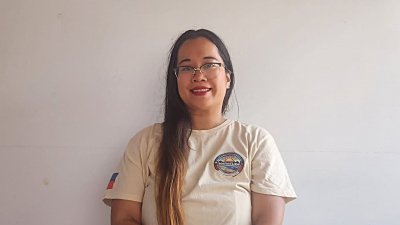
The president of the first Filipino association on the island, Reynali Bicaldo, was born in Lanzarote, but before that, her mother had emigrated to Castellón and her father to Saudi Arabia. When Reynali was 3 years old, they managed to reunite on the island.
In an interview with Ekonomus, Bicaldo explains how Maharlika aims to improve the integration of Filipino citizens in Lanzarote and ensure that the culture and customs of the Philippines are not lost among their descendants.
- How many Filipinos are there in Lanzarote? And in the Canary Islands as a whole?
The official data from the consulate in Las Palmas says there are approximately 500, but I would say there may be more who have not participated in the latest survey. It is estimated that there are about 4,500 Filipinos in the entire Canary Islands.
- What are Maharlika's objectives?
First, to improve integration, and second, to preserve the culture. Filipinos either integrate so much that they forget where they come from, or they integrate at work but not in other aspects.
There are children of Filipinos in Lanzarote who do not even know the language of the Philippines, nor where it is, or that it has more than 7,000 islands. And on the other hand, many people who may have been working for 20 years still only know a few words of Spanish because they only interact with Filipinos.
- Speaking of words in Spanish, Tagalog has taken many words from Spanish, hasn't it?
Yes, there are many, but perhaps with a slight variation, for example, 'mesa' (table) in Tagalog is 'lamesa' all together. We also say, for example, 'tenidor' for fork.
In the Philippines, the official language is Tagalog, in addition to English, but each province has its dialect. There is a small town where most of the vocabulary of its dialect is Spanish.
- English is more ingrained nowadays, isn't it?
After the Spanish colony, the Americans arrived, and today everyone in the Philippines speaks English. In fact, I think English is spoken more than Tagalog itself in the Philippines, which is also a shame. In schools and on television news, English is mainly used.
- How important is the maritime and island culture of the Canary Islands in the integration of Filipinos, who also come from an archipelago?
Very important, that's why they come, because it is similar to the Philippines in climate and the relationship with the sea. There are Filipinos in many places in Spain, but the Canary Islands are one of their favorite destinations.
- You were born in Lanzarote, but your parents are Filipino, what was their story until they landed on the island?
My mother arrived on the peninsula, in Castellón, and worked as a live-in nanny for a family that came to Lanzarote a lot for vacations. My father, on the other hand, went to Saudi Arabia, so they had a long-distance relationship by letter until my father could come here.
At home, we have always been raised with both cultures. In fact, I have spoken Tagalog since I was little. They have also tried to instill English in me, but I don't speak it as perfectly as, for example, one of my cousins who grew up in the Philippines would.
- Are you going to organize Tagalog and Spanish classes?
Yes, we would like those who do not know Tagalog to learn it, and for those who still do not have a good command of Spanish, to be able to master it and integrate much better.
- What activities are you planning for the coming months?
We would like to start with the children. As I mentioned, there are some who were born here and do not speak Tagalog or know Filipino culture. We are thinking of activities with typical games and with the basic words of the language.
- Are you going to offer legal advice?
Yes, I have a law degree, specializing in the area of Immigration. We want to help and ensure they have all the information, not just what their relatives provide. When you arrive in a new place, everything is chaos and you don't know where to start.
- How does the Lanzarote society receive Filipinos?
Very well. Here, the concept of a Filipino is a person who always has a smile on their face and is very humble and hardworking. They are received with open arms.
- What do they miss most about the Philippines?
Perhaps the food.
- Is there a Filipino restaurant in Lanzarote?
Nothing. Maharlika is the first official association in Lanzarote, but there are no Filipino food restaurants or bars on the island.
Filipinos do not usually set up businesses, and when they do, they have nothing to do with the Philippines. I think they are afraid of the fact that their culture is not well known, and they prefer to play it safe and open international or Spanish food restaurants in any case.
- Let's see if someone is encouraged to open a Filipino food restaurant...
Well, speaking of that. Precisely, my husband has a project to open a gastrobar with Filipino dishes in Playa Honda.
- And is your husband Filipino, Spanish, or both?
No, he is from here, 'conejero', 'conejero'.
- So in the end, is it going to have to be a 'conejero' who sets up a Filipino restaurant?
That's what he says. (Laughs). He is a cook and passionate about Asian food. Let's see if it comes out by September.

Add La Voz de Lanzarote as a preferred Google source.
Stay informed with the latest current news.