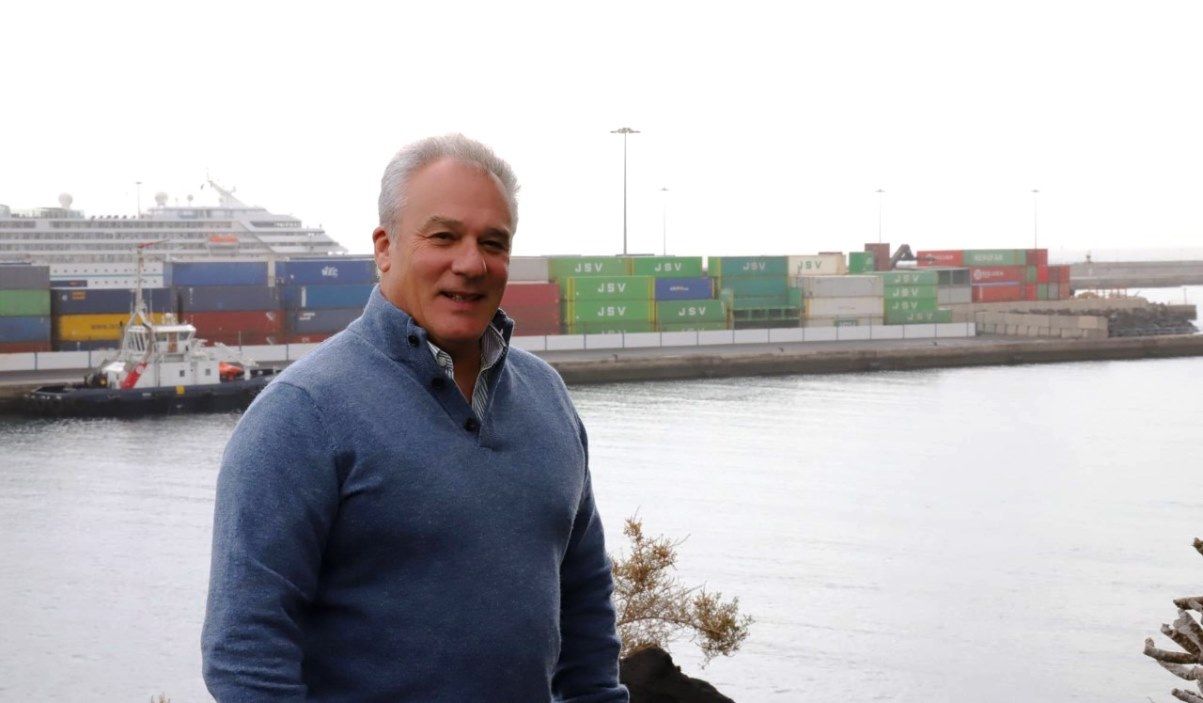
After the lockdown, goods are taking longer to arrive and transport costs have increased significantly. Can you explain this to us? Will it take long to return to the previous normality?
The increase in maritime freight rates originates from the Suez Canal incident, when the Ever Given ran aground in March of last year, although a sharp rise in prices had already been experienced during the lockdown.
According to OECD data, between February and June 2021, approximately 20% to 30% of cargo capacity has been canceled on the main commercial shipping lines, causing prices to skyrocket, especially on transoceanic routes.
International shipping companies have increased their freight rates by more than 300% in the midst of the COVID crisis and continue to increase them. For example, a forty-foot container from Ningbo (in China) to Arrecife used to cost 4,500 USD before COVID. During COVID, it rose to 15,500 USD, and we are currently paying around 15,800 USD. You even have to pay an extra 1,000 euros to get priority in boarding.
It will take quite some time to return to those numbers of 4,500 USD for a 40-foot container. To return to those prices, there would have to be an increase in the number of lines and sufficient empty equipment in the ports of embarkation.
For their part, traffic from the Peninsula to the Canary Islands has also been affected with approximate increases of 10%.
With air transport, in Lanzarote, we experienced an ordeal during the lockdown. There were days when we had no connections with Madrid to receive radiopharmaceuticals or send fresh fish, for example. Regardless of the Government decreeing minimum services, in some cases, they were not met. Obviously, during the pandemic, air freight rates increased, especially on international routes. As an example, a shipment from Lanzarote to Hong Kong, in the midst of the pandemic, had a cost of 10 euros per kilo, currently it is 6 € per kilo, but before COVID it was 3 € per kilo. Currently, there are still airlines that have not opened all their routes.
Are delays in the delivery of goods at customs becoming more pronounced?
Customs, like all state and regional bodies involved in the clearance of goods, were 100% involved during the pandemic.
For example, we have the case of masks, PPE, etc. Obviously, at the beginning, there was quite a bit of confusion with the organization of teleworking in one or another body. Currently, I have nothing to object to about its operation.
The delays that we read in the press or hear on the radio are those caused in parcel companies such as Correos, which I believe have not yet implemented the new customs regulations for low values.
Does the AIEM, Arbitration on Imports and Delivery of Goods in the Canary Islands, still make sense in the current context?
The AIEM is a direct tax that is applied to the entry of some goods into the Canary Islands, ranging from 5% to 15%. One of the arguments put forward by the Government of the Canary Islands is that its purpose is to increase the price of the imported product that competes with the local one. The fact is that there are products that are not manufactured in the Canary Islands and are taxed with the AIEM, or their production is quite limited to supply the Canarian market.
It is important to remember the importance of declaring the Cádiz - Arrecife line as a Public Service Obligation
How were the toughest days of the lockdown experienced in the transport of island goods? Are we recovering activity levels?
Like all service companies, we had a pretty bad time and with a lot of uncertainty, in addition to suffering a sudden stop overnight.
The sector came to take a little oxygen in mid-August. I don't think there were shortages, thanks to the public service obligation in maritime and air transport between the Islands. For this reason, it is important to remember the importance of declaring the Cádiz - Arrecife line and vice versa as a Public Service Obligation, which has been demanded for years.
Activity is currently recovering, although it is very subject to tourist flows. With all this, it has become clear once again that the companies of Lanzarote depend 90% on tourism.
With Brexit we need the animal B.I.C. urgently
In recent years, significant investments have been made in increasing the capacity and shelter of the port of Arrecife. Are there still needs to be met in the island's logistics field?
Of course, we still have needs to be met in our port, since the B.I.C. for goods of animal origin is still pending. So far we only have the plant B.I.C. in operation with great activity. But now with Brexit we need the animal B.I.C. urgently. And it is that when the United Kingdom leaves the European Union, all its goods are considered customs-wise as if it were a third non-community country. This demand of the B.I.C., since the 90s, is not a business whim, as some may think, it is a necessity of the island to maintain its commercial flows and serve English tourism, which is proportionally higher. They consume their products, therefore, the B.I.C. is necessary.
What are the main challenges facing your sector on the island?
As for many SMEs, the main challenge is globalization in our sector, due to the multinationals of logistics and transport. The companies in our sector will be able to compete with these multinationals by offering exclusive services to our clients, such as advice on foreign trade, regulatory advice on the different customs regimes, specialized transport, etc.


Add La Voz de Lanzarote as a preferred Google source.
Stay informed with the latest current news.