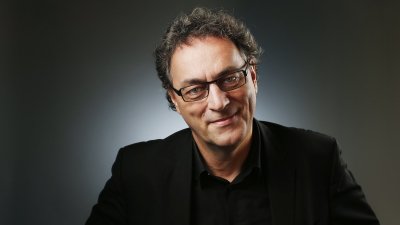
Gerd Leonhard was born in Bonn and resides in Zurich, but escapes to Las Breñas whenever he can. He was always interested in the future and does not forget the impression the first time he saw Blade Runner as a child. It was the music that catapulted him to fame, as he predicted the digital revolution of music.
After 20 albums and 15 years of touring, he decided to write 'The Future of Music', which became one of the best-selling books in numerous languages and in which he anticipated the digital revolution of music.
From there, some of the most important companies in the world called him to advise them on the future, and later, it was governments and international organizations such as the European Commission or the United Nations, which led him to focus on the major issues: climate change, pollution, energy, digitization, artificial intelligence and social justice, among others.
Prestigious international speaker and author of 5 books, Leonhard is considered by Wired magazine as one of the 100 most influential people in Europe and by the Wall Street Journal as one of the world's leading futurists. Among his differential features, his use of video and new technologies to transmit his messages stands out.
In an interview with Ekonomus, Leonhard explains the advantages that Lanzarote has to design a great future for its people and advocates for measures such as the energy revolution, the tourist tax and territorial sustainability.
- When did your passion for trying to envision the future begin?
I was always very interested, even as a child. I remember when I saw Blade Runner for the first time. As a musician, I was always interested in the future of music. In the mid-90s when the internet appeared, I had some investor friends, so we set up a series of companies to promote and sell music online. We were part of the first wave of Napster, Mp3.com... before Apple.
At that time it was difficult to market music on mobile phones, there were no iPhones yet. There were mp3 players, but the music industry did not dare to market music through them.
In the 90s I had 120 employees doing largely what Spotify does today, but with the dot-com crisis in 1999 and then 9/11, we had to close. The idea was good, but we had it too early, 10 years in advance.
- But it helped you write a book about the future of music...
Yes, that was in 2004, it took me two years to write it, The Future of Music, which became one of the best-selling books in the world. It inspired Spotify and many other companies, one of our main themes in the book was 'music as water'.
The difficult thing was to convince the record companies, which rejected the internet, they wanted to maintain their monopoly. But Apple arrived and created a device only for music, the ipod, and then the iphone, with the ability to have music on your phone easily, safely and cheaply, which managed to convince the record companies.
- And since then you have been predicting the future in many other fields...
People started contacting me, they called me a futurist and I didn't really know what that word meant, I had simply written a book about the future of music.
Record companies, then film producers, advertising companies, publishers, media... asked me for help. For this I created The Futures Agency, a job that ended with the pandemic. Now I don't dedicate myself to business issues, but to global issues such as climate change, artificial intelligence, democracy, energy...
- What is your relationship with Lanzarote?
We had been coming on vacation for 20 years until we decided to buy a house in Las Breñas, where we have friends and where all the Germans of Lanzarote live (laughs).
Las Breñas is a beautiful and quiet place, with a very good climate, so we decided to buy a house to come more often and even have an office here.
- Would you like to work for the governments of the island and the Canary Islands?
When we were considering moving to the island, I did a lot of research on Lanzarote and its future, so I would like to work for the island.
I have worked for several governments such as Singapore, Denmark or Switzerland, also the European Commission and the United Nations. Governments have complex problems so they allowed me to focus on the big issues.
I think there is no one in Lanzarote, the Canary Islands or Spain who has taken the lead to think about the future. There are Americans who do this or Yuval Harari for example, but not here.
- César Manrique was a great visionary about the future of the island
Yes, and I think there is a great movement to maintain the figure of César Manrique, but there is no new Manrique. I think that if Lanzarote wants to be in a good position in ten, fifteen or twenty years, some things have to happen.
- Deadlines are getting shorter and shorter...
Now everything moves at great speed. The world will change more in the next 10 years than in the previous hundred years.
That is why we have to understand that the future is not science fiction, but it is here and we are not paying attention to it.
In the fight against climate change we need emergency decisions and more decisive messages to citizens and businesses
- You advocate for making radical decisions, for example on climate change...
In the fight against climate change we need emergency decisions and more decisive messages to citizens and businesses. It is possible that in 20 years we will see significant changes in the ocean, and also in the haze, which will become more and more frequent.
And the other big problem will be climate refugees. It will be impossible to live in North Africa if everything stays the same.
In Lanzarote we cannot change the climate, which is a global issue, but we can prepare ourselves with immediate decisions on smaller issues such as the type of energy we use.
- Are you in favor of introducing a tourist tax in Lanzarote?
Absolutely. Some of the measures against climate change do not cost money, such as banning the sale of plastic bags, but others do need funding.
The tourist tax should be proportional to the budget of the visit so that the rich pay more. The rich of the world, 10% of the population, are responsible for 85% of the pollution.
I am working with a German airline to implement a mandatory fee for frequent flyers so that the more you fly, the more you pay, the tourist tax would be the same.
Lanzarote has a perfect size and a historical reputation for being different and sustainable
- How can governments introduce unpopular measures now, but that are good for the future?
You have to explain the situation and create a good narrative. If you say that we are going to be the leading island in sustainability, in social justice, in digital innovation... if you say that is the goal and give it a name and a date, then you have a story.
- In order to improve the housing problem, would it be good to prevent the construction of more hotels or the granting of more vacation licenses?
I think everyone who builds, particularly those who build hotels, should pay what it really costs.
The true cost of building a hotel includes its impact on the climate, water, energy and the social cost of those who work there and where they are going to stay. Perhaps hotels should build the accommodation for their workers.
- How long do you think it would take for the island, for example, to have 100% of its energy from renewables?
In 5 or 6 years it could be achieved. But it is primarily a political and budgetary issue.
Lanzarote has a perfect size and a historical reputation for being different and sustainable to resume work in that regard.
- Social justice is another of the major issues that stands out for the future...
Yes, making it possible for the local population to balance the growth of prices with the growth of their income.
To improve their income, we must focus on education and digitization. More than university degrees, I think more technical certificates are needed to develop specific skills, for example in digital marketing or sustainable tourism, everyone is doing it, Canada, Finland...
- Precisely another great axis that stands out for the future is digitization...
Society has to digitize to compete. It is necessary for young people to learn programming and understand artificial intelligence. In half a year or a year they can train, it is not difficult, it is not necessary to go to Madrid either. It can be done here. And if they speak English, they can work for international companies from here.
In addition, an innovation center could be created. Arrecife, for example, could create a tax-free digital zone, without paying rent for two years and with free high-speed internet to attract international companies to the island. It has been done in Thessaloniki, in Greece, where there are already 5,000 people working for digital companies who previously had no employment.
- You propose creating an annual event in Lanzarote about the future...
Yes, I call it the Good Future Congress. It would be an annual event, a mixture between Burning Man and Davos, which includes nature, culture, art and above all, discussions about the future. It could include several days, one or two focused on Lanzarote, the Canary Islands and Spain and two others that are international.

Add La Voz de Lanzarote as a preferred Google source.
Stay informed with the latest current news.