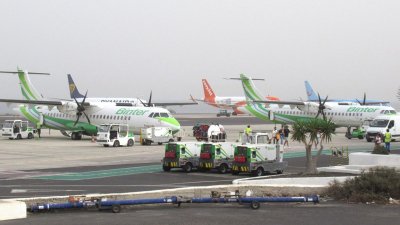
The Government of Canary Islands aims to promote the generation of sustainable aviation fuel (SAF in its international acronym) of second generation, using only waste materials as raw material, in an initiative that would be pioneering in Spain if it comes to fruition in the medium term, as announced this Thursday.
The production of an SAF with these characteristics would turn the Canary Islands into "the spearhead of the development of this technology in Spain", where there are already companies that make this kind of biodiesel in some parts of the peninsular territory but without using waste as a base, said the director of Public Policies of the Ecology and Development Foundation Ecodes, Mario Rodríguez de Pargas.
Ecodes, in fact, monitors the purposes of the Canary Islands Government, from the conviction that promoting the generation of recycled aviation fuel from waste substances "is a challenge" that they value in this foundation, among whose aims is "to foster a sustainable energy model based on improving energy efficiency and consuming energy from renewable sources".
The reason is that making this idea a reality would be "a fundamental advance" for the air and tourism sectors, for the archipelago and for all of Spain, as it would imply developing "an entire value chain" with repercussions, furthermore, in the industrial, employment, and innovation fields, argued Rodríguez de Pargas.
This Ecodes executive spoke about this issue within the framework of a visit to Las Palmas de Gran Canaria to attend a meeting between SAF producers and demanders convened by the Canary Islands Government in order to debate the viability of its purposes to generate this fuel in the islands.
There are several reasons, since, firstly, in the medium-long term, it will be necessary to have a sufficient supply of SAF, which is sought to progressively replace the kerosene traditionally used in aviation, an indispensable sector in the region for external communications, the supply of goods, and the sustenance of its largest economic sector, tourism.
The Deputy Minister of Ecological Transition of the Government of the Canary Islands, Julieta Schallenberg, leading the meeting, pointed out that there are other reasons for wanting to produce it in the territory itself, highlighting that one is that in the archipelago "we need to have more fuels of endogenous origin, which make us less vulnerable to situations like the one we are experiencing today geopolitically, where the price of oil has skyrocketed".
The current situation makes it clear that conflicts or problems, in principle, remote, can create "a situation of great vulnerability and fragility, as islands that we are, ultraperipheral and dependent on fuels and aviation for the engine of our main economy, which continues to be tourism", stated the deputy minister.
The commitment to generate a "second-generation SAF, from waste" is due, on the other hand, to the fact that those intended to be developed "are more experimental technologies, more innovative, but with enormous development potential that, furthermore, would solve two problems", she said.
Julieta Schallenberg explained that, if the project goes ahead, it would solve "not only the problem of being able to have these sustainable planes arriving in the Canary Islands, but also the problem of the waste we currently have, with overflowing landfills, and to which we have to find a solution".
The deputy minister clarified, in any case, that the idea is "still at a very initial stage, an incipient stage", in which work is being done to define how to face the challenge that putting it into practice would entail.
The regional head of Ecological Transition detailed that, for now, two meetings have been convened to analyze the viability of the project, the second one this Thursday, because from the Government "we are logically seeking complicity with those who know how to do it", the companies that already produce SAF in Spain, "but we are also seeking that complicity with the Canarian business community".
Schallenberg wishes that Canarian companies be "part of this business, of these facilities, of this work, of this job creation" that its achievement would entail, she pointed out.


Add La Voz de Lanzarote as a preferred Google source.
Stay informed with the latest current news.