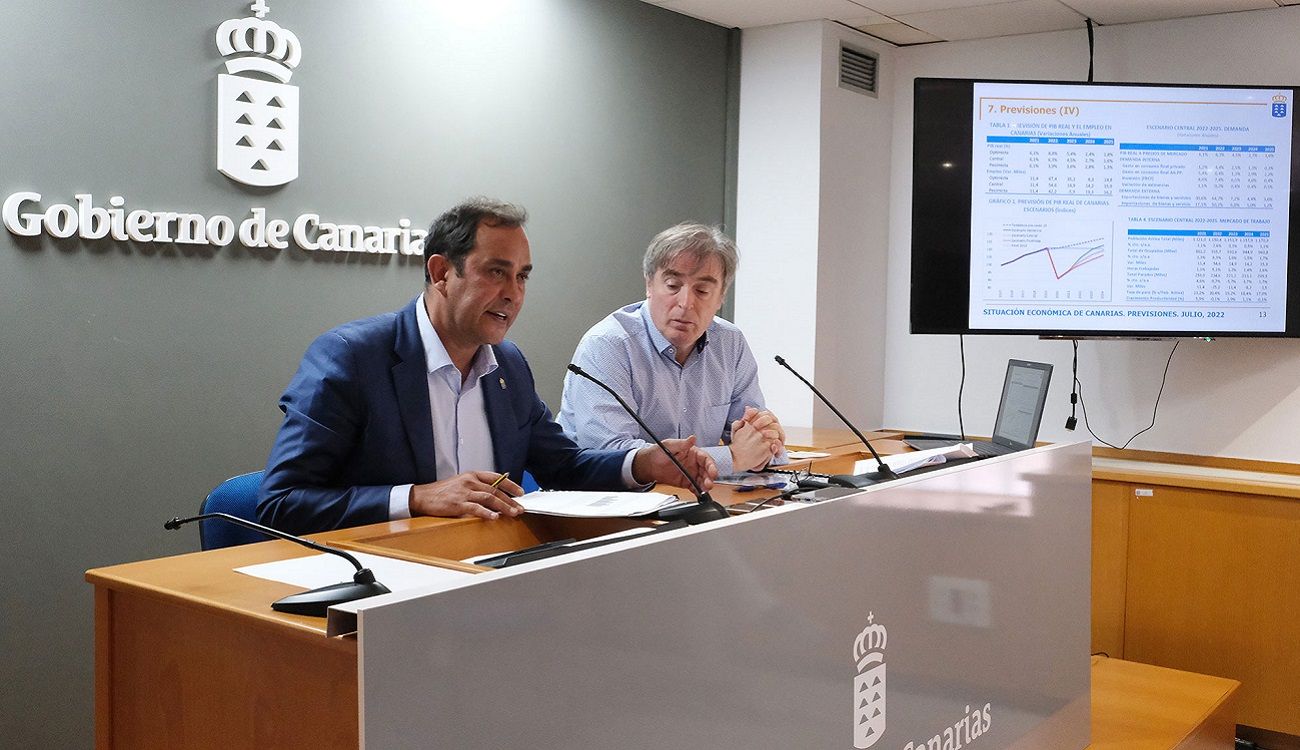
The economy of the Canary Islands could close the year with a growth of 6.3% in a central scenario, while state forecasts, yet to be revised, place the state average at 4.3%. This was stated by the Deputy Minister of Economy and Internationalization of the Government of the Canary Islands, Blas Acosta, during the presentation last Friday of the quarterly report on the evolution of the archipelago's economy and the forecasts of his department for the coming years.
“We can make a moderately optimistic forecast, because so far almost all the economic indicators of the Canary Islands are showing improving trends,” Acosta said during his speech, in a context of great uncertainty at a global level.
To reinforce his argument, the Deputy Minister recalled that, with the data already recorded, “the average growth of the Gross Domestic Product of all the Autonomous Communities in the first quarter of the year was 6.3% at the state level, while the Canary Islands stood at 12.2%, almost double.”
The key factor: Tourism
As an explanation for this difference, Acosta indicated that the economic structure of the Canary Islands, highly dependent on tourism, meant that it was the autonomous community with the largest drop in the year of confinements and border closures, “but that same characteristic, with a tourism sector that will now approach 2019 levels, together with the effect of coming from a greater decline than the others, means that, as a percentage, our growth is expected to be significantly greater.”
The economic forecast of the economic department of the Government of the Canary Islands starts from a previous analysis of the evolution registered in the first semester of the year, with positive indicators in almost all areas, which consolidate the recovery already observed from the second quarter of 2021.
Thus, electricity demand maintains its upward trend, despite being one of the most inflationary sectors, which indicates that "economic activity continues to increase despite inflation", Acosta pointed out.
On the other hand, until May of this year, 5,560,053 tourists entered the Canary Islands, which is 'only' 13% less than in the same period of 2019 and occupancy forecasts indicate that 71.5% of the total hotel accommodation capacity will be reached in the third quarter of the year, which is a figure very similar to that of 2019. “And more important than the volume of tourists is the expenditure they make,” -Acosta nuanced- “which in the first quarter of the year was already 3.5% higher than in the same period of 2019.”
Other influencing factors
As other indicators, the Deputy Minister listed the Consumer Confidence Index, which stood at 82.5% in the first quarter, less than 5% below 2019; vehicle registrations, which have increased by 44.4% annually; retail sales, which, in May, had grown by 9.4%, compared to May 2021; or business confidence which, for the third quarter of the year, is higher than in 2019.
According to the Deputy Minister's explanations, all these factors “have a clear reflection“ in the labor market. In this case, he compared the figures with those registered in February 2020, just before the confinement due to Covid. Since then, and after an intense drop in employment, “sustained in good part thanks to the Erte”, the number of affiliation to Social Security has risen by 26,521 people, “and today there are more people working in the Canary Islands than ever before”. As for registered unemployment, the islands fell below 200,000 people since April “and the figure has continued to decline”, so that today there are 8.5% fewer people registered in employment offices than before the pandemic.
As a negative indicator, Blas Acosta pointed out the “strong escalation of prices, which has a global impact and that provides very high doses of uncertainty, which force us to be cautious in forecasts and consider different scenarios, depending on the multiple factors that come into play, such as monetary policy, the evolution of the war in Ukraine, the evolution of energy supply and especially Russian gas to the countries that are the main issuers of tourists to the Canary Islands, etcetera.”
Three possible scenarios
Although the central scenario is considered the most likely, the combination of all the factors listed means that two other scenarios must be considered: an optimistic one, in which the economy would grow much more than initially indicated, and a pessimistic one, in which the economic recovery would be much more contained.
According to the latest update of the economic forecasts of the Vice-Ministry of Economy and Internationalization, the scenarios show a range of growth of the Canary GDP in 2022 of between 3.9% and 8.8%, and between 3.6% and 5.4% in 2023, so that, in the optimistic scenario, the islands would already be close to the 2019 GDP level in 2023, while, in the pessimistic one, that figure would not be achieved until more than two years later.
“What we are presenting today are the forecasts for the evolution of the Canary economy, which are positive in all scenarios, which does not mean that we are currently in an optimal situation, but that we must continue working to support that recovery and to implement policies that allow all the people who live on the islands to benefit from that trend towards improvement that we foresee,” concluded the Deputy Minister.



Add La Voz de Lanzarote as a preferred Google source.
Stay informed with the latest current news.