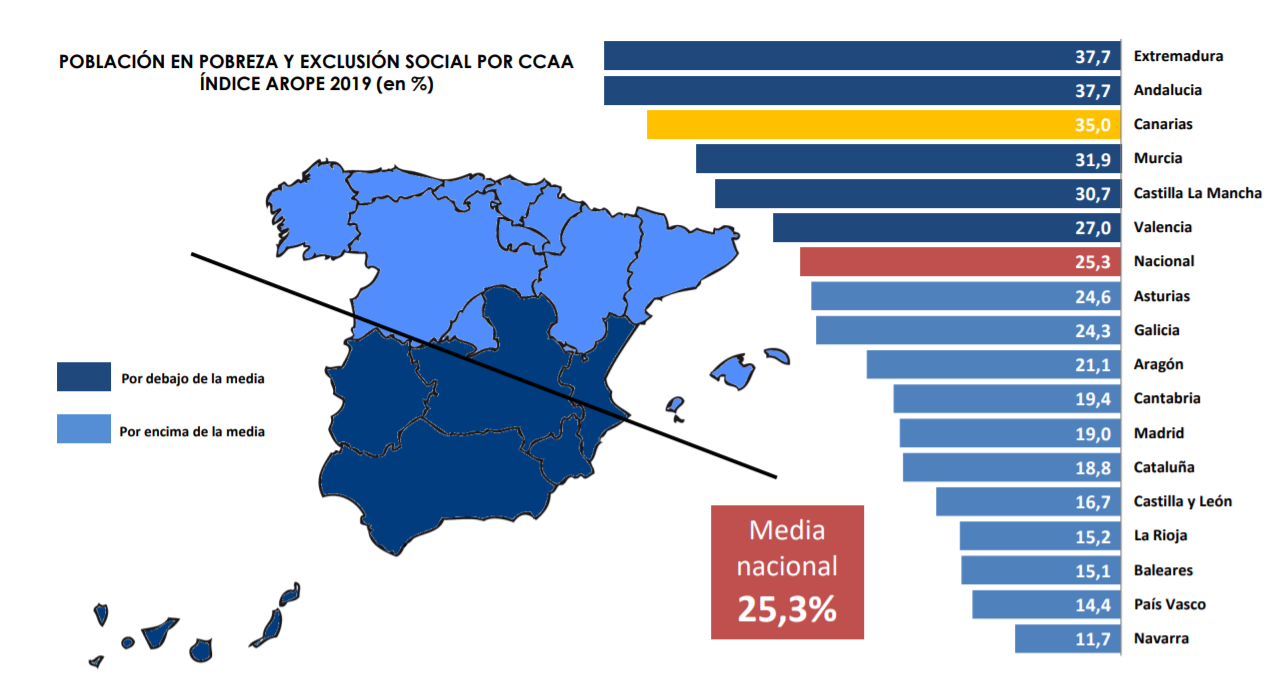
According to data from the report that has just been published on 'The State of Poverty. Monitoring the poverty and social exclusion indicator in Spain 2008-2019', 35% of the population of the Canary Islands, some 773,000 people, were already at risk of poverty and/or social exclusion a year ago. The data thus corresponds to the past year, so it does not include the consequences of the Covid-19 pandemic on the archipelago.
These figures, which among other things do not reflect the increase in unemployment registered in the Canary Islands in recent months, already placed the archipelago 10 points above the national average, set at 25.3% (11,870,000 people), and with the third highest AROPE percentage, only ahead of Extremadura and Andalusia.
In relation to the Poverty Risk Rate, the threshold for the Canary Islands is set at 641 euros per month and the data reflects that 28.5% of the population lived on less than this amount, which represents an increase of 2.6 percentage points compared to 2018. This means that in 2019 there were about 628,282 people at risk of poverty in the Canary Islands, 53,718 less than the previous year.
Likewise, 11.2% of the population, or what is the same, some 247,378 people, lived on less than 500 euros per month, which is the threshold set for the severe poverty rate, which, in this case, has increased by two points compared to 2018.
53.7% of the population, with difficulties to make ends meet
Similarly, the report reflects that around 86,000 people, 3.9% of the Canarian population, lived in conditions of severe material deprivation. These are people who cannot afford a healthy meal at least every two days, who cannot keep their homes at an adequate temperature, who do not have the capacity to cope with unforeseen expenses, who have had delays in paying housing-related expenses and who cannot afford to have a personal computer.
The report also expresses how around 53.7% of the Canarian population had some kind of difficulty in making ends meet. In addition, it is pointed out that this situation has been registered and aggravated mainly among the groups that already experienced greater difficulty in making ends meet or facing unforeseen expenses.
In addition, the data reflect that 14.8% of the population under 60 years of age residing in the Canary Islands lived in households with Low Work Intensity, that is, in households where members of working age worked less than 20% of their work potential in the year. The figure represents some 249,291 people, is four points higher than the national average and the fourth highest of all the autonomous communities, only surpassed by Andalusia, Melilla and Ceuta. In addition, this rate has increased since 2008 by 5.5 points.
At the state level, the poverty rate among people with work stands out, which has remained static since 2014 at around 14%, which is considered to "demonstrate the limitations of unemployment protection and the restrictions of the current welfare state". Regarding salaries, it is pointed out that the average income in the Canary Islands in 2019 was 9,486 euros per person, 2,194 euros lower than the national average.
"This Government has not needed to know this data to start working"
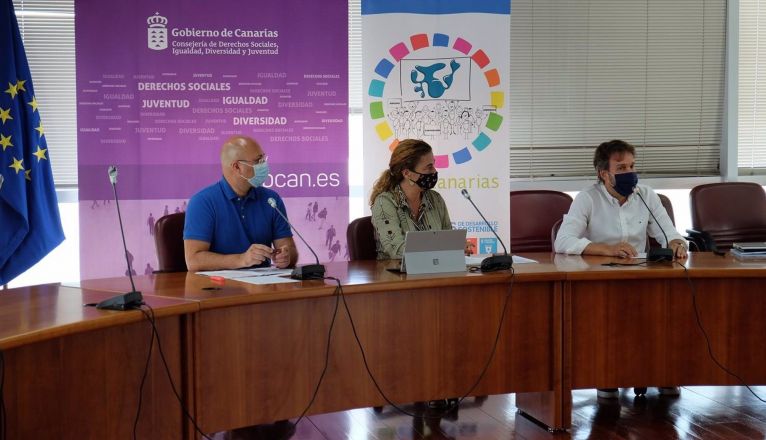
During a press conference, the Deputy Minister of Social Rights, Gemma Martínez, stressed that "we still cannot speak with data of the consequences that the current situation of social and economic crisis caused by Covid-19 will bring us, but this Government has not needed to know this data to start working and articulate a whole battery of protection measures for the most vulnerable people".
In this way, she stated that in the islands unemployment and poverty are "structural", so they need a set of both social and economic actions. "Since we took over the Ministry of Social Rights -she continued- we have been approving a whole series of measures in order to alleviate a situation that was already complicated before the health crisis".
Here, the Deputy Minister highlighted the modification of the Canarian Insertion Benefit to include families with dependent children; the approval of the Canarian Insertion Income through which an economic cushion has been granted to more than 16,000 families and the promotion of the Citizen Income Law project, which will reach Parliament at the end of the month.
For its part, the data from this tenth Report show that Spain "is very far" from fulfilling its part of the commitment to reduce poverty assumed in the Europe 2020 Strategy, which specified a reduction of 1.5 million people at risk of poverty and/or social exclusion (AROPE rate) on the data of 2008, "and that should be reached no later than 2020".
"The situation of poverty in the Canary Islands is going to become even more fragile", said the president of EAPN-Canarias, Juan Carlos Lorenzo, referring to the current macroeconomic data, according to which the Consumer Price Index (CPI) in the Archipelago has increased by 0.4%, especially in food, footwear and alcoholic beverages. "All this translates into an accentuation of the profiles of families who are in a situation of social exclusion and poverty or at risk of suffering it", he added.


Add La Voz de Lanzarote as a preferred Google source.
Stay informed with the latest current news.