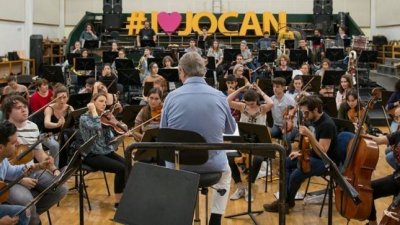
Barely 6 hours after the New Year's chimes ring, the long-awaited notes of the New Year's concert by the Joven Orquesta de Canarias (JOCAN) will begin to sound. It will be on January 1 at the Teatro Guimerá in Santa Cruz de Tenerife, where its new symphonic tour will begin, at 6:00 p.m., with nearly 100 musicians on stage. On Thursday the 2nd (8:30 p.m.) they will be at the Alfredo Kraus in Las Palmas de Gran Canaria, on Friday the 3rd (8:30 p.m.) at the Fuerteventura Congress Palace, and on Saturday the 4th (9:00 p.m.) at the Santo Domingo Convent in Teguise, in Lanzarote.
Organized by the Culture area of the Government of the Canary Islands and with the artistic direction of Víctor Pablo Pérez, the young ensemble presents itself again to the public with a repertoire that revisits the fascination with the Canary Islands and Spain, with a journey from our Islands to how others believed Spain sounded. Thus, the concert begins with the 'Sorondongo', a popular melody arranged by Peter Hope; they will continue with the 'Spanish Symphony' by Édouard Lalo; the 'Cervantina' by Juan Durán; and as a grand finale, the 'Bolero' by Maurice Ravel.
The Deputy Minister of Culture, Juan Márquez, was present at the first joint rehearsal of the ensemble, after having dedicated the previous days to rehearsals by instrumental sections. In his opinion, "it will undoubtedly be a new opportunity to once again enjoy the virtuosity of these young Canarian musicians, but now with a demonstrated solidity after more than 50 concerts offered since its creation four years ago." Márquez encouraged the public to attend this concert that "unites young people from all the islands, turning music into a bridge and a barrier-free Canary Islands, making it a good way to start the year."
For his part, Víctor Pablo Pérez pointed out that on this occasion they are presenting a "very beautiful, very New Year's program, with four works, all with a Spanish air, atmosphere, and scent." According to him, "just listening to Ravel's 'Bolero' makes it interesting to go to a concert, but we also have the 'Spanish Symphony', which is like a concerto for violin and orchestra, which is fantastic; and an orchestrated 'Sorondongo', wonderful, very fresh and cheerful, in addition to another piece with music and themes from the time of Cervantes, so it's a journey through Spanish music from the national but also French point of view.'
The price to enjoy these concerts will be 8 euros in the two capital islands, 2 euros in Fuerteventura, and free in Lanzarote. Likewise, a special rate has been enabled for students and the unemployed, amounting to 3 euros in Tenerife and Gran Canaria and 1 euro in Fuerteventura, available only at the box office two hours before the function begins.
Tickets can be purchased on the websites of the spaces hosting the concerts and at www.entrees.es. In the case of Lanzarote, invitations can be picked up at the House of Culture of the Teguise City Council and at the Tourist Office in the same town.
Program
The program that JOCAN will offer on this occasion pays attention to the interpretation of Spanish music from other points of view and at different moments in history. These are works that revisit the fascination with the Canary Islands and Spain as sound spaces that open up the possibilities of traditional European language and imagery. The concert is presented, thus, as a journey from our islands to how others believed Spain sounded. The first stop is the 'Sorondongo', typical of Lanzarote, which, arranged by Hope, allows the public to explore its timbral and rhythmic potential.
'La Cervantina', by Durán, is a suite that unites themes that are already part of the sound identity of our country and that will make us reflect on what our possible "soundtrack" would be, while the 'Spanish Symphony', by Lalo, and the Bolero by Ravel, for their part, show the idealization of the Spanish world from the perspective beyond our borders. Precisely Ravel's work allows for an individual and collective display of the musicians and will allow us to verify once again the great level of these young performers.
Accompanying the ensemble, as a guest soloist -in Lalo's work- is the French violinist of Russian origin Alexandra Soumm, a virtuous and precocious musician who gave her first concert on stage at the age of 7. Since then, she has had a long musical career, in addition to being passionate about teaching and communicating her art, with her master classes being highly recognized in many countries around the world. She is a multifaceted artist who, as a young violinist, has collaborated with several of the most prominent international orchestras. She is also a strong advocate for new generations of musicians. She currently plays a Gioffredo Cappa made in the year 1700.
With these new concerts, JOCAN will have already exceeded fifty appearances before the public, most of them on tours on stages in the Islands, but also in several of the most important auditoriums in China, on a tour organized by a producer from the Asian country.
But it will be the first time that they face a program with an instrumental mass integrated by 97 musicians, which is why they require large-scale scenic spaces. To prepare for this tour, the members of JOCAN, many of whom are completing their studies outside the Islands, will concentrate in the last days of December in Tenerife, where they will carry out individual and sectional rehearsals under the guidance of 14 guest professors, "of the best that are currently working with young people," according to the director Víctor Pablo.

Add La Voz de Lanzarote as a preferred Google source.
Stay informed with the latest current news.