
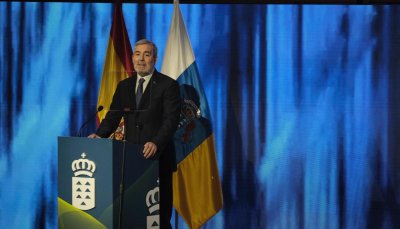
The president of the Canary Islands, Fernando Clavijo, considers that "short-term maneuvering, the search for narrative over results, constant bickering, and a lack of substance in management have become the norm, and it is impossible to move forward like this".
During the institutional event to mark Canary Islands Day, Clavijo assured that "the political crisis situation in Spain does not exactly contribute to giving stability and certainty to our land".
In his opinion, "the events experienced recently certify that this is not going to change", which is why "it falls to us, once again, to defend ourselves alone and demand the respect that our people deserve".
The Canarian president has demanded "respect for the Canary Islands" and has called on the entire archipelago to demand it "with pride and without complexes".
"Our greatest heritage," according to Clavijo, "is not only in the history that precedes us, but in our capacity to continue building a more just and stronger land together".
Likewise, he has defended "a Canary Islands that does not resign itself to being a periphery of anyone", a Canary Islands that will extend its hand "whenever it finds respect in front of it", but which will not tolerate "pushes and impositions".
Because "the Canary Islands know what it is and does not need anyone to tell it. It is a solidary land that does not allow lessons from outside, because it decided long ago to speak for itself. A land that asks for respect, that does not admit impositions, and that knows that its present and its future must be decided here," Clavijo emphasized during his speech.
In his opinion, "the Canary Islands have advanced when they have been clear about their place, when they have defended their accent, when they have protected their symbols, when they have looked at the world without complexes, and when they have understood that our identity is not a nostalgia, but a strength".
Clavijo considers it especially important that the Canary Islands defend this unique voice in "a complex time" that the islands must face with "more unity, more responsibility, and more self-confidence".
He believes that "we are navigating an ocean where clear signals are being sent to us that announce storms. And it would be irresponsible not to prepare ourselves to overcome them," because "every international crisis, every war, every tension in the markets, every decision made far from our islands has very concrete consequences in the daily lives of our people".
Thus, he pointed out that "the events experienced in this first quarter of the century confront us with the evidence that the world is undergoing gigantic paradigm shifts. Major community policies for social cohesion and aid to productive sectors are threatened by cuts derived from other priorities".
And in the face of these challenges, "we cannot afford to be naive. Neither in Europe nor in Spain".
He also warned that the Canary Islands have a lot at stake in the negotiation of the EU's new Multiannual Financial Framework.
"We are risking Europe continuing to understand that the Canary Islands do not ask for privileges, but for justice; that being an outermost region is not an administrative label, but a daily reality that affects the cost of producing, transporting, living, and competing from islands located in the middle of the Atlantic," he highlighted, and called for unity to face this challenge.
In his speech at the institutional event for Canary Islands Day, the president also focused his message on highlighting the strong roots of Canarian identity in the archipelago's youth.
It is, he stated, "an identity that changes form with each generation but continues to say the same thing: here is a people that recognizes itself, that loves itself, and that wants to continue being the master of its destiny".
Clavijo pointed out that, "for a long time," the islands' identity "was transmitted in homes, in squares, in pilgrimages, in songs, and in the stories that were written".
However, "today our young people sing, write, and create with other codes; with another language, with other rhythms, and with another way of being in the world, but they feel the Canary Islands with an intensity that is not so different from that of previous generations".
The president believes that this "strength" of Canarian identity is manifested in the new generations of the archipelago "when they defend their accent, when they speak and write about their island, their neighborhood, their street, when they recognize themselves in their symbols, or when they become indignant because they feel that this land is not respected or is not being cared for as it should be".
For Clavijo, "this living identity shows us that the Canary Islands continue to speak to themselves. That our young people have not broken the thread. And that is one of the greatest challenges we have as a society: to ensure that what we inherit does not become a heavy obligation for those who come after, but something they can feel is their own".
However, he warns that this "pride in the Canary Islands" should not lead to complacency, and that "a land is truly loved when it is looked at completely, not only when what goes well is celebrated. The Canary Islands have reasons to be proud, of course, but they also have challenges that we cannot ignore."
Add La Voz de Lanzarote as a preferred Google source.
Stay informed with the latest current news.


