
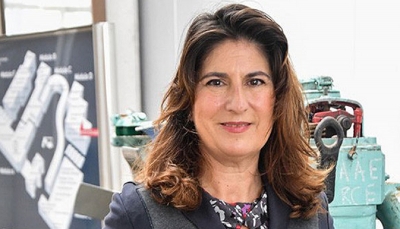
The Deputy Minister of Ecological Transition of the Government of the Canary Islands, Julieta Schallenberg, has assured this Wednesday that the Canary Islands meets the requirements to host the first floating offshore wind farms in Spain, a development that will begin in the Port of Las Palmas, in Gran Canaria.
To this end, the president of the Canary Islands Federation of Port Companies (Fedeport), José Juan Socas, explained in statements to the media the role that the 'Blue Supply Chain' project will play, which seeks to "add value" so that the Canary Islands territories are at the forefront of the implementation of offshore wind power with institutional support that offers "strength" to Canary Islands entrepreneurs in their preparation to "be leaders" in marine renewable energies.
Socas has conveyed that offshore wind power "is the present of port activity" and that the Canary Islands "must be in the starting line" and have trained personnel and infrastructure for development, a start-up that will require a space that the president of the Port Authority of Las Palmas, Beatriz Calzada, has estimated at 118 hectares that will be allocated to offshore wind power.
Calzada has announced that they are in administrative processes for the adaptation and provision of these spaces and has admitted that the role of the Port Authority should be "to provide logistical support and provide infrastructure to Canary Islands companies" so that the Port of La Luz and Las Palmas "is a benchmark in offshore wind power."
He also warned that "if the Government of Spain does not change its strategy," it will be the Canary Islands that will make the first development of offshore wind power in Gran Canaria and has praised the role of the 'Blue Supply Chain' project in the generation of economy, quality work, professionalization in the sector and the good path towards decarbonization in the Canary Islands.
Schallenberg also highlighted that two tenders will soon be launched to characterize the areas of the Maritime Space Management Plans (POEM) of Gran Canaria and Tenerife to "be able to have a detailed picture" of what exists in the funds and resources of the perimeter delimited for offshore wind projects.
Socas has announced that in the coming days the calendar and actions to be developed of the Blue Supply Chain project will be established, the only one of the 34 approved within the framework of the 'Interreg MAC 2021-2027 Program' of the European Union, although he has avoided setting dates for the start of activity in the islands because "they are waiting for resolutions from the State."
The Councilor for the Environment, Climate, Energy and Knowledge Area of the Cabildo of Gran Canaria, Raúl García Brink, has guaranteed "the clear and clear commitment" for Gran Canaria to host the first floating offshore wind farm in Spain and that this will make the transfer of knowledge and "the impact of offshore wind power on the blue economy" a reality.
For his part, the director of the Port Authority of Tenerife, Pablo Nieto, has also guaranteed that the island of Tenerife "will be prepared" for when the activity lands in the Canary Islands and has assured that "works are already being carried out" in the Port of Granadilla destined to host the offshore energy activity.


