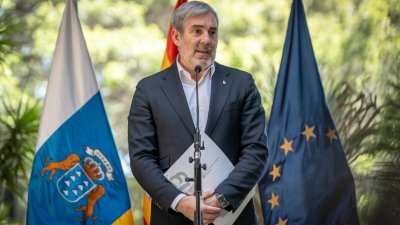
The President of the Canary Islands, Fernando Clavijo, described this Tuesday as a “triumph for the entire Canarian society” the approval in the Council of Ministers of the decree law for the mandatory distribution of unaccompanied migrant minors through the modification of article 35 of the Immigration Law. Clavijo considers this “important step” an achievement of the unity and joint work carried out in the Canary Islands so that the State has attended to this demand.
In a press conference to assess the approval of the decree law, the head of the Government assured that it is “a happy day” for the archipelago and for the entire country, because a step is taken “that they told us was impossible” for which the Canary Islands have been fighting for 18 months. “We have always had the no ahead, but we have achieved it knowing that we were right. Today what was not possible in 30 years is possible and we have achieved it as a society as a whole”, he said.
Clavijo has attributed the approval of this decree law to the joint work carried out from the Canary Islands to ensure that the State was open to legislative change. “The first thing was always a no”, he recalled, adding that it has been the autonomous Government that has had to do the task by drafting the legislative texts, looking for solutions when negotiations have stalled and “even collecting political support with everyone in the world and at all times”.
“I want to vindicate the usefulness of politics. The importance of putting the general interest above the particular and the permanent clash”, he highlighted on a day “very important for the Canary Islands” because Spain responds “as a country” to a demand from the autonomous Government in the face of the limit situation of the reception system for migrant minors on the islands.
Fernando Clavijo highlighted that Canary Islands “once again” has lived up to expectations giving an example of “unity, solidarity and coexistence” in defense of the best interests of the minor and the rights of migrant boys and girls who he protects. In this sense, he has been proud of the “exemplary” response of the entire society of the archipelago to the migratory crisis and, in particular, of that of the citizens of El Hierro.
The president has also taken advantage of his appearance to thank the support of all the parliamentary groups that, except Vox, have supported the Government's strategy under the umbrella of the Canarian Migration Pact. He has announced that he will convene a new meeting of this forum to analyze the content of the decree law and agree on its support.
He has also had words of gratitude for the NGOs, the island councils, city councils and Canarian society as a whole. He has also referred to the “enormous and intense” work carried out by the legal services of the autonomous community, the workers of the Ministry of Social Welfare, the public universities, the judiciary and the Prosecutor's Office for minors. “We have all rowed together”, a unity strategy that “has given us strength to claim what was fair”, he said. In his opinion, the decree law approved this Tuesday “is a triumph for the entire Canarian society, which in a limit situation has set an example to the world” with an “outstanding in solidarity and coexistence”.
After the approval of the decree law in the Council of Ministers and its publication in the Official State Gazette, the decree law will enter into force “tomorrow itself”, the president explained. Then it will be the turn of the Congress of Deputies to support the legislative change within a month. Looking ahead to this vote, the head of the autonomous Executive has expressed confidence that the previous work carried out with the parliamentary groups to gather support will obtain positive results.
Months of negotiation and alliances
The decree law approved this Tuesday by the Council of Ministers comes after more than a year and a half of “hard work” by the Government of the Canary Islands in search of a solution for the effective distribution of unaccompanied migrant minors among all the autonomous communities. After the declaration of emergency on August 30, 2023, President Fernando Clavijo opened a negotiation with the State to achieve a legislative change that would alleviate the pressure on the archipelago's reception system.
In search of support in the face of the limit situation in the Canary Islands, the head of the autonomous Government has also led a national and international offensive to focus on the deadly Atlantic Route and, in particular, on the solidarity care of unaccompanied migrant minors. As a result of this strategy, the president has met with European commissioners, leaders of the European Parliament, representatives of the EU regions. He also conveyed the emergency situation to Pope Francis in a meeting held in the Vatican on January 15 of last year.
He has also held meetings with representatives of all the NGOs involved in child care in search of improvements in the reception system despite the saturation and the lack of human and material resources to care for migrant minors fully respecting their rights.
Currently, the Canary Islands alone hosts 5,810 boys and girls distributed in 86 devices, almost triple those that were open when the current migratory crisis began in the summer of 2023. This volume of minors protected by the autonomous community has remained stable for 15 months, despite the solidarity referrals to other regions and the reaching of the age of majority of many migrants. The continuous arrival of boats to the coasts of the archipelago, with almost 87,000 people rescued in 2023 and 2024, has prevented reducing the pressure on the islands' reception system. So far in 2025, more than 9,500 migrants have already arrived.


Add La Voz de Lanzarote as a preferred Google source.
Stay informed with the latest current news.