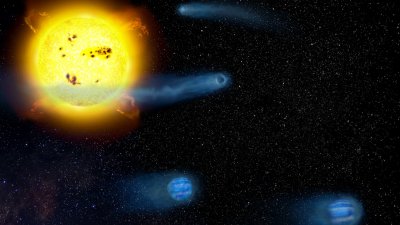
The study of four newborn planets in the V1298 Tau system has provided a snapshot of the transformation process to become the most common types of planets in the galaxy.
The most common planets in our galaxy are between the size of Earth and Neptune (super-Earths and sub-Neptunes). However, they do not exist in the solar system, so their formation mechanisms still have many gaps.
These planets, as has been determined, could lose a large part of their atmosphere during their early years of life and transition from giant planets, like those in the solar system, to sub-Neptunes.
An international team, with participation from the Institute of Astrophysics of the Canary Islands (IAC), has found a key link to determine how this change process occurs, according to a study published in 'Nature'.
V1298 Tau is a young star, about 20 million years old, compared to the Sun's 4.5 billion years, and due to its activity, the mass of its forming planets could not be precisely measured.
For this study, the team used a “clever technique” based on the mutual gravity between planets to overcome that obstacle, notes Enric Pallé, a researcher at the IAC.
The four giant planets in formation are between Neptune and Jupiter in size, but – unlike growing babies – research shows they are extraordinarily puffy worlds that are contracting in size and constantly losing their atmosphere
Researchers thus saw a preview of what will become a very normal planetary system, as the four are likely to contract into super-Earths and sub-Neptunes.
The study offers a fundamental piece for reconstructing the evolutionary history of the most common planetary systems in the galaxy and will help understand why our solar system is an exception.
For a decade, the team used a battery of ground-based and space telescopes to precisely measure when each planet passed in front of the star, an event known as a transit, which allowed for a solid measurement of their masses
The results were surprising, as although they have between five and ten times the radius of the Earth, their masses are only five to fifteen times that of our planet.
In other words, they are incredibly low-density and more “like a planet-sized cotton candy than rocky worlds like our Earth,” explains the IAC in a statement.
By comparing their masses with their radii, it has been determined that "they are exceptionally fluffy and that, in the next millions of years, they will lose a large part of their atmosphere to space due to the intense radiation from their star," highlights Felipe Murgas, also a researcher at the IAC.
This characteristic helps solve a historical puzzle: generally, sub-Neptune planets undergo a very radical transformation early in their lives, losing a large part of their initial atmospheres and cooling rapidly as the gas disk surrounding their star disappears.
V1298 Tau is a "key link between the star-forming nebulae we see across the sky and the mature planetary systems we have discovered by the thousands," according to Erik Petigura, from the IAC.
Understanding those kinds of systems can also help explain why our own solar system lacks the super-Earths and mini-Neptunes that are so abundant elsewhere in the galaxy.



Add La Voz de Lanzarote as a preferred Google source.
Stay informed with the latest current news.