
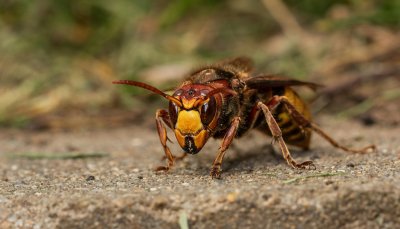
The Asian hornet or yellow-legged hornet (Vespa velutina ssp. nigrithorax), an invasive species present in the north of the Iberian Peninsula since 2010, has been detected for the first time in the Canary Islands. Specifically, according to the Government of the Canary Islands, the presence of a nest with 93 specimens has been confirmed in an urban area of Las Palmas de Gran Canaria, the capital of Gran Canaria.
After receiving the alert, a team of firefighters from the capital removed the specimens that same night and immediately informed the Early Warning Network for Invasive Exotic Species of the Government of the Canary Islands (RedEXOS), dependent on the Ministry of Ecological Transition and Energy.
Following the sacrifice by freezing of the captured specimens and the collection of samples by the Network's Intervention Teams and their morphological analysis by expert personnel, the identification of the species was definitively confirmed.
Attractant traps in urban parks
From then on, and in coordination with the City Council of Las Palmas de Gran Canaria and the Cabildo of Gran Canaria, a protocol was established consisting of the installation of attractant traps in the urban parks near the detected nest, whose main objective is to locate potential additional nests.
Similarly, they will be placed in the port area, thanks to the collaboration of the Port Authority of Las Palmas. The process will determine the extent and evolutionary stage of the population, which will help to better guide control efforts, which would begin in any case before the arrival of autumn. Furthermore, the beekeeping sector has already been informed and is collaborating in a coordinated manner with the administrations, as is the Canary Police.
Experts see it as positive that the focus was detected in spring
Consulted experts consider it positive that this first focus was detected during the spring, a time of year when colonies are beginning to grow and, according to the Canary Executive, it is "unlikely that the species will be in a condition to reproduce." However, the unknown factor remains "how the special climatic conditions of the Canary Islands, which the species has not faced until now, will affect its annual cycle." Alerting rather than trying to eliminate them is, according to specialists, the most appropriate course of action during this initial diagnostic phase.
The species in question is easily identifiable by its large size (up to 3 cm long, double that of Vespula germanica, the most common wasp species in the Canary Islands), as well as by its color pattern: dark body, yellow legs, and a yellow-orange band that crosses the lower part of the abdomen. It is precisely its wingspan that explains why its stinger is also larger and its sting more painful, allowing it to inject a larger amount of venom. However, its toxicity is similar to that of other species, so the greatest risk is suffered by people already diagnosed as allergic to bee or wasp stings in general.
Likewise, it should be emphasized that the Personal Protective Equipment (PPE) usually used in beekeeping does not adequately protect against the Asian wasp, so the removal of potential nests must be reserved exclusively for specialized personnel. Furthermore, this removal must be carried out at night, when the colony's activity decreases.
Avoid direct interaction and call 112
General recommendations to the public therefore involve avoiding direct interaction with these wasps, which only become aggressive in the immediate vicinity of their nests. Any sighting must be immediately reported to CECOES (1-1-2) or by sending photos or videos of the wasps or their nests to the RedEXOS WhatsApp (646 601 457).
On the other hand, it is more likely to be detected near fountains, water deposits, or swimming pools, where they must go to hydrate periodically and more frequently as summer approaches. As it is a carnivorous species, whose main prey are common bees and wild pollinators, it is also possible that they appear lurking around beehive facilities, where they may go to hunt.
Add La Voz de Lanzarote as a preferred Google source.
Stay informed with the latest current news.


