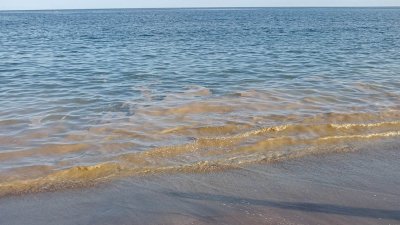
Lanzarote is not free from the presence of microalgae. This Saturday afternoon, La Concha beach in Arrecife woke up with a large brown stain. As seen in the photo, they are large expanses of stains that reach the shore of the sand. Fortunately, this Sunday the beach is clean.
During this summer we have seen the presence of these organisms especially in Gran Canaria and Tenerife. Las Canteras beach has been one of the most affected.
According to what they explain from Public Health of the Government of the Canary Islands, "after the episodes of 2004 and 2011, the Canary Islands have experienced new massive blooms of microalgae of the species Trichodesmium Erythraeum in 2017, a cyanobacteria whose arrival to the coasts depends exclusively on the meteorological conditions, and has nothing to do with the existence or not of wastewater discharges. This is a totally natural phenomenon, frequent in other areas of the planet with warmer waters, such as Australia, where citizens have learned to live with them."
Recommendations and protection measures
In general, and following the guidelines of the World Health Organization, when a microalgae bloom is detected that affects a beach, the General Directorate of Public Health recommends in the affected areas:
Refrain from bathing and avoid contact with the material deposited in the sand in areas with visible concentrations of algae or foam.
Avoid standing upwind to reduce the possible inhalation of aerosols on the shore.
For the practice of nautical sports or any other activity that involves immersion, neoprene garments should be worn that prevent contact of water with the skin and whose openings fit well to prevent the entry of water, since the trapping of microalgae between the skin and the garment increases the contact time and the effects.
After contact with a 'microalgae' bloom, it is necessary to shower or rinse abundantly to remove any residue on the skin.
Wash and dry clothes or material that has come into contact with the bloom.
If you notice any health effects after exposure to a bloom, see a doctor.
Since the arrival of this type of massive microalgae blooms is not predictable, it is recommended that the organizers of recreational or sports activities on the beaches provide alternative solutions in their programming.
It is recommended that the municipalities, in the event that the presence of these massive blooms is detected in the bathing areas, install posters or warning signs to users that include the list of advice.
In addition, it is important that both the rescue and lifeguard personnel, as well as the local police on duty on the beaches, have this information and can transfer it to the bathers to obtain their collaboration, avoiding bathing in the affected part of the beach.


Add La Voz de Lanzarote as a preferred Google source.
Stay informed with the latest current news.