
First of all, congratulations on the 50th anniversary and the well-deserved Gold Medal of the Canary Islands for the leading radio station and all its brands of evolution, La Voz de Lanzarote, first paper and later one of the pioneers on the Internet since 1995 and also for Lanzarote Media and all those who have worked to bring the events lived in this half century on the island of Lanzarote.
In the 1973-74 academic year, a group of conejeros (people from Lanzarote) were studying at the Teacher Training School of Las Palmas, now the Faculty of Education Sciences. Every Sunday we followed the football events of UD Lanzarote and there we discovered in the stands the retransmission of football matches for Lanzarote with quite precarious means but we encouraged the team through the proximity of the microphone.
My first approach to Radio Lanzarote occurred as a member of the Trade Union of Education Workers of the Canary Islands (STEC). It was 1987 and we were preparing to compete in the first trade union elections in the field of education as a member of the Teaching Staff Board of the Canary Islands for the province of Las Palmas. We spread the word that we were a nationalist, autonomous, assembly-based socio-political union against the traditional pluralist model practiced by UGT and CC.OO. Job stability, homologation, continuous working day, school canteens, the incorporation of labor personnel and AMPAS (Associations of Parents of Students) into the life of the centers... all this made up our "demands table", assemblies by the educational centers and debates in the small studio of Radio Lanzarote. I remember the day I went live and the director, Agustín Acosta, left me alone in front of the microphone, I think he went down to have a coffee at the "México" bar, -"talk there and don't stop, I'll be up soon". The world came crashing down on me in those untimely hours of the morning, fortunately, thanks to Francisco José and his good work in the control room, he saved the situation. In short, thanks to the leading radio station, the union and its recognized victory in Lanzarote and in the Canary Islands became known and in a short space of time it became the hegemonic union in the education sector.
In the early nineties, Radio Lanzarote witnessed the end of the EGB (General Basic Education) and the arrival of the LOGSE (1990). When I joined the Lanzarote Teachers' Center as director, the radio made it easier for us to inform Lanzarote society about the major structural changes in public, private and subsidized education in the State and its calendar of application throughout that decade. Teachers seek to update their knowledge in the new contents and methodologies in the CEPs, innovation and improvement arrive, the Jameos magazine is promoted, Arte Docente is created, the Internet appears, mobile telephony and the first device to make videoconferences is made from the headquarters of the Teachers' Center in a connection, I think with the Territorial Directorate of Las Palmas. Many of these events are recorded in La Voz de Lanzarote paper version and on the radio.
The LOGSE transforms the old EGB schools into Infant and Primary Education centers (CEIP) and the Secondary Education and Baccalaureate Institutes into Secondary Education Institutes (IES). Education is divided into Educational Districts. And it is in this last point where many radio hours are spent explaining to society the consequences of the new model, the AMPAS come on the scene, Loly Luzardo acquires notoriety in the sector of parents of students and monopolizes media attention so that parents take part in the School Councils.
The great structural changes in education and the arrival of the first tourist boom warned by Cesar Manrique in the late eighties, collapse all public services on the island: roads, water, electricity, security, health and education. The vertiginous growth of hotel and non-hotel constructions attracted large contingents of personnel from all corners of the earth, multiculturalism appears in the classrooms, up to sixty different nationalities in many educational centers and it was necessary to design urgent intervention plans to be able to attend to the new school population of over-enrollment and therefore the entry into the new century caught us with many "homework", the voracity of the construction exceeded all our forecasts with "Moratorium" included. Exhausted all available spaces in the centers, libraries, departments, the situation forces to place modular classrooms in many centers to provide solution to the overcrowding in critical moments, despite the unpopularity of the solution.
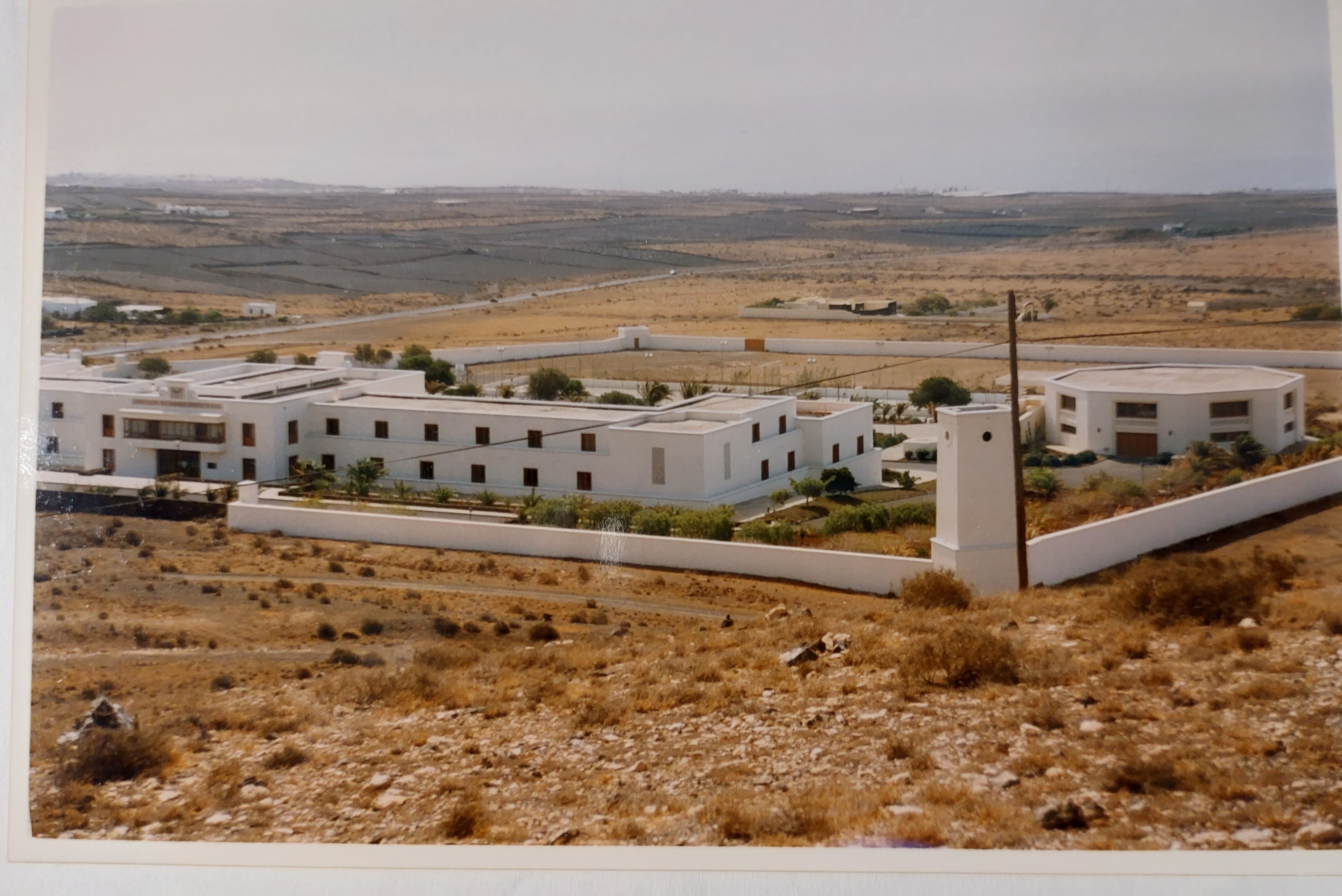
The Map of educational needs was quite bleak and to make matters worse, unfortunate actions are undertaken that do not help to move forward, such is the case of the town hall of Yaiza that comes up with the "brilliant idea" of building an institute in Capitas, on the border with the municipality of Tías. He is warned that the entry of the LOGSE is imminent but contradictorily obtains the approval of the Minister of Education of the Government of the Canary Islands in 1988, the Center is inaugurated in style the same year that the new Law is applied. Since the 1990 academic year, all the students of the IES have to be transported, which has made it the center with the highest expenditure of public money on school transport and the greatest inconvenience and sacrifice for the transported students. The Playa Blanca school has tripled its capacity of places since its opening, until the recent opening of the CEO. And it is that currently Playa Blanca, with almost 13,000 inhabitants, is the second largest population center of Lanzarote.
Arrecife presented a dilapidated educational zoning, most of the Primary and Secondary schools were atomized in Titerroy and applying Education by Districts with that morphology was very complicated. The nucleus of Argana goes from being an external classroom of the Colegio Benito Méndez, to being an independent center. Similar case occurred in Los Geranios, first attached to the Adolfo Topham school and the Mercedes Medina Díaz school, initially for a secondary school, but difficulties with the bankruptcy of Huarte construction company and the population increase, it was decided to start its journey as a Primary school until 2017 when it became a Secondary school to balance the District. For the secondary school students from the Nieves Toledo school, it was necessary to negotiate with the Ministry of Fisheries to temporarily convert the IFP Maritimo Pesquero into IES. It was desperate to locate educational land in Arrecife to locate the CEO of Argana. The Cabildo facilitates a plot in the back of the Molina Orosa Hospital to make an Industrialized center, with the consent of the desperate parents of that moment, a lot of business pressure to expand the industrial area, assemblies, debates, offices, hours of radio so that this area of Argana had a Secondary center. The Center was made and the City Council promised to give exit to Santiago Alemán street towards Iguazú... and plant arganes all around it to create a green center and beautify the environment... For Arrecife, a plan was proposed to improve the playgrounds by lowering the heights of the walls and placing translucent elements to gain in security and social interaction and also to design safe routes for the surroundings of the schools.
The last action in educational infrastructure in Arrecife has been to replace the CEIP La Destila. This piece of land of 4,000m/2 in the center of Arrecife where "Los Grupos" were located since the sixties, since its change is proposed, all kinds of reactions begin to occur: to take the center to the periphery, to exchange land, to speculate, parking etc. Fortunately, the success of the local architect Martín Martín, has designed us a harmonious and modern building reference of educational use for the city of Arrecife.
The town hall of San Bartolomé, its mayor and teacher, gets a delegated section for an institute locating it in the Casa Ajei in the late eighties and in the year 2000 the IES San Bartolomé is already in its current location. The population of Playa Honda becomes in a short time the main residential population of Lanzarote, its soil is saturated and the school of Playa Honda since its inauguration was already small and in the late nineties urgently undertakes plans for reform, expansion and improvements (RAM), to double its capacity. In the academic year 2003-04 the IES of the same locality is inaugurated, closing the educational map.
The tourist residential town of Costa Teguise went from having half a hundred primary school students who were schooled in Tahíche and Teguise to more than three hundred, the urgent route is used, for this a commission composed of parents, teachers and others visit centers of this type in Barcelona. The center is built in seven months, the arrival of the modules by sea and taken to the center in special transports was an event reflected in all media and radio. The same day that the primary school opened in 2005, the town hall was demanding the provision of land for the Secondary School, inaugurated in 2012. Teguise already had a secondary school since the 1993-94 academic year.
The island of La Graciosa in 2008 manages to take Compulsory Secondary Education. After multiple meetings with the entire educational community of the eighth island, the IES of Haría, School Residence, even with the two shipping companies that connect with Órzola, it is agreed that the CEIP Ignacio Aldecoa will be transformed into a Center of Compulsory Education (up to 4th of ESO). At that time the center had 72 students and 11 teachers were assigned to it.
Tinajo opened a secondary school in the academic year 1999-2000, as did the municipality of Tías a year earlier. In a short time it almost doubled its capacity of school places and the IES of Puerto del Carmen (2005) is built to balance the educational district that is complemented with the construction of the new CEIP Asomada-Mácher (2010) being the first municipality of Lanzarote that closes its Map of Educational Needs, at that time. Tías has been the only municipality that has changed its Ordinances (Art 47) to carry out two educational centers.
Haría was a pioneer municipality in advancing secondary education by creating in 1967 the Colegio Libre Adoptado to offer secondary education and later the institute as a delegated session of Arrecife, the old center suffers cracks as it is settled on quicksand and technically a good part has to be disabled and the new project inaugurated in this school year is being managed. The population of Arrieta considerably increases its population enabling a CEIP of line one, surpassing in students that of San Juan de Haría.
We finish this review of the newspaper library of La Voz that also reminds us of the creation of more than twenty school canteens, the generalization of extracurricular activities and the optimization of school transport routes, in addition to the incorporation of other resources to public education such as the centers of Preferential Attention. To thank again the Radio and its means appeared later, having allowed us to approach to pour information on this important public service from three different perspectives: the vindictive, the training and from the administrative stage and management of educational resources
Congratulations on the Gold Medal to the Radio, La Voz and Lanzarote Media.
To be Canarian is to fight for your land, always.
Canary Islands Day 2022
Add La Voz de Lanzarote as a preferred Google source.
Stay informed with the latest current news.