
The century-old rural post office of Mácher closes its doors as the last postman retires. The Mácher post office has played an important social role for nearly a century, and with it, a piece of identity also closes. We have data on places where this public messaging service was practiced. The postman Antonio Urbín Díaz combined his work as a blacksmith in a place that still persists on the road to La Calderina. When he was called up to the Spanish Civil War, he was temporarily replaced by the shopkeeper Antonio Cedrés Viñas (father of José Antonio), from 1936 to 1939. When Antonio Urbín retired, Marcial Hernández Saavedra took the postman's place in a house on the main road, owned by Juan Rodríguez Romero. Marcial was a shoemaker with a long family tradition and was also a renowned slaughterer in the town who helped slaughter domestic cattle for the neighbors. Marcial attended to the letter delivery service on foot and by donkey for almost forty years.
In the early eighties, after his retirement, a regular customer of José Antonio's shop, Marcial encouraged him to take the vacant postal service. Consultations were made with the Central Post Office Headquarters and, after being assured by his closest colleagues, those of Yaiza and Tías, Cedrés Medina took office as postman of Mácher on March 23, 1981. From a young age, he had links with communication. In his house, in addition to the shop, the National Telephone Company of Spain had installed the first public telephone in 1965. Toñito took telegrams to the many tomato and onion growers-exporters in the town, from whom he usually received some extra reward for the errand.
"The transfer of powers" took place on the same day and he received a mailbox, a post office sign and a postmark. He converted an old stable into an office and connected it to the back of the shop and in a short period of time, the residents of Mácher stopped seeing Marcial and his donkey "Mariola" for a faster postman motorized in a "Honda 70". The type of correspondence in those years ranged from letters from boyfriends and girlfriends, letters from the military, mail order, Readers' Circle, some scarce subscriptions to the Eco de Canarias, bank letters from merchants, to the payment of pensioners with the monthly subsidy. His first salary as a postman amounted to 10,621 pesetas.
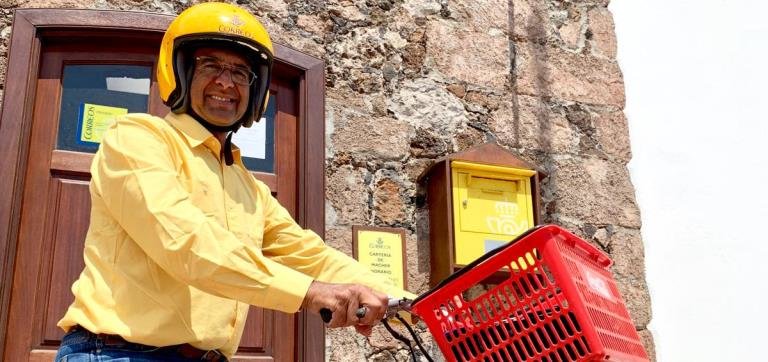
From the first moment he received the first bag of letters, which arrived on Pepe Cedrés' bus at noon, he discovered that he liked his job and felt restless to go and deliver the mail and the opportunity to share with the neighbors. "If the job of postman was just putting letters in mailboxes, I wouldn't have been a postman"- says José Antonio-. He left from noon and returned at sunset, he spoke to everyone even if he didn't leave them letters, he felt fulfilled sharing, talking, taking an interest in the elderly, for many it was the only opportunity to talk. He took an interest in the new neighbors who were arriving in the town, adding friendship to them. Passing through the paths, roads he had traveled as a child, gave him great satisfaction of joy, repeating it day after day. It was a privilege of freedom, fortune and satisfaction, to have fun doing his job.
That is why his son Toñito, on the last day of work, using the means of communication of the "competition" that is, an email and Facebook, dedicated this post to him: "Who has not passed through Mácher and seen this peculiar image? Always on his Honda 70 for 38 years at the service of the town that give for many experiences? Today is not an easy day for him, he does not want this moment to arrive? His work is not work, it is his way of life! How he likes to be, stopping at each house and stopping time talking to each neighbor, understanding the importance of each letter that he delivers to the recipient? We will not forget this image, but now it is time to enjoy another stage of your life?
Happy retirement Cedrés!"
Juan Cruz Sepúlveda


Add La Voz de Lanzarote as a preferred Google source.
Stay informed with the latest current news.