
I remember, suddenly, a poem that comes from the other side of the Atlantic Ocean, some verses by the Venezuelan writer Yolanda Pantin: "the waters do not illuminate/ they darken the earth/ their source is fear/ that flows from us/
and also from the drowned/ in the humid air." Do the waters illuminate? Do they darken thought? Do they offer a path to travel or can they mean the end of a journey full of hope? What is the true source from which its ancient voice reaches us? What does the sea still have to tell us? What does our sea in particular have to say to us?
These are some of the questions that the reading of Ondina, Andrea Bernal's latest and original poetic bet, suggests to me. We met a long time ago through a mutual friend who told me that she was a wonderful writer and that she would like to put us in touch. As we are always very busy, it still took a long time from when we first wrote to each other until we met in person. But one good day she appeared in El Almacén with a straw hat and a long dress that the cool afternoon wind moved gracefully, like one perhaps imagines an Alsatian undine. She also came, on that occasion, with a book under her arm.
It was Andrea Bernal, professor of Philosophy, as well as a poet, and she came with a wonderful gift: what was then her latest book, Nominalismos (Eolas Ediciones, 2022). Later, with her reading, I could enjoy an exploration of names and their intentionality, the investigation of the poetic word arising, among other influences, from readings of Lusophone writers who have also been inspiring for me, such as Sophia de Mello Breyner or Ana Luísa Amaral.
But before Nominalismos, Andrea Bernal had written three other books of poems: Los pájaros (Ed. Eolas, 2013), Adiós a la noche (Ed. La Isla de Siltolá, 2016) and Todo lo contrario a la belleza (Ed. La Isla de Siltolá, 2019). She was, therefore, an author with a long career and had participated in poetry meetings such as the Fray Luis de León International Poetry Congress in Salamanca.
Now she returns with Ondina (Huerga&and Fierro, 2024) which, as the author herself has explained: "is born from the depth of the sea, from a vision of Los Hervideros de Lanzarote". A quote from Emerson opens the book "Who can guess how much firmness the rock beaten by the sea has taught the fisherman?" and insists on this initial idea: that of inspiration from a long contemplation of the agitated sea of Los Hervideros, a determination that has led to this book, what the contemplation of that sea and that almost original landscape of pure basalt has done in her poetic gaze.
Andrea Bernal addresses in Ondina, then, an image of the sea as an area of freedom and profound beauty, but also as a place of death. The legacy of the sea and beyond the body-sea, the transfiguration of love, the oceanic immensity of heartbreak and deep telluric movements of inconsolable loneliness make up the spirit of the book. Distance as a sea that is always between two lovers. I have always thought that Lanzarote is an island to be in love and where amorous failure can end up leading to a heroic act of artistic creation.
From what sources can that creation drink? Ondina is inspired by the sea, but also by a 1934 work, L'air de l'eau, by the pioneer of surrealism, André Breton. And in a broader sense I would say that this book pursues that radical affirmation about Breton's aesthetics: "beauty will be convulsive or it will not be", in that search that Andrea Bernal makes for a beauty that is disturbing and that makes us feel uncomfortable. For Breton, beauty could only arise from an intense, visceral and transformative experience. The experience of Lanzarote in the life of a poet like Andrea Bernal is undoubtedly so.
A vision of the strange south of Lanzarote, reproduced by the experience and fractal memory of a poet. Another aspect to highlight of the book is the fragmentary nature of the poems with an assumption of a literary legacy in which also, of course, there are some hints of the surrealism of Agustín Espinosa within a framework, of an aesthetic position to which he invites us through a certain concert of voices of a particular feminine imaginary.
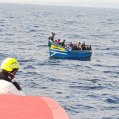
That feminine imaginary is articulated around mythology from the very title of the book. What is an undine? Undines, in classical mythology, were elemental forces that gave life to the feminine body. They are mischievous beings who have fun playing with humans, who move the waters causing currents and drowning, on occasions, fishermen and travelers without always being aware of that evil deed. In a transfer to the present we could make a comparison with the dangerous routes of migrants in North Africa towards our islands, towards Europe.
But undines have also fallen in love with some humans, becoming their protectors. That is exactly what Andrea Bernal does with the reader: protect them in a first reading. Then the meanings of the poems are expanded. The words are resignified. Because in Ondina we find a vision of the sea, but also, as I have already pointed out, a book of love ¿or heartbreak? The inevitable reference to Christian Petzold's German film and the revision, in a transfer to the modern world of the myth of the undine, makes me also bet on this vision of the book, with the question of betrayal in the background.
In short, I think that Ondina is a new significant contribution to literature, and in particular to poetry, written in Lanzarote in recent years. We will find in its reading a solitary and personal voice, the intimacy of the sea. I read it with the happiness that provides knowing that such a beloved landscape shapes another look, that its waters illuminate and find a path that offers us to share through the ocean, recovering echoes of the old voice of the sea of Lanzarote that serves as deep inspiration for a poet who has lived and felt the island intensely.
Add La Voz de Lanzarote as a preferred Google source.
Stay informed with the latest current news.