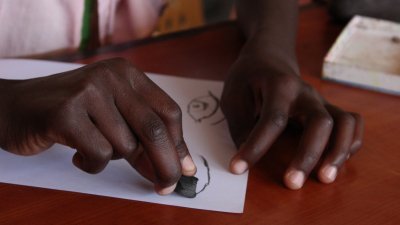
Souleiman, Babacar, Omar, Mamadou, Birame, Ibrahim, Mussa and Mahruf pack their bags in Tenerife to move to centers for minors in peninsular Spain. They arrived in the Canary Islands by dugout canoe in 2023 and 2024, are between 13 and 15 years old and all carry on their shoulders the hope of their families.
This week marks one year since the reform of the Immigration Law that forced the rest of the autonomous communities to share with Ceuta, Melilla and the Canary Islands the responsibility of hosting the children and adolescents who arrive without their parents in dinghies and canoes.
More than a thousand have been transferred since August, despite the legal battle undertaken by the communities that resist welcoming them, the political controversies and, even, some protests in localities where the cliché that identifies them with problems has taken hold among certain residents. That which reduces them to the acronym 'menas'.
The EFE Agency has shared a day with eight minors from Senegal, Gambia, Mali, and Guinea hosted in a center in a town in northern Tenerife, to learn the reasons that pushed them to the cayuco and listen to the plans they are making for their new life in Galicia, Andalusia, Castilla-La Mancha, and the Community of Madrid.
The eight arrived in El Hierro and Tenerife in 2023 and 2024, the two record years of the Atlantic Route that caused the Canary Islands' reception network to collapse and led, at times, to opening centers almost overnight, reaching a total of almost 6,000 minors under guardianship.
They are a good example of the minors who are being transferred to the peninsula: adolescents, sub-Saharans and eager to be able to work to send money to their families. The majority leaves this week what has been their home in Tenerife for months.
Souleiman (Mali), 13 years old
The youngest of the group, 13 years old, studied in a Koranic school in Mali. He arrived a year and a half ago in El Hierro with his older brother. He doesn't remember how much time passed from when he left his home until he embarked on a dugout canoe in Mauritania... or prefers not to remember it, because he admits it was hard. His brother is already in France.
He wants to stay in Spain, studying. He is determined to be a doctor. "My parents tell me that for that I have to study a lot." He will do it, he promises; he is good at it. Every week he demonstrates it at his high school. His plans will now continue in the Community of Madrid.
Babacar (Senegal), 15 years old
Among the young people at the center, Babacar is one of those who best gets by in Spanish. He studied it in Senegal, along with French, because he found it easier than Arabic. He will probably soon abandon his studies: he wants to be a carpenter to earn a living and lend a hand to the three brothers he left in Senegal.
He arrived in October 2024 in El Hierro with a hundred more people in the cayuco. "I came because of the situation in my country. My parents believed that if I stayed in Senegal I would not have a future," he confesses.
Omar (Gambia), 15 years old
Unlike his friends, who train in football teams in Tenerife, Omar's thing is Canarian wrestling. He doesn't need to say it, his body speaks for him. He already practiced Senegalese wrestling in Gambia, so getting hooked on the sport par excellence of the islands was easy.
He smiles when they ask him if he wants to be like the Malian Mamadou Camara, the 'puntal A' of Tegueste, a titan of the wrestling grounds who also arrived as a child in a cayuco, in 2008. Omar was rescued in El Hierro in 2024. This week he flies to Galicia. He will miss wrestling, but his plan now is to become a good welder.
Mamadou (Senegal), 14 years
If the African boys are asked when they arrived in the Canary Islands, most respond with a periphrasis or an approximation. Mamadou, no.
He drops the date with aplomb: September 9, 2024. He assures that he doesn't forget it because "it was an important day, a happy day," after the cold he endured in the cayuco.
He leaves for Galicia with Omar, so he is interested in what that Spanish region is like. "Does it rain a lot?, more than here?". The answer doesn't seem to please him much, but his face changes when they tell him that Galicia is a land of good fishermen. He also wants to be one.
Birame (Senegal), 15 years
He got on a cayuco to El Hierro at twelve years old because his uncle was going to emigrate and his mother encouraged him to follow him. He wants to be an actor. What's more, he believes his thing is comedy, but for now he misses home cooking, the 'ceebu jën' (rice with fish), which for every Senegalese is like paella for a Valencian: identity.
"I want to have a lot of money before returning. With the first thing I earn, I would like to take my father and my mother to Mecca. And build a house for my family." These are the dreams of Birame, who will soon move to the peninsula. He doesn't have a destination center yet, but he hopes it will be in Andalusia, because he has an uncle in Almería.
Ibrahim (Senegal), 15 years old
It's already a year and a half since he arrived in Tenerife, but he still feels ashamed to look his interlocutor in the face. Like many African boys, Ibrahim is used to lowering his gaze when an elder speaks to him, out of respect. He continues to do so, even though his educator explains to him that in Europe it's just the opposite.
He will soon go to another community. Although he doesn't have an assigned destination, he would like it to be Barcelona, to be a good cook. In Tenerife he has made good friends. "And a friend," he confesses, before the laughter and the 'oh, oh, ooooh' of the other boys at the center interrupt him. They are teenagers, hormones are bubbling.
Mussa (Guinea), 14 years old
Of all of them, he is the only one who wants to be a footballer. He trains with discipline, but they do not allow him to play. There are dozens of African children like him in the Canary Islands, who every weekend are disheartened in the stands, because FIFA considers them international signings and does not process their registrations. Soon, he will be in a center in Andalusia, but he says that, as soon as he is older, he will continue his journey to France.
"My mother asks me if everything is going well. I tell them yes," he says. Also at home, they didn't know he was going to emigrate. It was in 2024. His dugout canoe took him to Tenerife. He didn't even know he had arrived at an island.
Mahruf (Gambia), 15 years
In his case, it was his mother who encouraged him to seek a future in Europe, as his uncle had done before, only he arrived in Italy, via the Mediterranean. Mahruf has not heard of Libya, nor of the abuses that thousands of migrants suffer there. He only knows that his uncle advised him to find another route. His destination shortly will be a center in Castilla-La Mancha, but the cayuco took him to Tenerife in 2023.
On the journey, one of his 190 companions died. He threw himself into the sea in a delirium. Almost no child from the cayucos will admit that they were scared on the journey. Mahruf neither: "Me, no. I was only afraid to look at the sea." For seven whole days he was surrounded by nothing but an ocean.


Add La Voz de Lanzarote as a preferred Google source.
Stay informed with the latest current news.