
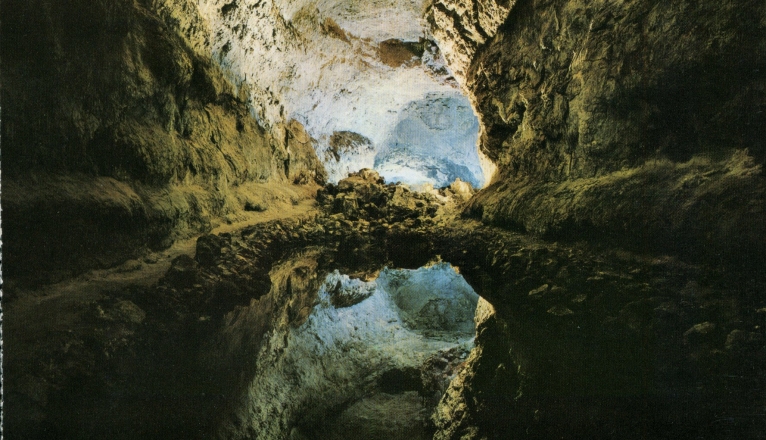
Ashes took over the sky, which little by little turned the blue of the atmosphere black. After that came the stones and, finally, the lava. One of these currents advanced, crossing and burning everything in its path, until it reached what is now the sea, where it solidified. This formed that volcanic tube that gave rise to several legends and that, over time, would end up becoming one of the great works resulting from the fusion between man and nature: Jameos del Agua and Cueva de los Verdes.
The Cueva de los Verdes has witnessed the history of Lanzarote for more than 25,000 years, even when the volcanoes had not yet taken over the island. However, it would not be described for the first time until the arrival of the Italian engineer, Leonardo Torriani, in the distant 16th century, who narrates in his work Descripción de las Islas Canarias, its uses as a refuge against pirate incursions, such as those that occurred in the year 1586, “...the others hide in the caves of the mountains, among which there is one, called de los Verdes, very large and safe, towards the northeast, six miles away from the town.”.
And on another occasion, already in the year 1618, as Manuel de Paz mentions in his book La pirateria en Canarias with the arrival of Tabac Arráez and Solimán, the citizens fled the capital, at that time the Villa de Teguise, and took refuge in numerous natural caves, including that of Los Verdes. Sadly, on that occasion, the refugees were discovered and subdued, because the island's scribe, Don Francisco Amado, revealed the secret entrance through which food was brought.
However, these defensive functions were put aside already in the 18th century. To a large extent, the cave was forgotten, almost asleep, without anyone remembering its importance in days gone by, somehow reminiscent of that phrase from the beginning of the Lord of the Rings “...And those deeds that should never have fallen into oblivion were lost in time. History became Legend, Legend became Myth…”
It was then that, in 1854, light returned to the cave thanks to the scientific activity initiated by the German geoscientist George Hartung, who investigated its orography and later published his findings in the book Die geologischen Verhältnisse der Inseln Lanzarote und Fuerteventura.
Despite this interest from the scientific community, the cave fell into oblivion again until 1909, when the Spanish geologist Hernández-Pacheco investigated its secrets. Amazed by the cave, he expressed his fascination in his work Estudio Geológico de Lanzarote y de las Islas Canarias.
And, as always, the cave was forgotten again. It was not until 1931 when an event changed its history forever: the Biscayan military man Casto Martínez resurrected the cave through his writings, where he narrated the main attractions of the island with the aim of attracting tourism, although his mission was not successful. In some way he was a precursor, a visionary of what would later be one of Lanzarote's great attractions.
Three decades later, the cave saw the light again when Agustín de la Hoz decided to show the general public its unique beauty. Thanks to his initiative, Gabriel Fernández Martín was able to take the first negatives of this swarm of lights and shapes that had remained dormant. Being described by the journalist in the newspaper Antena as “...unpublished interiors, of different beauty, either in the complicated rooms, or in the high ogival vaults, or the stalactites, or the large calcareous canvases, the gorges and chasms...”
That same year, in 1961, the Tourism Board decided to illuminate the cave for tourist purposes. For this reason, a year later, it would be ceded by the Haría City Council to the Cabildo de Lanzarote. This lighting task fell to a then unknown Jesús Soto, who intervened outstandingly in the cave. Hiding the projectors so that it seemed that the light emerged from nowhere or from the stones themselves, as an addition he decided to reproduce one of his favorite pieces of classical music, Antonio Vivaldi's Spring, with this the Majorero electrician created art without knowing it, La Cueva de los Verdes, that fantastic grotto in the purest style of Journey to the Center of the Earth, which transports us to the remote silence, to the appreciation of the silent work of the lava, of the colors and shapes that are hidden, was now an immovable, immortal piece of art and remembered by everyone who visits it.

Add La Voz de Lanzarote as a preferred Google source.
Stay informed with the latest current news.