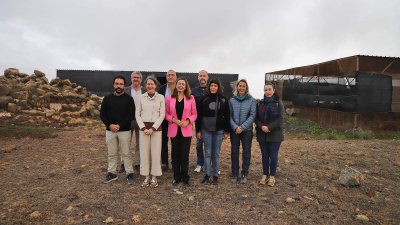
Work begins on the archaeological complex of Zonzamas. On the morning of this Thursday, January 12, the president of the Cabildo of Lanzarote and the island councilor for Historical Heritage, Ariagona González, traveled to this emblematic enclave to present to the media -in Structure 1- the execution plan of the “Site Museum in the Archaeological Zone of Zonzamas (Site Museum Infrastructure and parking lots)”, which is the name of the project underway.
"This is a demanded - for decades - public initiative around heritage and dissemination that now will be carried out by the public company Grupo Tragsa, with the financing of the Cabildo", they point out from the Institution.
María Dolores Corujo has highlighted the town of Zonzamas, “one of the most relevant archaeological sites in the Archipelago”. And she has remarked, emotionally, the work of the professionals of the Heritage Unit that now leads to a main stage of this Site. “It is a day, really, that we wanted to share with you because, if anything is worthwhile when we are in public management, it is having the best team and valuing our history.”
Interpretation Center
The president of the Cabildo has explained that the future Zonzamas Site Museum represents an “integral project” that includes an interpretation and visitor center, “which will be the reception space where the site will be explained.” And that, "a few meters from where archaeologists can continue their research work on the ground."
"The interpretation and visitor center will have a parking area and will be powered by clean energy sources through a photovoltaic installation," they explain from the Cabildo.
Corujo made a special mention to Inés Dug Godoy, “who will be (February 2023) the first woman recognized with the new Distinctions and Honors awarded by the Cabildo of Lanzarote; a pioneering archaeologist in Spain who will be an Adoptive Daughter of Lanzarote.
"She, back in 1971, carried out the first excavations of this site, something for which we will be eternally grateful," she emphasized at one point in her speech.
On the other hand, the president has lamented that “despite its importance, the archaeological complex of Zonzamas has been surrounded by setbacks” during the past decades. The Lanzarote president also referred to the abandonment suffered in the facilities, which meant that it was included in the Red List of Heritage designed by Hispania Nostra since, in her opinion, this enclave was in serious danger.
“We are leaving behind inadequate projects by the previous government that remained mere presentations, posturing before the media, without a real start of work.” Fortunately,” Corujo added immediately, “all that is behind us and today we present the progress of the new stage in which Zonzamas finds itself.”
A presidential and team commitment
The councilor Ariagona González joined the president's thanks, and stated that “as has been said, this Site Museum was one of the pending issues that we had on the island in terms of heritage.” She delved into the historical importance of this enclave, assuring that “knowing our past and being respectful with the environment that surrounds us, is what will help us create the map of our future where our identity is collected,” González noted.
“The Department of Historical Heritage of the Cabildo,” she added, “works and will work on the conservation and dissemination of our heritage. But if we are here today it is because of the effort and commitment, on the one hand, of the president because from the beginning of the mandate she was directly involved in the heritage of the island and provided the Area with the human team necessary to carry out this and other projects; and also for the constant commitment of our work team,” said Ariagona González during the presentation.
Investment of 2.7 million euros
The budget of the project for the commissioning of the Zonzamas Site Museum amounts to 2,777,033 euros (taxes included), commissioned to the Public Company Tecnología y Servicios Agrarios S.A., S.M.E, M.P. (Grupo Tragsa).
Most of this investment is concentrated in the year 2023, and sets the completion of the works in 28 months. “It will be finished in 2024,” clarified María Dolores Corujo. The intervention has a guarantee period of 12 months and the GPY Arquitectos S.L.P. office has the complete works management.
The project is executed along some 1,700 square meters of museum infrastructure, with an architectural and landscape proposal “respectful with the environment”, as its promoters have insisted this Thursday morning. It also contemplates the creation of itineraries in which the points of special interest will be fixed; and will include the recovery and adaptation of the pre-existing building “to avoid consuming more territory.”
While these works advance, the didactic guided visits to the areas where the excavation campaigns are carried out will continue.
Projects that "did not prosper"
The Archaeological Zone of Zonzamas has been immersed in previous projects that, “fortunately,” said the president, “did not prosper because they were inadequate.”
Looking at the history of archaeological research of the place, "it should be noted that the first works in the site were carried out by Doña Inés Dug Godoy, between 1971 and 1985, developing a total of 17 archaeological campaigns in which several architectures of aboriginal affiliation were brought to light", point out from the Cabildo.
At the end of these interventions in 1995, the site was covered by greenhouses to prevent water from entering the deep houses. "However, these greenhouses were abandoned, becoming a place frequented for all kinds of activities that damaged the site. A few years later it was decided to bury the archaeological structures with rofe", concludes the Cabildo.


Add La Voz de Lanzarote as a preferred Google source.
Stay informed with the latest current news.