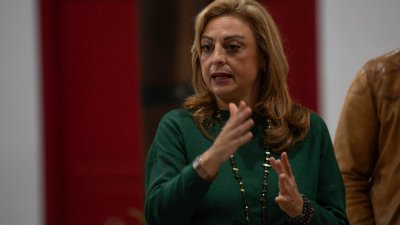
The spokesperson for Coalición Canaria (CC) in the Congress of Deputies, Cristina Valido, led an informative and listening meeting this Wednesday at the Teguise Agrotechnological Complex with professionals from the primary sector of Lanzarote and La Graciosa, in which she firmly defended the position of the Canarian nationalist party against European and state decisions that threaten the viability of agriculture, livestock farming, and fishing in the Archipelago.
The meeting is part of the project Lanzarote and La Graciosa Need You, an initiative for citizen engagement launched by CC Lanzarote and La Graciosa, aimed at gathering proposals, priorities, and demands from citizens to define the future of both islands through participation, proximity, and commitment to the territory. An open process with the people of Lanzarote and La Graciosa to which Coalición Canaria will continue to give continuity in other sectoral areas.
"Threats" to the sector, according to CC
Valido focused his speech on defending the Canary Islands' primary sector against what he considers the "three main threats": the trade agreement between the European Union and Mercosur, the new Fishing Regulation, and the current European financial framework. In this context, he strongly rejected the agreement with Mercosur, considering that it "introduces unfair competition for local productions, by allowing the entry of products from third countries that do not meet the same social, labor, environmental, and health standards required of European producers."He also criticized the new European Fishing Regulation, warning that it entails "new limitations for the Canary fleet and for artisanal fishing activity, putting at risk the economic sustainability of a strategic sector for many families in the Archipelago".
Decrease in POSEI
Another of the central pillars of his speech was the denunciation of the reduction in funds for the Specific Options Program for Remoteness and Insularity (POSEI), which constitutes "a fundamental pillar for the survival of the primary sector in the outermost regions."Valido warned that the reduction of these aids considerably harms the already delicate situation of Canarian farmers and ranchers, and is further aggravated by the new financial framework set by Brussels, which jeopardizes the Common Agricultural Policy (CAP) itselfIn this regard, he recalled that the CAP is the European Union's (EU) main instrument for financing and regulating the primary sector, guaranteeing agricultural income, environmental sustainability, and food security, and that in the Canary Islands it is adapted to its ultra-peripheral singularity through the Strategic Plan of the Common Agricultural Policy (PEPAC) 2023-2027However, he warned that European proposals to integrate the CAP into common funds and cut specific allocations threaten to dilute the differentiated aid the Archipelago needs to maintain its competitiveness and protect agricultural land
Defense of Canarian interests
Given the above, the nationalist spokesperson called for firmness from the State Government in defending Canary Islands' interests before Europe and demanded that both POSEI and the differentiated CAP for outermost regions be safeguarded, emphasizing that there can be no talk of territorial cohesion or ecological transition without guaranteeing the survival of the primary sector in territories like the Canary Islands.
The meeting was attended by a large representation of CC Lanzarote and La Graciosa members, supporters, and public and organic officials, including the senator for the Autonomous Community and island secretary, Pedro San Ginés, the Minister of Universities, Science and Innovation of the Government of the Canary Islands, Migdalia Machín, the national secretary of Coalición Canaria, David Toledo, and the president of the Cabildo of Lanzarote, Oswaldo Betancort.
Canary Obedience
San Ginés highlighted the importance of "having a Canarian voice in the Congress of Deputies that defends the Archipelago's interests with the firmness that Cristina Valido does, before Europe and the State on issues that directly threaten the future of our agriculture, livestock, and fishing"; at the same time, he stressed that Coalición Canaria "does not answer to any party with headquarters in Madrid" and that "its only political loyalty is to the interests of the Canary Islands and its people. We are a party of Canarian obedience," he emphasized.
He also denounced that "issues of importance affecting the Archipelago are not a priority for either the central government or the state parties," recalling the systematic breaches and delays in commitments made in the Canary Agenda, as well as the lack of sensitivity on key issues such as immigration, where "if it depended on the state parties, all minors arriving in the Canary Islands would remain here without a supportive response from the State as a whole."
Fernando Clavijo
Regarding this, the senator and island secretary of CC Lanzarote and La Graciosa highlighted the motion he registered this very Wednesday in the Senate's Fisheries Commission, urging the Spanish Government to flexibly apply the new European Fishing Regulation and to defend the same approach before the European Union, with the aim of guaranteeing the "viability, safety, and continuity" of the artisanal fishing sector and of the Canary Islands as a whole as an outermost region.
"We would like," he added, "that in Spain, just as in Portugal or France, we had someone in the central government who defended its outermost regions as the President of the Canary Islands Government, Fernando Clavijo, does, in the face of Pedro Sánchez and his government's contempt for everything related to the needs of our Archipelago."
Island Political Council
Previously, CC Lanzarote and La Graciosa held an Insular Political Council, also at the Teguise Agrotechnological Complex, where, in addition to addressing the aforementioned threats affecting the Archipelago's primary sector, the strategic importance of having a strong Canarian nationalism in the Congress of Deputies was emphasizedIn this context, it was highlighted that the experience of the current legislature, with the decisive weight of Basque nationalism and, especially, of Catalan pro-independence parties, demonstrates the extent to which it is crucial to have a solid parliamentary group, of exclusively Canarian obedience and independent of state leaderships, in a political scenario without absolute majorities, where every vote is fundamental to defend the interests of the Canary Islands and assert the archipelago's unique characteristics.
Add La Voz de Lanzarote as a preferred Google source.
Stay informed with the latest current news.