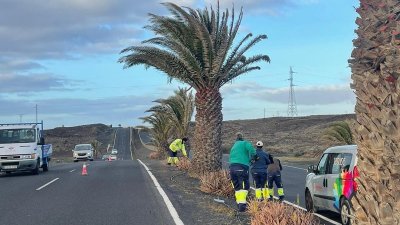
The Ministry of Ecological Transition and Energy of the Government of the Canary Islands, together with the Cabildo of Lanzarote, launches new informative material to offer professionals and the public information on the general conditions for carrying out work with palm trees on this island, with the aim of eradicating and controlling Diocalandra frumenti, the pest that affects this plant species.
According to the regional councilor, Mariano H. Zapata, "this free tool, in triptych format, is now available, both online and physically, within the framework of the Palmeras Lanzarote project", which offers "information of interest to know how to perform care, pruning and maintenance work in the palm grove of the island, since for this you must request authorization from the competent administrations".
In this sense, he explained that this document shows "through QR codes to which institution you should go in each municipality, and also provides a list of accredited companies and specialists in this type of work, who must comply with a series of requirements for both pruning and felling, and comply with current regulations, as well as in the use and collection of plant remains generated after carrying out these tasks".
For his part, the island councilor for the Environment, Samuel Martín, recalled that this is one of the actions "developed by the Ministry of Ecological Transition and Energy of the Government of the Canary Islands together with the Cabildo of Lanzarote through the Palmeras Lanzarote project, which has the collaboration of GMR Canarias, and which seeks to promote the active participation of the population in the protection of this valuable natural resource, a symbol of our island. We thus reinforce our conviction that training and knowledge are key to the conservation of our native species".
In addition, he stated that the material "will be available in educational centers, agricultural associations, municipal offices and digital platforms for easy access by the entire community", so that, "one of the axes of action of the project, linked to the area of training and dissemination, is reinforced".
This document was recently presented at a technical coordination meeting between both organizations and is available through the following link. At the meeting, a review was also made of the status of the control plan works to date and the work plan for 2025, in order to reinforce the coordination of actions with the town councils.
Diocalandra frumenti, a pest under strict monitoring
Diocalandra frumenti, located in 1988 in Maspalomas, has been spreading, and its damage is caused by the function that the larvae perform when feeding on the palm tree, drilling galleries in roots, petioles (rachis) of the leaves, inflorescences and fruits and even in the stipe or trunk.
Through the Palmeras Lanzarote initiative between 2023 and 2024, which already has 12 workers in service, almost 80,000 palm trees have been inspected and counted and about 3000 specimens have received endotherapy treatment, a type of phytosanitary treatment. Only those specimens that due to their morphological characteristics did not admit the endotherapy technique, have been applied treatment by spraying.

Add La Voz de Lanzarote as a preferred Google source.
Stay informed with the latest current news.