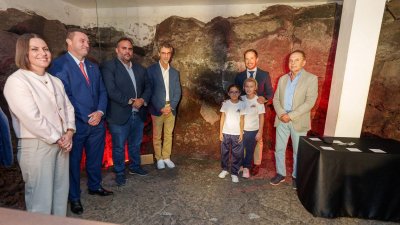
Since September 2024, more than eighty professionals from the scientific community and technicians have participated alongside the citizens of Lanzarote in informative conferences and discussion tables held at the Mancha Blanca Visitors and Interpretation Center (Lanzarote) to publicize the half-century of knowledge that has been generated in Timanfaya since it was designated a National Park in 1974.
Four are the main conclusions that have been drawn from these meetings held over the past year. The first is that "it is necessary to recover the historical memory of the Park, not only on a scientific level, but also in terms of the traditional knowledge and uses of the territory."
Pascual Gil explained it last Friday, October 3, during the closing ceremony of this celebration: "We must incorporate this knowledge and place more emphasis on the conservation of cultural heritage. We must regain contact with Lanzarote society."
Also fundamental is "managing the current trend towards more mass tourism to make it compatible with conservation." In this regard, the Ministry of Ecological Transition and Energy, led by Mariano H. Zapata, is working with the technical team of the Timanfaya National Park to ensure that visits to the park, together with environmental education and effective communication, "allow us to transform society towards awareness and responsibility with the planet we inhabit, so that we ensure that our children can enjoy at least the same quality of life that we had."
The YouTube channel of the Timanfaya National Park has become a repository of scientific knowledge open to the public and allows viewing of all the conferences that have been held in Mancha Blanca.
Timanfaya is a "unique laboratory in the world" for the international study of volcanology, brings together an "exceptional" biodiversity that demands constant monitoring systems, and constitutes a perfect natural space "to study the process of ecological succession." It has also become a global benchmark in thermoelectric geothermal energy, since the prototypes installed on the Islote de Hilario generate 500W continuously thanks to the high temperatures of the subsoil.
The study of historical sources has allowed us to learn how a volcanic crisis was managed in the 19th century, and the latest research reveals that the Canary Islands are within the Atlantic tsunami risk area. In addition, the neighborhood has become aware that invasive species are responsible for 60% of global extinctions, and we need "early detection," "inter-institutional coordination," and "citizen awareness."
The park wants the volcanic landscape to be "a transformative educational tool" where we see "the resilience of life in extreme conditions." Timanfaya should be able to generate "emotional connections" and "critical reflections." The conclusion that the current access model is "unsustainable" and must be replaced by a "shuttle system with prior reservation" is unanimous.
It is also essential to transition towards "a sustainable and regenerative tourism model" and for the park to diversify its interpretive offerings by developing "guided trails and environmental education programs" that allow reconnection with the local community.


Add La Voz de Lanzarote as a preferred Google source.
Stay informed with the latest current news.